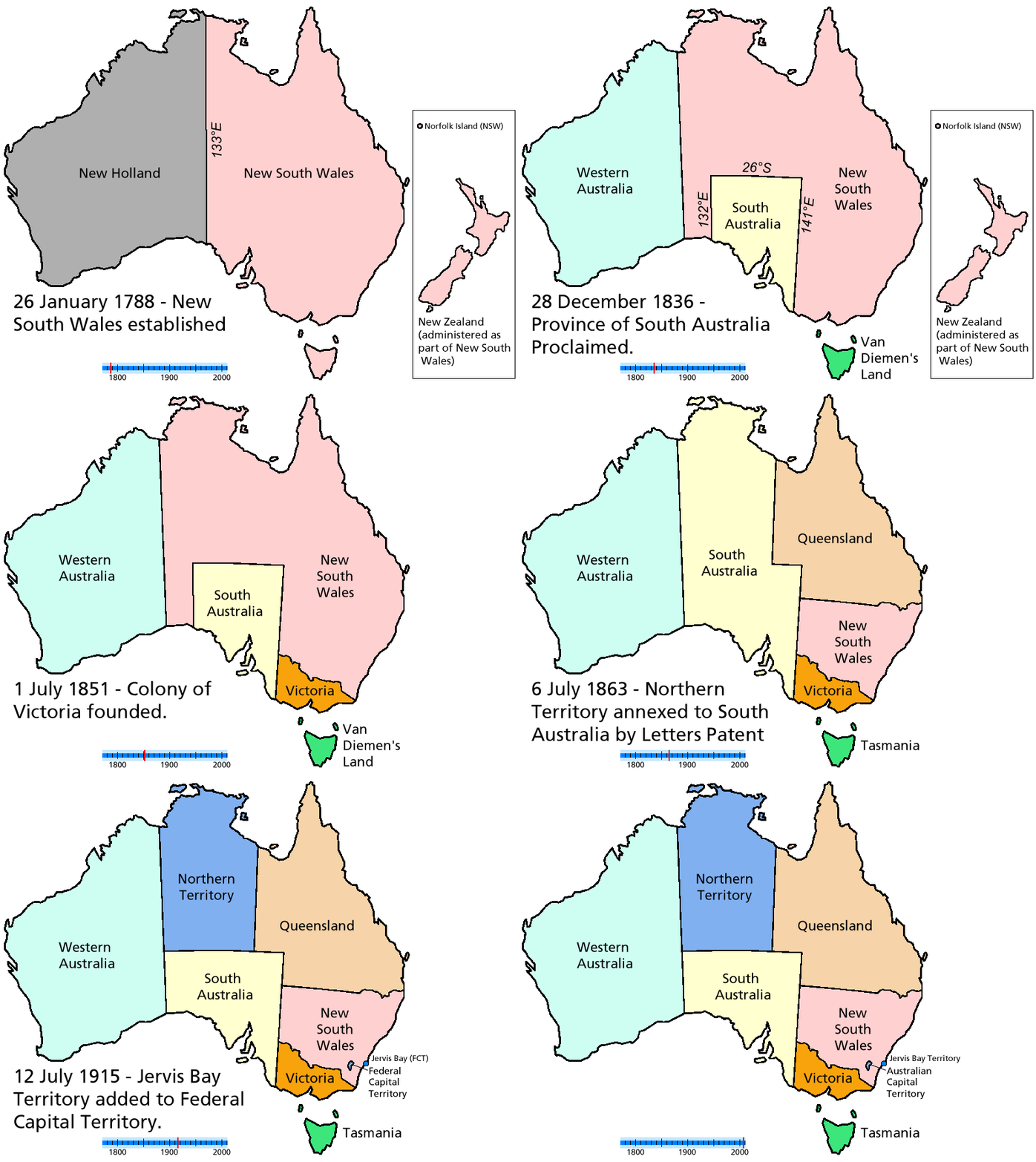
I received this link by e-mail from one of my Anglospheric contacts in the United States. It is a historically changing map or Australia. Great fun and, dare I suggest it, something children who are learning history might enjoy playing with.
 Tory Historian maintains that the American Thanksgiving celebration ought to be an Anglospheric fesitivity. It grew out of the Harvest festivals of this country (and many others) and there is no getting away from the fact that many of the ideas the Pilgrim Fathers carried with them to the new land were those of England and became the seeds of Anglospherism.
Let us not push it too far but celebrate the day with the somewhat anachronistic picture above and a quotation from the editorial that the Wall Street Journal publishes every year, which is a version of the records kept by Nathaniel Morton and based on the account by William Bradley, governor of the Plymouth Colony.
Besides, what could they see but a hideous and desolate wilderness, full of wilde beasts and wilde men? and what multitudes of them there were, they then knew not: for which way soever they turned their eyes (save upward to Heaven) they could have but little solace or content in respect of any outward object; for summer being ended, all things stand in appearance with a weatherbeaten face, and the whole country, full of woods and thickets, represented a wild and savage hew.It was merely the beginning.
If they looked behind them, there was a mighty ocean which they had passed, and was now as a main bar or gulph to separate them from all the civil parts of the world.
 It is not often that I do more on this blog than make announcements, mostly about the Journal (and yes, I am looking for articles, preferably very soon and, if possible, about the Anglosphere) but I was present at Jonathan Aitken's talk and was greatly intrigued by one or two things he said.
Mr Aitken told a number of highly entertaining stories, including one about a dinner at which there were present former Prime Minister Harold Wilson, former President Richard Nixon, Marcia Falkender (Baroness Falkender or Forkbender as Private Eye used to call her) and Mr Aitken himself.
The highlight of the dinner was, apparently, the two politicians singing, as a duet, Sir Joseph Porter's song from HMS Pinafore, "When I was a lad..". Clearly a dinner to remember.
Mr Aitken spoke at length about being a speechwriter (that being one half of the advertised title) and how seriously he took his duties when he wrote speeches for John Selwyn Lloyd, Chancellor of the Exchequer, political fixer and, later, Foreign Secretary.
Being a speechwriter is not easy, as one has to produce speeches that sound as if the person who is saying them wrote them himself (or herself, Margaret Thatcher famously went over her speeches many times, changing them and honing them till they became her own). The young Mr Aitken consulted the man who was then and probably until now the greatest speechwriter, Ted Sorensen, who worked for JFK.
The point Mr Aitken was making is that a speechwriter has to get into the speech-maker's head and that is what Ted Sorensen maintained he did. In question time I asked whether the movement was only one way or whether the speechwriter also shaped the speech-maker.
Mr Aitken thought about it and agreed that there was a great deal of it. For instance, JFK was not a particularly eloquent personality though he had a dry wit, whose flavour his speech writers managed to capture. But the great orator with vision and ideas was largely created by Ted Sorensen and Arthur Schlesinger.
The whole concept is fascinating. I see it as something like the famous Escher drawing of one hand drawing the other, which is drawing the first, the two in slightly different positions.
This evening's meeting of the Conservative History Group will take place in the Wilson Room, not the Thatcher Room. Don't know what the speaker, Jonathan Aitken, will think of that.
The Wilson Room is in Portcullis House and the meeting will start at 6.30 pm. The title of Jonathan Aitken's talk will be: "Confessions of an old speech-writer and speechmaker". Should be very interesting and entertaining.
 It has been suggested once to Tory Historian that, perhaps, another time and day should now be chosen for Remembrance as this time and day are too closely connected with the First World War. Naturally, Tory Historian disagreed. If there is no need to change there is every need not to change and the words "the eleventh hour of the eleventh day of the eleventh month" have come to mean much more than just the ending of that terrible conflict.
Having listened to the prayers led by the Bishop of London and the other parts of the ceremony by the Cenotaph Tory Historian remains certain that this is the time we must dedicate to remembering the sacrifices made and being made by so many on our behalf.
As ever, there are excerpts from two poems to be quoted. The first is by the Canadian medical officer John McCrae, who wrote the poem in 1915 and died of pneumonia towards the end of the war. It is odd to recall that more people of influenza in 1918 throughout the world than were killed in the Great War, terrible though the casualties were. In fact, the Second World War was the first war in history in which direct casualties were higher than those of attendant and subsequent illness. Whether that is a reflection on medical or military developments remains to be an open question.
In Flanders fields the poppies blowFor personal reasons Tory Historian finds Lawrence Binyon's lines particularly moving:
Between the crosses, row on row
That mark our place; and in the sky
The larks, still bravely singing, fly
Scarce heard beneath the guns below.
They shall not grow old, as we that are left grow old.We should never forget them but this is the time we really remember.
Age shall not weary them, nor the years condemn.
At the going down of the sun and in the morning
We will remember them.
 Tory Historian has already attended a bonfire and fireworks event and can report with some disgust that there was no Guy on the fire. This is a relatively new development as for many years this particular bonfire did have a Guy and one year the fireworks culminated in a picture of Guido Fawkes himself slowly disappearing.
Why so many of these events have abandoned any historical link to the festivities is a mystery. Some people consider it to be the result of political correctness.
Tory Historian thinks it has more to do with the curious development that is unique to Britain whereby all celebrations, all entertainments have been separated or are being separated from their meaning, historical, social or simply seasonal.
This does not work with the celebrations that the various ethnic minorities have, no matter how hard people like Mayor Livingstone try but otherwise it has taken hold. Nothing needs to have a reason any more.
There is nothing like this anywhere in the world, not in Europe, not in Asia, not in America; developed and industrial countries retain their knowledge of history and traditions. Why is Britain the exception? Why are people satisfied with amusing themselve to death? Then again, the tale of the Catholic Plot, the attempted terrorist outrage, the arrest of the plotters, their torture, confession and horrific execution is a strange and grisly event to celebrate.
Remember, remember,And there is no reason. Grisly and unpleasant but part of our history.
The fifth of November,
Gunpowder, treason and plot.
I see no reason
Why gunpowder treason
Should ever be forgot.
 The Russian myth of the Third Rome grew out of the fall of Constantinople to the all-conquering Ottoman army in 1453. In 1510 the monk Filofei wrote to the Grand Duke Vasili III: “Two Romes have fallen. The third Rome stands and there shall be no fourth.” Recently, during the usual falling out between various Orthodox priests and patriarchs, the theory was denounced but the Russians do not really care.
Moscow remains the third Rome. After all, the Russians never did get Constantinople though given the number of them who seem to be domiciled in Istanbul one wonders whether they are using a different method to the same end.
All this is a preliminary to a paean of praise by Tory Historian to the city of Istanbul, known for many centuries as Constantinople, the second Rome. It is not a city that buzzes nowadays though the melancholy mentioned by Orhan Pamuk is not exactly discernible. Quite simply, Istanbul is what Vienna was in the twenties and thirties – an imperial city that has lost its role.
When, in 1923, the Turkish Republic was formed, Kemal Atatürk was so anxious to break with the Ottoman past and to create a new, secular state that he settled on a new capital, Ankara. For the first time in many centuries Constantinople was not the heart of a great empire (though Byzantium was considerably less than great by the time of the final conquest in 1453). It is taking a long time for the city to come to terms with that but it is also taking a long time for Turkey to settle down with its own Turkish identity, no matter how strongly people feel it inside them. The uncertainty over the mildly Islamist party taking power and the whole row over the Armenian massacre of 1915 are evidences of that uncertainty.
One must wish Istanbul well because it is such a glorious and fascinating city. Surely, it will reacquire a role for itself but there is no doubt that its role is tied in closely with Turkey’s ability to define more securely her identity and her own role in the world. In that, too, one must wish the country well. It is, at present, the one fully secular Muslim country and if that experiment fails, there is little hope for peace between Islam and the West.
Of course, one could argue that there was rarely peace between Islam and the West and why should there be.
In the meantime Istanbul is extraordinary in the way one can quite literally walk though several centuries in one afternoon’s progression through the city. There are slums of the kind one would see in Third World countries cheek by jowl with highly respectable middle class areas that remind one irresistibly of Eastern and Central Europe.
The public transport is excellent and the food is uniformly superb whether it is a borek-seller in a street or a restaurant that boasts of its “Ottoman” food.
Antiquities, whether Byzantine or Ottoman have not been well preserved though efforts at restoration are being made and clearly there is a renewed interest in the city’s pre-Ottoman history, which is all to the good.
Functioning mosques are beautiful and well-kept as well as surprisingly welcoming, something not a few tourists seemed to abuse. Courtesy requires that one obeys the rules of the place of worship one visits. If women do not like wearing headscarves they do not have to go into the Blue Mosque.
Tory Historian’s abiding memory is sitting outside a Greek monastery (not functioning but relatively well preserved, drinking coffee and looking at the Turkish flag flying proudly as at four o’clock the muezzins began their call for prayer (largely ignored by the population at large). Oh well, of course, there is the other abiding memory of discussing Anatolian rugs over a little glass of chai in the Grand Bazaar.
The next two speaker meetings of the Conservative History Group are as follows
Monday 19 November, 6.30pm
JONATHAN AITKEN
"Confessions of a speech-maker and speechwriter"
Thatcher Room, Portcullis House
Tuesday 4 December, 6.30pm
ALISTAIR COOKE
"The history of the Carlton Club"
Boothroyd Room, Portcullis House
The latest copy of the Conservative History Journal has just been sent to members. Anyone who has not received their copy yet should email info AT conservativehistory DOT org DOT uk
October 12 seems to be a particularly sombre day. Looking at the BBC site "On this day" we find that this is the day on which the USS Cole was attacked in 2000 and the Bali nightclub explosions killed dozens of people.
Though the number of casualties was smaller, in many ways for Britain the biggest and most horrific anniversary is that of the Brighton bomb in 1984. Aimed to kill the Prime Minister and any member of the Cabinet that got in the way, it did kill 4 people and injure many more, some, like Lady Tebbit, permanently.
Miraculously, the Prime Minister survived and came out to address briskly the assembled media. It was a frightening day for many of us.
It only needs to be added that the perpetrators were caught, tried and sentenced only to be released as part of the dubious peace process.
On a more cheerful personal note: Tory Historian will be away for a week or so, visiting Constantinople or Istanbul, depending on which bit of history you happen to approve of.
 Tory Historian has been reading about social mobility in Victorian England. The book in question is Kathryn Hughes’s biography of Mrs Beeton, author of that famous cookery book and manual of domestic arrangements. It seems to have been one of those biographies that Eng.Lit. reviewers liked more than readers if the comments on Amazon are anything to go by – lukewarm at best.
Indeed, the book is probably a little too long. Ms Hughes is given to padding. Writing about the fact that the Mayson-Dorling family (Isabella’s mother and step-father who had 21 children between them and jointly) decided to send the girls to a boarding school in Heidelberg that provided a better education than anything they might have found in England at the time and that certain families that had been the Maysons’ neighbours in the City did the same, she writes:
This decision of friends and neighbours to send their daughters to the same school on the other side of Europe might seem quaint to modern eyes but it made sense.She then proceeds to enumerate the various ways in which it made sense and, indeed, she is right: it did make sense. But there is a great deal too much of this condescension at the expense of the early Victorians and inhabitants of early nineteenth-century England with too many comments about how odd it must all seem to modern eyes. One must assume that a person who has decided to read about Mrs Beeton is not going to be too astounded by the fact that the world was a somewhat different place 150 or 200 years ago.
Speculating on what the girls might have been doing when they were not being put through their severe curriculum, Ms Hughes surmises that they must have spent their Sundays trailing up to the castle. Um, maybe. Then again, they may have gone to church and for walks or done botanizing – a favourite occupation of the time – or allowed out to the town’s cafes under proper chaperonage. Who knows?
Is there really any need for the following piece of padding?
In the midst of all this chocolate box prettiness it is worth remembering the odd fact that by the time the last of these quaint young ladies had died – Isabella’s sister Esther Mayson, as it turned out, in 1931 – Hitler was only two years away from becoming Chancellor and the infamous Nazification of Heidelberg University was on its way.Actually, it is not worth remembering at all in the particular circumstances of trying to understand how several Victorian families chose to educate their daughters. The chocolate box prettiness is introduced quite gratuitously by Ms Hughes and the young ladies in question can be regarded as quaint only if we take the rather bizarre view that whatever we see around us at this moment is the absolute norm. Surely, no historian or biographer can think that way.
Tory Historian is beginning to think that the ordinary commenters on Amazon were nearer the mark than the EngLit critics in the various newspapers and magazines.
As to the theory, based on Nancy Spain’s guesswork that Sam Beeton probably had syphilis and infected his wife on their honeymoon – Tory Historian has not read far enough to find out how well founded the guess is.
Of greater interest are the early descriptions of the various parts of Isabella Beeton’s family – haven’t reached Sam’s yet – rising rapidly through early Victorian society in a way that would have been very difficult at best in a pre-industrial age.
Isabella’s grandfather, the Rev. John Mayson was an intelligent son of a farmer who was educated at school till the age of 14 and then somehow (he is lost from sight for many years) managed to become a curate. At that position he stayed for most of his career because of lack of social contact and, presumably, formal education. He became a vicar towards the end of his life because the man at whose disposal the living was temporarily had no member of the family to whom he could give it.
John Mayson’s surviving son Benjamin, on the other hand, made a spectacular career through the cotton industry, becoming a well-off warehouseman and agent in the City of London. Had he lived longer he, too, would have been able to give his children a very good education.
Elizabeth Jerrom, the woman whom Benjamin Mayson would marry, was born on 24 May 1815, three weeks before the great victory of Waterloo. Her parents Isaac and Mary were domestic servants working for one of the big houses around Marylebone, part of the feverish development of gracious squares that had been built towards the end of the last century to house the newer aristocracy during the ‘London’ part of their wandering year. When the couple had married eleven months earlier at St Martin-in-the-Fields, they had signed the register clearly, confident in themselves and their new merged identity. The same, though, cannot be said of their witnesses. William Standage, Mary’s father, has done his best but the sprawling scratch he makes in the register is indecipherable: underneath the parish clerk has been obliged – tactfully, crossly? – to write out his name properly, for the record. Mrs Beeton is only twenty years away from people who would have been happier signing themselves with a cross.William Standage was, in fact, a highly prized and very well paid groom to the Duke of Richmond and horses figure a great deal in Isabella Beeton’s family. Isaac and Mary Jerrom did very well in the changing new world that Ms Hughes is slightly disdainful of (clerks and shop girls careering round the City in cabs – faugh!). Isaac kept a livery stable, hiring out horses and coaches to those who could not afford their own and ran a hackney cab business. Mary ran a respectable lodging house – a not infrequent combination at the time, which made a good deal of sense.
Elizabeth Mayson was widowed young and, left with four small children, she married a close friend of the family, whose own wife had died some months previously in childbirth (an all too frequent tale). Henry Dorling was second generation of an upwardly mobile family. His father William had moved his small printing business from Bexhill to Epsom, where he gradually expanded it and took over more and more of the town and its biggest business, the annual Derby Day race, in the process cleaning up what was a financially and legally dubious business before that.
Henry Dorling continued in his footsteps, gradually becoming the most important man in the town and almost the sole controller of the Epsom race course. The fact that he could spend a good deal money on the education of his daughters and step-daughters as well as the boys in the family attests to his wealth and his imagination.
There are many other interesting details about the various families in the book, which Tory Historian does recommend, despite the author’s irritating habits. What is worth remembering as one reads through this early whirlwind activity and social mobility is that Isabella Beeton’s journalism in the “Englishwoman’s Domestic Magazine” and other periodicals as well as her monumental “Book of Household Management” was meant for people like her and her family: upwardly mobile, perhaps a little uncertain of their social position, in need of guidance as to how to behave and run a household.

September 28, 1745 was when God Save the King (you see, there was a reason for that title) was sung for the first time after a performance of Ben Jonson’s “The Alchemist” at the Drury Lane Theatre. The tune was Thomas Arne’s.
In the middle of the Jacobite rebellion (or the forty-five as “1066 and All That” refers to it) patriotic fervour was rife in London. After this night it was sung by “the Gentlemen of the House” every night.
This website, Know Britain, tells an interesting detail. The original song, not yet the National Anthem, more by way of prayer for the safety of the Monarchy and the realm, included the following verse:
Lord, grant that Marshal Wade,
May by thy mighty aid,
Victory bring.
May he sedition hush and like a torrent rush,
Rebellious Scots to crush,
God save the King.
Inevitably, the story of where the tune comes from has been the source of much discussion and debate, as this Wikipedia entry outlines. The same entry gives a detailed history of its acceptance as the National Anthem and the influence it has had on the national music of other countries, English-speaking or not.
 Sadly, we all seem to be writing far too many obituaries these days. The old generation is going. Tory Historian, on the whole, is not in particular sympathy with Lord Gilmour’s “wet” politics, while recognizing that his rather paternalistic “one nation conservatism” does have a serious historical background and a following in the party.
In fact, one might say that a good many of those wet policies are now the policies of the Conservative leadership, though we have yet to see how attractive the electorate will find them.
Having read the excellent and exhaustive obituary in the Daily Telegraph, with an excellent photograph that conveys the man’s personality in one shot, Tory Historian is left with something of a puzzle.
What exactly motivated Sir Ian Gilmour, later Lord Gilmour of Craigmillar? Was it noblesse oblige? Was it a feeling of distaste for the commonness of the new Conservative Party with people like Margaret Thatcher and Norman Tebbit in charge? Surely not.
How is it that he managed to find himself on the wrong side in every debate, except one? For some incomprehensible reason he was quite tough in Cold War politics, while you would expect him to try to find compromises and see good things in the Soviet leadership. But he did not and that is greatly to his honour. Not much else is.
No need to despair: the next issue of the Conservative History Journal has gone to the printer and will be ready for the Party Conference with subscribers receiving their copies after that. More copies will be available from the Conservative History Group.
It is full of goodies, including two cartoons of the Suez Group, one by Vicky, that have not been published for fifty years or more and are the property of Lady Biggs-Davison, the widow of one member of the rebellious group, Sir John Biggs-Davison.
Then there is an article by Alistair Cooke on one of the dames formidables of the Conservative Party, an early organizer (as women could not, at that time, be agents), who ensured that Ramsay Macdonald was re-elected in 1931.
There is an interview with Jonathan Aitken by Mark Coalter, a regular contributor to the Journal with Aitken telling entertaining stories about the 1963 Conservative Party Conference; a piece about the Ukrainian-born MP, Josef Terlezki; two articles with relevance to the present situation, one about the eighteenth century Scottish Prime Minister, Earl of Bute and the other about Anthony Eden’s long wait to inherit Churchill’s mantle. Eden was not, perhaps, the most successful of our twentieth century Prime Ministers.
And, as they say, much, much more.
 This is not the forum for discussion of present Conservative Party policy and, in any case, it would be invidious to single out one of the policy commission reports. So Tory Historian prefers to quote from an account of the first few settlements in New England.
This comes from a book Tory Historian has been reading, David Gelernter’s “Americanism – the Fourth Great Western Religion”. This is a fascinating book whose thesis is clear from the title. Gelernter argues that American or American Zionism (not to be confused with the political Zionism of Jewish nationalism) grew out of English Puritanism.
At some later stage there will be a more detailed posting on the book. In the meantime, here is an account of the early Plymouth Plantation, based on that written by William Bradford, the second Governor.
During its first two planting seasons, however, Plymouth Plantation was a farming commune: everyone worked at food production and community chores; the results were doled out to each Pilgrim family according to need. It was pure socialism.Well, well. How many times has that idea been proved to be false since those days in Plymouth Plantation? And yet, some people still believe in it, as long as they are not affected themselves.
But the results were catastrophic. And so “at length,” Bradford writes, the governor (namely himself) “gave way that they should set corn every man for his own particular,” in other words for his own household, “and in that regard trust to themselves”. Bradford “assigned to every family a parcel of land, according to the proportion of their number … This had very much good success, for it made all hands very industrious.” The result proved the falseness of the idea “that the taking away of property and bringing in community into a commonwealth would make them happy and flourishing”.


On the grounds that conservatives must always rejoice in tyrants’ ends, this is a day to be celebrated as the anniversary of Mao Zedong’s death in 1976. We still do not know exactly how many millions of deaths he was responsible for but information is slowly emerging.
Nor can we compute the tens, if not hundreds, of millions of broken lives, bodies and souls; the attempted (thankfully failed) destruction of a great culture; the economic and political catastrophe that the Chinese and through them others still have to deal with.
Then there are the nauseating Western supporters of Mao, all in the comfort of their “despicable” capitalist societies. The sun is shining, the world seems quite a decent place (just quite, you understand) so, perhaps, the less said about them, the better.
 Tory Historian has been reading Robert Conquest's latest book (some more are in the pipeline) "The Dragons of Expectation", which is subtitled "Reality and Delusion in the Course of History". Professor Conquest is a man of many parts, a noted Sovietologist and historian, poet, novelist, literary critic and political analyst.
The essays in this book range widely from discussion of the Soviet Union, communism and its misguided supporters in the West to discussions of the state of modern art. There is even a long poem, entitled "Reconnaissance", that summarizes the author's views of the world and the universe.
One particular idea struck Tory Historian as being of great interest (actually, there were others but these will be discussed in other postings):
In the eighteenth century, the English enlighteners, if you wish to call them that, debated in pubs and clubs and homes, the French in châteaux and salons and academies. In politics, there could scarcely be two "activists" more different than John Wilkes and, say, Condorcet.In a way this idea is a continuation of Shakespeare's comparisons as seen in Henry V but, naturally, enough the play was more or a propaganda.
Earlier, Voltair and others validated the British experience, but in the long run it was the theorists and emotionalists who triumphed mentally in Paris.
The French, and European, Enlightenment thus emerged not on the absis of a political class or political institutions, but from minds more or less bombinating in a vacuum.
The two cultures can accept a measure of spillover from each other, as with parts of the U.S. Constitution. So if we speak of the two traditions as muturally exclusive we are only generalizing. Still, the historical or historico-cultural difference stands.
 Tory Historian took advantage of the NFT’s Laurence Olivier season in which “Henry V” has been given pride of place with a certain number of disclaimers by critics who, over the years, have had to acknowledge with pursed lips that, despite its heroism and emphasis on patriotism, the film is superb. Some of us might think that contrariwise, the heroism and patriotism add to the quality of the film but that is probably why we are not film critics.
Made during the war, with Olivier taking time out from his service with Fleet Air Arm, it does emphasise patriotic ideals, in particular ideals of England. As it happens, none of that was invented by the film-makers – the lines, the images, the concepts are there in Shakespeare’s play, which is what makes them so interesting.
Cinematically the film is mesmerizing, beginning and ending with a panorama shot of Elizabethan London, carefully recreated from contemporary prints. Famously, Olivier accepted and incorporated into the film the sheer theatricality of the play. We start with a raucous performance of “The Chronicle History of King Henry the Fift with His Battell Fought at Agincourt in France”, during which the Chorus, played by Leslie Banks, urges us to expand the play in our imagination to take in England and France, and opens out first into the Boar’s Head Inn, where Falstaff is dying, then the two courts, the armies and the battles themselves. William Walton’s music spreads through the film.
The opened up scenes are not realistic in any sense, showing the castles, the fields, Princess Katharine’s enclosed garden and everybody’s costumes as illustrations from the Book of Hours. The faint artificiality of Technicolour adds to the imagery’s beauty.
There is, throughout the play, an image of England and of the English King that is essentially different from France. The French King is not an unattractive personality but he is weak and has been buffeted by history. The Dauphin is a fool and a braggart, a man who causes trouble through his thoughtlessness. The French nobles have no link with the people. The only truly attractive character is the Herald as he becomes more and more impressed by Henry.
England, on the other hand, is its people; the King is the King of all and the yeomen are as important if not, indeed, more important than the nobles. Although, the core of the play is England as reality and as idea, there is a kind of a proto-Union in the delightful vignette of the four captains: Gower, Fluellen, Jamy and McMorris, representing the four parts of it. They dispute, quarrel and drink together and there is an undying link between them.
In the night before the battle, the French nobles and the Dauphin sit in their own tent and alternate between dismal premonition and braggadocio. The Dauphin, spends not a minute of his time on his troops – they are there to serve him and the nobles. If anything is mourned it is the destruction of its flower at Crecy, though the lesson of that has not been learnt by anyone except the King of France. The heavy and heavily decorated armour in which the knights have themselves mounted onto their unfortunate horses symbolizes France in the same way as swiftness, lightness and, above all, ingenuity symbolize England.
In the night before the battle, Henry leaves his nobles without a single complaint from them, puts on a cloak and walks through the camp, making sure he visits every tent (“a touch of Harry in the night”). He talks to soldiers as well as captains; he listens to their complaints and to their fears; he meditates on the duties and responsibilities of kingship, in some ways echoing his own father’s thoughts on the head that wears the crown lying uneasily. Of course, he does not have his father’s bad conscience, having inherited rather than usurped his position. Nevertheless, he acknowledges his responsibility for whatever horrors might come in the morning.
There is an interesting discussion between two soldiers in which one expresses the view that if the King’s cause be wrong (the very fact that an ordinary soldier can think such a thing is astonishing) he will pay a heavy price for the battle and its outcome:
I am afeard there are few die well that die in a battle; for how can they charitably dispose of any thing when blood is their argument?To which another soldier, one who is considerably more rebellious in his attitude to the King, replies:
Every subject's duty is the king's; but every subject's soul is his own.Henry hears it all and thinks his own heavy thoughts.
His prayer at dawn is interesting. He does not pray for victory but for his soldiers to lose their fears:
O God of battles! steel my soldiers' hearts;When he addresses his troops he addresses them all on both occasions. They are all his friends, his brothers:
Possess them not with fear; take from them now
The sense of reckoning, if the opposèd numbers
Pluck their hearts from them.
For he to-day that sheds his blood with me(The film uses the alternative reading of “base” instead of “vile”.)
Shall be my brother; be he ne'er so vile
This day shall gentle his condition:
The battle is won by the yeomen archers and their craft as much as by the outnumbered nobles and the image of England as the land where all are one and the King is at one with all, is complete.
As a coda one sees Henry wooing the French Princess Katharine, who is obviously greatly taken by him, telling her that he is a plain speaking English soldier, who loves her but who will not produce flowery language for her sake. She must take him as he is but as he is he will be hers. This is a wonderful English theme, developed by numerous writers in subsequent centuries.
Of particular interest is Olivier’s Churchillian pronunciation of a few French sentences, which must have been treasured by those who understood the joke.
Olivier’s King Harry shows the actor to be a remarkable film director and producer as well as the greatest Shakespearian actor of the twentieth century. He may not have had Gielgud’s mellifluous and mesmerizing voice but he could say those lines as if they were a natural way of talking. Who can rival that even now?
“Henry V” was most probably written and first performed in 1599, only a decade after England had withstood and triumphed over a great danger from Spain, in the middle of yet another Irish rebellion and a time when folk memory could still recall accounts of the century long civil war that preceded the Tudors. A look across the Channel would have shown countries where civil warfare seemed almost endemic.
Olivier’s film was made at a time when Britain (or England) was once again in danger and the people were united behind the leader (with some very loud grumbling in the ranks).
There have been numerous interpretations of Shakespeare’s attitude to war – was he glorifying it and praising Essex’s incompetent attempt to subdue Tyrone’s rebellion (probably, if he knew which side his bread was buttered on) or undermining it by the presence of such contemptible braggarts as Pistol and cowardly thieves like Bardolph and Nym? The answer, one suspects, is both, which is a happy thought for all those critics and producers. How else could they pretend that they understand what Will said than Will did himself?
The film is on for a few more days.
 By now most of our readers (certainly, on this side of the Pond) would have heard of the death of Lord Biffen of Tanat. He was 76 and has been seriously ill for some time.
His name would be familiar to anyone who is interested in the Thatcher premiership. The BBC sums up his career as follows:
Lord Biffen had been the MP for Oswestry from 1961 to 1983 when he won a by-election, then for Shropshire North from 1983 to 1997 when he was given a peerage.He was a man of strong principles, a true free-marketeer, a eurosceptic, one who stood by his ideas and, in some ways, managed to rise above party politics. This, of course, can be seen as sinking below party loyalties. Biffen was, famously, sacked from the Cabinet in 1987, having been described by Bernard Ingham as being semi-detached.
He became chief secretary to the Treasury in 1979, moving on to be trade secretary in 1981 and then leader of the House of Commons until 1987.
John Biffen’s own description of Margaret Thatcher was that “she was a tigress surrounded by hamsters”.
In the House of Lords, to which he was elevated in 1997 he was a notable, almost brooding presence, taking a habitual strong line on the Treaties of Amsterdam and Nice, until his illness prevented him from coming to London.
Below is a tribute paid to him by his successor as MP for Shropshire North, Owen Paterson:
John Biffen was an exceptional man. He was MP for North Shropshire for thirty five years and people of all parties and all interests owe him a great debt. He was greatly admired as a constituency MP for his conscientious hard work, his judgement and his kindness to all, regardless of their political affiliation.Tory Historian can add nothing more to that.
On the national stage, he was first and foremost a great Parliamentarian, still remembered as one of the finest Leaders of the House of the last fifty years. Liked and respected by both friends and opponents, he handled the House with fairness and a deft sense of humour. He was a staunch believer in the sovereignty of the House of Commons.
He played a key role in the revival of the Conservative Party’s fortunes in the 1970s as a member of Margaret Thatcher's inner circle, rethinking and developing the policies that led to eighteen years of Conservative Government and the transformation of Great Britain.However, to the end he was brave and independent-minded, never afraid to part company with the party line if he believed it to be wrong.
My thoughts go out to his wife Sarah and his stepchildren Lucy and Nicholas. She has always been a tower of strength and in particular, has looked after him with unfailing care in recent years as his health declined.