
The Codebreaker Girls – Only 99c!
1 month ago
Tomorrow is St Crispin's Day and 600 years ago it was the day upon which the Battle of Agincourt was fought. Here, as you would expect, is the speech made on the eve of the battle in Shakespeare's play by Sir Laurence Olivier:
And here is part of the battle from the same film:
One of the most famous battles in English history, a stupendous achievement by English arms but did it achieve anything? Well, it made the English temporarily victorious in the Hundred Years' War, created a great legend, which, oddly enough was largely true - the English and the Welsh army was considerably smaller than the French, which they defeated - and staved off the war between the House of York and the House of Lancaster.
Here is a useful account and a list of ten reasons why the French were defeated by numerically inferior forces.
Not only is today St George's Day (as every schoolchild should know) but it is the day we traditionally celebrate as Shakespeare's birthday though the real day is unknown. We do know he was baptized on April 26, 1564, that is 450 years ago and died also on St George's Day in 1616. So let us celebrate both of them and what better way of doing so than by watching Sir Laurence Olivier speaking that speech:
 Today, as every school child ought to know, is St George's Day, something that, according to Ed West, became a matter for celebration in the 1990s and then for purely commercial reasons. True, to some extent, but a little unfair. The Scouts, for instance, always celebrated the day. St George remains the Patron Saint of several countries and organizations - in fact, he is a very busy sort of saint.
Many Patronages of Saint George exist around the world, including: Georgia, England, Egypt, Bulgaria, Aragon, Catalonia, Romania, Ethiopia, Greece, India, Iraq, Israel, Lithuania, Portugal, Serbia, Ukraine and Russia, as well as the cities of Genoa, Amersfoort, Beirut, Botoşani, Drobeta Turnu-Severin, Timişoara, Fakiha, Bteghrine, Cáceres, Ferrara, Freiburg im Breisgau, Kragujevac, Kumanovo, Lebanon, Ljubljana, Pérouges, Pomorie, Preston, Qormi, Rio de Janeiro, Lod, Lviv, Barcelona, Moscow and Victoria, as well as of the Scout Movement[3] and a wide range of professions, organizations and disease sufferers.
 April 23 is also the birth- and death- day of William Shakespeare. Actually, nobody is too sure on which day he was born but he was baptized on the 26th so it is fair to assume that he was born shortly before that. The parallel of his birth and death has always pleased people.
 April 23 also happens to be the day W. J. M. Turner claimed as his birthday but there is no real evidence for that. He was baptized on May 14 and that is all we know definitely. Still, it would be pleasant to think that the greatest English playwright and one of the greatest English artists were both born on St George's Day.
The 1922 Committee derives its name from the fact that it was formed by some MPs who were first elected in 1922. Led by the MP for Lowestoft, Sir Gervais Rentoul, they decided to create a body ‘for the purpose of mutual co-operation and assistance in dealing with political and parliamentary questions, and in order to enable new Members to take a more active interest and part in Parliamentary life’. As new MPs, they had little knowledge of Parliament. There was no party structure, other than the whips, within the House to assist. The new Tory Members showed feelings, in Rentoul’s words, of ‘ineffectiveness and bewilderment’.Many things to celebrate, then. You will forgive me, however, for putting up the most obvious sequence for this day.
A preliminary meeting was held on 18 April 1923, at which Rentoul explained the purpose of having a Committee, and the Members then adjourned until 23 April. At this second meeting, the principles on which the body was founded were agreed and the meeting elected officers and an Executive Committee. Rentoul was elected chairman. It was also agreed to meet each week – on Mondays at 6.00 p.m. – when the House was sitting. The first of the scheduled meetings was addressed by the Chief Whip, Leslie Wilson, who offered his assistance and that of his colleagues. The Committee also set up a series of Sub-Committees, though these were superseded in the next Parliament by formal backbench Committees set up by the Party Leader.
Today is the anniversary of the Battle of Bosworth Field that brought to end the reign of the Plantagenets and introduced a completely new dynasty which led to other dynasties though none of it can be seen as entirely legitimate. History Today has reprinted an article from 1985 about the actual battle and the various problems that surround it. In fact, as far as TH can make out, next to nothing is known about it.
What seems rather extraordinary is that the author of the article should so easily accept the Tudor myth of Richard III, the relentless tyrant and usurper.Surely, Polydore Virgil's account, written many years later and under the reign of Henry VII who was not known for his tolerance of people that doubted his right to the throne, cannot be taken as gospel truth and neither can the account of the supposed hunchback (not shown in the portrait that is a copy of one made in his life time) and monster given us by Sir Thomas More.
Here are a couple of links to previous postings on the subject: a report on a trip to the fifteenth century, courtesy of the RSC and on Shakespeare's handling of some thorny issues and the story of a trip to Leicester which mingles German expressionism with that city's celebration of the man their predecessors saw as the rightful king.
What better way of celebrating St George's Day as well as Shakespeare Day than by posting Laurence Olivier's rendering of Henry V's speech outside Harfleur.
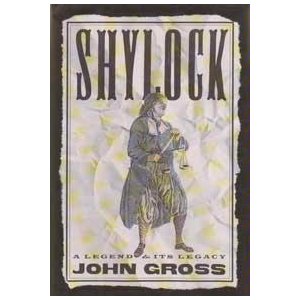 Tory Historian has been wading into literary studies of a kind by reading a fascinating book by that well-known man of letters, John Gross, on Shylock (a review in the Independent). Among other many fascinating things even in the first third, Tory Historian found this aperçu:
Between them, Antonio and Shylock represent two extreme versions of Economic Man, one benevolent, the other malign. Jekyll-Antonio embodies the fantasy that you can enjoy the benefits of economic enterprise and confer them on your society, without being competitive and self-assertive. Hyde-Shylock is the capitalist as total predator conferring good on no one except himself. They are twin aspects of the same phenomenon; and a tremendous amount of the play's energy is pent on keeping them apart.Antonio is the merchant of the title who has trading interests all over the world and is known for lending money without interest, which annoys Shylock for the very good reason that it undercuts his own business and that of people like him.
Today is, as every school child ought to know, St George's Day, the Patron Saint of numerous countries, cities, regions and organizations. Tory Historian has noted this in the past here and here. But of all the many countries that claim St George only one had William Shakespeare, the man who may well have been born on April 23 (baptized on April 26) 1564 and died on April 23 1616.
So, let us combine the two. Here is that famous speech from Henry V (Act 3, Scene 1, outside Harfleur):
Once more unto the breach, dear friends, once more;
Or close the wall up with our English dead.
In peace there's nothing so becomes a man
As modest stillness and humility:
But when the blast of war blows in our ears,
Then imitate the action of the tiger;
Stiffen the sinews, summon up the blood,
Disguise fair nature with hard-favour'd rage;
Then lend the eye a terrible aspect;
Let pry through the portage of the head
Like the brass cannon; let the brow o'erwhelm it
As fearfully as doth a galled rock
O'erhang and jutty his confounded base,
Swill'd with the wild and wasteful ocean.
Now set the teeth and stretch the nostril wide,
Hold hard the breath and bend up every spirit
To his full height. On, on, you noblest English.
Whose blood is fet from fathers of war-proof!
Fathers that, like so many Alexanders,
Have in these parts from morn till even fought
And sheathed their swords for lack of argument:
Dishonour not your mothers; now attest
That those whom you call'd fathers did beget you.
Be copy now to men of grosser blood,
And teach them how to war. And you, good yeoman,
Whose limbs were made in England, show us here
The mettle of your pasture; let us swear
That you are worth your breeding; which I doubt not;
For there is none of you so mean and base,
That hath not noble lustre in your eyes.
I see you stand like greyhounds in the slips,
Straining upon the start. The game's afoot:
Follow your spirit, and upon this charge
Cry 'God for Harry, England, and Saint George!'
Tory Historian was browsing through YouTube (yes, technology has reached even TH), looking for films of historical content and importance. No sign of any excerpts from The Young Mr Pitt on which there was a posting before.
So, Laurence Olivier it has to be. There are many possibilities but here is one of Tory Historian's favourites: the St Crispin's Day speech. No, this is not the right day for it, but could anyone ever better Sir Larry in Shakespeare? He managed to make it sound like ordinary every-day speech.
 Tory Historian is used to being puzzled by critics’ comments about some film or play and wondering whether they had seen the same one. Usually, one can dismiss such discrepancies by assuming that the critic in question is probably quoting some semi-literate hand-out written by a PR person who had most certainly not seen the work in question.
However, when it comes to serious historians writing about very well known plays and characters in a way that suggests there is a certain lack of understanding, the puzzlement increases.
Tory Historian is reading a book about that Whig stronghold, the Kit-Cat Club by Ophelia Field. (Know thine enemy.)
She describes the “cultural wars” (an anachronism, of course, but one can see why Ms Field is using it) around the theatre and gives a detailed though to some extent imagined account of a group visit to a performance at the theatre in Lincoln’s Inn Fields of a play that has Sir John Falstaff in it. As this could be one of three, a little more explanation would be useful but the documents she quotes, including a poem by Matthew Prior, refer merely to the actor Betterton playing the fat knight.
Then Ms Field explicates:
It is significant that the Kit-Cats so honoured Falstaff, a character moderating tragedy with comic excess and abundance, resilient in his frivolity, regenerative in his adaptability and a patriotic nobleman who fondly mentors young Hal, the future King of England. Falstaff could be viewed as a hero of English paternalism and materialism, while his love of food and drink was a straightforward connection to Kit-Cat dining.Her only other quotation from Kit-Cat writing refers to Falstaff’s girth and is clearly jocular. The rest of her analysis is, if one may put it that way, tosh. Even allowing for the inexplicable opinion present in some Eng. Lit. specialists that Falstaff is the real hero of the two Henry IV plays and his rejection by Henry V is a tragedy, this makes very little sense.
Well, new to Tory Historian who was directed to it by a reader. Other readers may recall Tory Historian's gushing praise of the Histories performed by the RSC at the Roundhouse (they had been performed over two years at Stratford's Courtyard before that) here and here.
Since then Tory Historian, in company with many of the 250,000 or thereabouts who had seen the Histories, has searched on and off the names of the actors to find out what they are doing now.
Well, no need to search. There is now a blog that deals with just that topic, Beyond the Histories, written by a "self-confessed theatre dork based in the UK". Long may it continue.
 Tory Historian is very pleased that one can celebrate on the same day the Patron Saint of England and her greatest playwright, though just as St George is the Patron Saint of many other places and entities so Shakespeare is a playwright for the whole world.
St George, a military saint, though paintings that depict him tend to show him as a very youthful, sometimes even effeminate soldier, is highly venerated in all the Orthodox Churches as well as the Anglican. Moreau's picture above happens to be one of Tory Historian's favourites. As for Shakespeare, what can one say on this day? He is supposed to have been born on April 23, 1564 but all we know for certain is that he was baptized on April 26. Well why could he not have been born three days previously? His death is recorded definitely for April 23, 1616.
Surely one cannot end this posting without quoting some of the most famous lines from Henry V:
 It has taken a little time to recover from the trip back in time but Tory Historian has now returned to the twenty-first century, ready to discuss both the production and the history as presented in the plays, which is very different from the history as it happened though, curiously, the overall pattern is not inaccurate.
 (Tory Historian has finally worked out that Prince John, Henry V’s younger brother and later the Duke of Bedford, was not murdered spectacularly and bloodily by Joan La Pucelle but was actually the man who had her tried and executed. Furthermore, he died in his bed, which is quite an extraordinary idea, and was the founder of the University of Caen and a man who commissioned some of the finest illuminated manuscripts of the period. This is not a side of the man that is made at all clear in the Histories. One wonders whether the stylized appearance of Olivier’s Henry V, based largely on the “Très Riches Heures du Duc de Berry”, did not also take some ideas from the “Bedford Book of Hours”.)
Anyway, back to the Histories as written by Old Will and performed by the renewed Royal Shakespeare Company. First things first: the series was superlative. The whole ensemble performed extraordinarily well, doubling, tripling and quadrupling parts, as it is usually the case with the long sequence that has several hundred characters. Some of the actors are heading into the great Shakespearian league in Tory Historian’s opinion. Jonathan Slinger (Richard II and Richard III, as well as other parts), Geoffrey Streatfeild (Hal, Henry V, Suffolk and smaller parts), Chuk Iwuji (Henry VI, Montjoy and others), Patrice Naiambana (a superlative Warwick and other characters) are stars to be watched. They are not the only ones.
The use of vertical and horizontal space, the speed of action and movement on and off the stage, the fantastic acrobatics on ladders and ropes and the imaginative use of very limited scenery – mostly a couple of large gates, one above the other, and the occasional bed for carousing or dying – made those long, complicated plays engrossing.
Let us hope the RSC has thought of filming the sequence and the DVDs will be available though they will be no substitute for the excitement of being there.
The plays, while they follow events as they happened after a fashion, do play fast and loose with dates, ages of characters and, above all, time lags. It is hard to work out from Henry VI that the Wars of the Roses took up something like thirty years, depending on what you consider to be the end.
But, of course, they are not really history, despite the fact that so many people think them to be just that. The general pattern of what happened is there but, more importantly several themes are worked out, more obviously in the first tetralogy or Richard II to Henry V, which was written some years after the Henry VI and Richard III sequence.
The questions are about the inevitable tension between legitimacy, loyalty and fitness to govern. In what circumstances can one rebel against an anointed monarch? When he is unfit to wear the crown? When he is a usurper?
There is also the overriding concept of England and Englishness, whether in John of Gaunt’s famous speech, Mowbray’s despair at having to leave his country and forget his language, Bolingbroke’s return from exile, Henry V’s battle cry or poor Henry VI’s unaffected pleasure at being back in his own land, despite the danger that surrounds him.
England is special, being an English king is a terrible responsibility and the tensions are never fully sorted out, not even in the character of the hero, Henry V. The notion is that they will be reconciled in Henry VII but that is Tudor propaganda. There was no legitimacy in Henry’s claim and his army of French invaders supported by rebels against the anointed king triumphed through force and treachery against a ruler who then had to be shown to be unfit to rule retrospectively.
Shakespeare takes no real sides though he seems to have been antagonistic to high churchmen, most of whom are villainous intriguers. How much of the trouble in Henry VI might have been avoided if the Bishop of Winchester (a scheming Beaufort), later a cardinal, had not been so intent on establishing his power over the young king and thwarting his uncles?
One of the best scenes in this production is the death of Cardinal Beaufort in Henry VI Part II, where his prayers for God’s mercy are silenced by the ghost of the murdered Humphrey, Duke of Gloucester, the King’s uncle. With those two powerful personalities out of the way the fun between the Yorkists and Lancastrians begins. Which side is Old Will on? An interesting question, given the circumstances in which the plays were written and given the final one with the fantastically evil, hunchbacked Richard at the heart of it. The problem is that Richard the Monster is an inexplicable and unusual character, who suddenly morphs from Richard the loyal son of the Duke of York, member of a warm and affectionate family, brave and talented soldier. Towards the end of Henry VI Part III and in Richard III the clever, complex plays become crude propaganda.
Even then Shakespeare’s genius shines through. Richard is a favourite part for actors, most of whom seem to be able to find much that is human and, if not admirable, then attractive. After all, even according to the text, the hunchbacked, crippled monster excites loyalty in men and love in women. Famously, Richard wonders about that himself while spurring himself on to greater nastiness.
It’s not as if the series was particularly pro-Lancastrian. Quite clearly, they are usurpers who have cheerfully executed everyone who stood in their way and who supported the rightful king or his heir, imprisoning said heir, Mortimer, for life; when the Duke of York explains his claim to the throne, Warwick and Salisbury easily accept them and Henry VI finds them hard to refute. Nor are the Yorkists particularly unpleasant in their behaviour except the boys to Lord Clifford who had tormented their father and, worst of all, murdered their much loved younger brother, a child who would have been spared by anyone except a man demented by his father’s death in battle years before that.
The Rutland episode in Henry VI Part III is very peculiar. Easily the most brutal and revolting in the whole sequence, it trumps the infamous murder of the young princes in the Tower. Presumably, it is not so well known because the three parts of Henry VI are performed rarely whereas Richard III is fairly frequently.
Lord Clifford maddened by the death of his father in battle finds the Duke of York’s youngest son, a child who is hiding with his tutor after what is presumably the Battle of Wakefield, and cuts his throat. Subsequently, the Duke is captured (in fact, he was killed in battle) and tormented by Clifford and other Lancastrians before being murdered. Part of the torment is Queen Margaret producing a napkin, which she had dipped in Rutland’s blood, and rubbing it into York’s face.
Before his death the Duke, naturally enough, curses the She-Wolf of France and expresses the hope that she would experience a torment that equals his on learning of Rutland’s death. Unusually, she does not remember this curse when her own son is killed after the Battle of Tewkesbury.
When the three brothers learn of this monstrous behaviour they, particularly Richard, go into a frenzy of rage. The deliberate murder of a child is horrific.
The general effect is to turn the audience into Yorkists, even if they were not that before. In fact, one wonders whether there is not an academic dissertation to be written that would prove Shakespeare, the Warwickshire man, to have been a secret supporter of the Yorkist cause. (Just joking.)
The point is that the episode never happened. It did not simply happen otherwise; nor is there a question mark over it as there is one over the unexplained disappearance of the two princes. There simply was no such event and could not have been.
Edmund, Earl of Rutland was not the youngest son of the Duke of York – that was Richard. He did take part in the Battle of Wakefield and seems to have been killed afterwards by Lord Clifford but he was seventeen, old enough to be a soldier. His head went up on the gates of York together with those of his father and his uncle, the Earl of Salisbury. It was George and Richard who were little boys and had to be sent away to safety after the battle, which temporarily put paid to Yorkist hopes and ambitions.
Why did Shakespeare invent something so utterly nasty against the Lancastrians? There seems no explanation.
While we are on the subject of unexplained matters, one cannot help wondering about the fascination usurpers and usurpation exerted over Shakespeare. Of course, there is plenty of dramatic tension in the subject but there was also plenty of danger in writing about it in Tudor times. What, one wonders, did Queen Elizabeth and her various courtiers make of these discussions about legitimacy?
What did they make of a later play, also about usurpation and legitimacy, the very popular Hamlet? And what did King Jamie make of yet another play on that theme, Macbeth, with its uncanny description of what we would now call a totalitarian state?
Or were rulers then, as they are now, so thick-skinned that nothing short of a rebels’ standard, a sword or an axe brought their attention to these matters? One can believe that about James but Elizabeth? Surely not.
Tory Historian is taking a trip into the fifteenth century this week-end. It is very conveniently to be found at the Roundhouse in North London. Tonight it is Shakespeare's "Richard II" (well, all right, parts of the fourteenth as well) and tomorrow the two parts of "Henry IV".
As described earlier, "Henry V" had to be seen out of sequence, as tickets for tomorrow evening's performance had already been sold out. That means a break tomorrow evening and the three parts of "Henry VI" on Saturday.
"Richard III" will be given a miss. It is not a particularly good play - far less subtle than the others, being straightforward Tudor propaganda, as Tory Historian has discussed once before. It is a historical travesty and a terrible calumny on a king who was reasonably successful and reasonably popular.
Instead, a re-reading of Josephine Tey's "The Daughter of Time" is called for as well as, possibly, some of the new and more accurate books on the subject. If only there were time to read all that is needed.
Incidentally, Richard II ascends the throne as a child though not as a baby, which is the fate of Henry VI. Much trouble comes from these unhappy inheritances. Setting aside the question of who murdered the princes in the Tower and the problem of their legitimacy, it is quite clear that Richard III is right in thinking that a child ruling England at that time was a recipe for a disaster.
Further reports from the late Plantagenet reign will follow.
 Tory Historian is finding it very difficult to understand why politicians, the media and the educational establishment should suddenly start fussing about St George’s Day, when it has been little more than a source of gentle entertainment in a very typical English way in the past.
Some American bloggers are incensed that parades that have never existed before should now be cancelled not to provoke Muslim attacks. Muslims in Bradford are saying that they don’t really care and a nice parade would be just the ticket to cheer everyone up.
Radio 3 is playing English music, which is a good idea, though less well known pieces would be an even better idea but one cannot help asking why the BBC should suddenly decide to become involved with St George.
Politicians are sending round e-mails with St George’s flag, which must be the ultimate insult for that unfortunate saint.
St George is not only England’s patron saint. Here is the full list (probably):
Amersfoort, Netherlands; Aragon; agricultural workers; archers; armourers; Beirut, Lebanon; Scouts; butchers; Cappadocia; Catalonia; cavalry; chivalry; Constantinople; Corinthians (Brazilian football team); Crusaders; England; equestrians; Ethiopia; farmers; Ferrara; field workers; Genoa; Geogia; Gozo; Bulgaria; Greece; Gozo, Haldern, Germany; Heide; herpes; horsemen; horses; husbandmen; knights; lepers and leprosy; Lithuania; Lod; Malta; Modica,A busy man with many interests, clearly.
Sicily; Moscow; Order of the Garter; Palestine; Palestinian Christians; plague; Portugal; Piran; Ptuj, Slovenia; Reggio Calabira; riders; saddle makers; sheep; shepherds; skin diseases; soldiers; syphilis; Teutonic Knights
 Tory Historian has not had much time recently to blog but this will be rectified from now on. And the first thing to be written about is the RSC’s production of “Henry V”, seen at the Roundhouse on Saturday.
The RSC’s sequence of the Histories or Chronicles, from Richard to Richard, comes with high praise from two seasons in Stratford and the Roundhouse, nowadays a venue mostly for rock concerts, has been turned into a copy of the Courtyard Theatre. The tickets have been flying out of the box office.
Tory Historian was intending to see the whole series in order in May but found that the “Henry V” of that week-end had sold out. So it had to be seen out of order, which does not matter so much for this play as it is a stand-alone one, despite the tiresome Chorus, who comes in at the end to mute the celebrations of victory and Henry’s marriage to the French Princes Katharine by reminding the audience that in “Henry VI” they will see all that our hero has achieved being frittered away and the country descending into chaos.
If one compares the play with the glorious Olivier film it is the Chorus that makes it much duller. Sadly, he is there in the original and was largely cut out of the film. A tiresome theatrical business and one that is not entirely comprehensible. So far as Tory Historian recalls, “Henry V” is the only play in which Shakespeare used this convention.
Otherwise, the play stands up well to the comparison, not least because of the acting. Geoffrey Streatfield, as Henry, is excellent. We may well be seeing one of the great Shakespearian actors of the generation here and one does not say that lightly.
He is a much more tense Henry than Olivier was, less broody but quicker to give in to his temper, which is only imperfectly controlled. He is also more aware of the reality behind his throne. Made during the war, Olivier’s film could not allow such doubts to be voiced, so the prayer before the battle had to be shortened. The words about not wishing to meet his Maker yet to answer for his father’s and his own crimes against the true King of England were cut out. (After all, a three and a half hour long play cannot be translated into a film easily without extensive cuts.)
Streatfield’s Henry is always aware of how his father came by the crown, which has descended to him. He is reluctant to wear it, leaves it behind several times and when it is brought to him, shies away. When wooing Katharine he very deliberately takes it off and gives it to the lady-in-waiting to hold. This is a strong and heroic character that is, nevertheless, full of worry and doubt. The knowledge that he will die young and not fulfil his potential is so much more poignant.
There is much more to say about the play and the comparisons one can make with that superb film but it will have to be left to another posting. Perhaps, as once before, it will be possible to draw together several strands through several pieces on this blog; and, perhaps, there will be contributions on the subject from our readers.
