The Codebreaker Girls – Only 99c!
3 weeks ago
 Once again, Tory Historian is not travelling physically, but mentally. Reading matter for today (and the previous week or so) is Sam Tanenhous’s biography of one of the most important and enigmatic characters of the twentieth century, Whittaker Chambers.
The book that was published in the United States in 1998 finally made its way to this country last year, complete with an introduction by Mr Tanenhous that invokes some spurious parallels between events of the forties and the present. The introduction proves that Mr Tanenhous learnt nothing from his research into Chambers’s life.
One also wonders why it had to be retitled for the British reader. Instead of “Whittaker Chambers: A Biography”, it is now called “An Un-American Life: The Case of Whittaker Chambers”. Why “the case”? Do we in this country still believe that there is any doubt as to who spoke the truth in the famous Hiss-Chambers case? Or do we still credit those fraudulent charlatans who came up with ridiculous psychological explanations for Chambers’s behaviour that he explained very cogently?
Reading the biography naturally led Tory Historian back to “Witness”, that most elegiac of memoirs and discussions of the real twentieth century and a book that is indispensable reading for all who want to understand American conservatism, so much more sinewy than our own, “Odyssey of a friend”, Chambers’s letters to Bill Buckley, published by the latter in 1969.
Whittaker Chambers’s influence on Buckley and through him on the American conservative movement cannot be overestimated. This is not to say that Buckley did not have strongly held views, which he could probably argue through much better than Chambers could.
There were many disagreements between the two but they shared an almost apocalyptic vision of the struggle they felt they had to wage with Buckley, the optimist, often out in front gleefully attacking everyone in sight.
Chambers was a pessimist as all those who served the Communist cause well until they became so disillusioned that they broke their lives to escape thraldom. Other examples of this trend are Arthur Koestler, Ignazio Silone and Manés Sperber. The leading British anti-Communists had not been so strongly involved. Their opposition was more intellectual, less apocalyptic.
The battles of the late forties and early fifties; HUAC and the Senatorial hearings; the revelations of the widespread Communist conspiracy (since then proved by Soviet documents); and, most of all, the Hiss-Chambers case have all provided American conservatives with a toughness that has since weathered and triumphed over the set-backs of the sixties and seventies.
The future cannot be predicted but my guess is that Whittaker Chambers would have sounded Cassandra-like warnings during the celebrations of the fall of the Berlin Wall and would not have been surprised by the battles we have to fight now.
 No, this is not Tory Historian reporting from abroad, at least not physically so, but Tory Historian writing about conservative thinking in other countries’ history. Among these, possibly the most interesting is the case of Russia and its conservative thinkers, who have ranged from extreme theocrats to liberal conservatives like the legislator Mikhail Speransky (1772 – 1839) or the historian Boris Chicherin (1828 – 1904).
Both these gentlemen advocated as kind of rechsstaat for Russia. Their view was, and they were almost a century apart, that western-style liberal democracy was not appropriate for that country but the existing autocracy was undesirable.
The aim was a structure that was not parliamentarian but in which the rulers were subject to the law of the land. As Professor Richard Pipes, the pre-eminent historian of Russia and the Soviet Union, said in a recent talk he gave at the GB-Russia Society, that structure has not yet been achieved in Russia and was still highly desirable. He did not think we would see it in the immediate future.
Professor Pipes has maintained for some time that the West has a skewed idea of Russian intellectual development because it has concentrated on the liberals and the radicals – possibly a more glamorous cohort and one that has managed to install its views into Western consciousness since the 1870s.
Most recently, this fascination turned up in Tom Stoppard’s brilliant and tragic trilogy, “The Coast of Utopia”.
Tory Historian’s own view that a good deal of trouble has come from Sir Isaiah Berlin, who first popularized Herzen and his successors in the West in the twentieth century. This was real popularization. No university course on Russian history managed to get by without studying Russian Radical Thought. And Sir Isaiah’s admiration prevailed. He ignored the nastier aspects of that thought and concentrated on what he saw as the nobility of the struggle. Our perceptions of Russian history are still coloured by that.
There is more, says Professor Pipes.
In the West it is thought that Russia is a radical country. When I was at Harvard in 1948 we heard Isaiah Berlin lecture on Russian intellectual history; in time, Isaiah Berlin became a good friend of mine. Of course, his principal hero was Alexander Herzen, but others were Belinsky, Chernyshevsky and people like that.The fruit of all that endeavour is a fascinating book called “Russian Conservatism and its Critics”, published in 2006 and strongly recommended to all those interested in varieties of conservative thinking. You don’t have to approve of it.
He never lectured on the conservatives, and now we have a new play by Tom Stoppard called “The Coast of Utopia” which deals entirely with these people. But these people had minimal influence on the course of Russian history; if they did, it was in a very negative way by frightening the government and causing it to repress.
The course of Russian history for hundreds of years was determined by conservatives and there is virtually no one who deals with that subject, which is why I have made it my job to study Russian conservative thought and see how it influenced Russian thinking.
 Tory Historian has not had much time recently to blog but this will be rectified from now on. And the first thing to be written about is the RSC’s production of “Henry V”, seen at the Roundhouse on Saturday.
The RSC’s sequence of the Histories or Chronicles, from Richard to Richard, comes with high praise from two seasons in Stratford and the Roundhouse, nowadays a venue mostly for rock concerts, has been turned into a copy of the Courtyard Theatre. The tickets have been flying out of the box office.
Tory Historian was intending to see the whole series in order in May but found that the “Henry V” of that week-end had sold out. So it had to be seen out of order, which does not matter so much for this play as it is a stand-alone one, despite the tiresome Chorus, who comes in at the end to mute the celebrations of victory and Henry’s marriage to the French Princes Katharine by reminding the audience that in “Henry VI” they will see all that our hero has achieved being frittered away and the country descending into chaos.
If one compares the play with the glorious Olivier film it is the Chorus that makes it much duller. Sadly, he is there in the original and was largely cut out of the film. A tiresome theatrical business and one that is not entirely comprehensible. So far as Tory Historian recalls, “Henry V” is the only play in which Shakespeare used this convention.
Otherwise, the play stands up well to the comparison, not least because of the acting. Geoffrey Streatfield, as Henry, is excellent. We may well be seeing one of the great Shakespearian actors of the generation here and one does not say that lightly.
He is a much more tense Henry than Olivier was, less broody but quicker to give in to his temper, which is only imperfectly controlled. He is also more aware of the reality behind his throne. Made during the war, Olivier’s film could not allow such doubts to be voiced, so the prayer before the battle had to be shortened. The words about not wishing to meet his Maker yet to answer for his father’s and his own crimes against the true King of England were cut out. (After all, a three and a half hour long play cannot be translated into a film easily without extensive cuts.)
Streatfield’s Henry is always aware of how his father came by the crown, which has descended to him. He is reluctant to wear it, leaves it behind several times and when it is brought to him, shies away. When wooing Katharine he very deliberately takes it off and gives it to the lady-in-waiting to hold. This is a strong and heroic character that is, nevertheless, full of worry and doubt. The knowledge that he will die young and not fulfil his potential is so much more poignant.
There is much more to say about the play and the comparisons one can make with that superb film but it will have to be left to another posting. Perhaps, as once before, it will be possible to draw together several strands through several pieces on this blog; and, perhaps, there will be contributions on the subject from our readers.
Details of the next two CHG meetings have been confirmed.
MONDAY 21 APRIL 6.30pm
Enoch Powell’s Rivers of Blood Speech 40 Years On
Speakers: Simon Heffer & Nicholas Hillman
Venue: Thatcher Room, Portcullis House, House of Commons
TUESDAY 17 JUNE, 6.30pm
Lloyd George & His Women
Speaker: Ffion Hague
Venue: Thatcher Room, Portcullis House, House of Commons
As a special inducement, there will be a new edition of the Conservative History Journal available by the June meeting.
 There is no need to be upset by the death of an 84 year old man who has achieved much in his life, was greatly respected by millions of people around the world and who has given great pleasure to many millions.
For all of that Tory Historian was sad to hear a few days ago that the great Charlton Heston had entered into the last stages of Alzheimer's and even sadder to find this morning news of his death. Dirty Harry at Libertas gives a wonderful obituary so we need to add nothing more except to say that Heston was a true conservative - a believer in freedom and the constitution. He was also a man who was prepared to fight for what he believed in even if it threatened his career or made him a pariah in Hollywood. What a difference between that stand and that of people who prance around calling themselves courageous while repeating trendy slogans.
 Tory Historian is not the first person to note that there is something peculiarly and enchantingly English and conservative about Sir Edward Lutyens, whose birthday is March 29, 1869. That is not to say that there is only a conservative cultural tradition in England. There is a very separate radical one, though it, too, in many ways, is conservative in its outlook. But that is, perhaps, for another posting or for comments by readers.
He designed country houses, London houses, grandiose buildings in New Delhi and several war memorials including the Cenotaph in Whitehall. The one reproduced here is the Memorial to the Missing of the Somme at Thiepval, a structure that combines grandness of design with comfort of feeling. Could that be a definition of conservatism in culture?
There is something ineffably English about Sir Edward’s family life – the five children, born despite a less than happy marriage; the dottiness of his wife, Lady Emily Lutyens (later Lady Lutyens), who had actually proposed to him and insisted on the marriage and who later became fascinated by theosophy, Eastern religions (only some of them, one presumes) and Juddu Krishnamurti; the children, some of whom turned out to be completely conventional, some less so.
Mary Lutyens became a writer of biographies, including that of Krishnamurti. Elisabeth Lutyens is the most interesting offspring. A prolific and highly regarded composer, though something of a maverick, she has been lost to the general public through a double prejudice – against English and against women composers.
Tory Historian is going off the beaten track today to spend the day in preparation for a talk this evening on the Anglo-Russian Convention of 1907. Properly speaking, it should have been delivered last year, for the anniversary but not nearly enough people were interested.
For some reason, the anniversary of the Entente Cordiale of 1904 seemed of greater import. Yet the two are inextricably linked - both agreements negotiated in secret against popular opinion (especially the Anglo-Russian one) by a Foreign Office that was turning away from traditional ideas of international politics.
Both were supposed to put an end to centuries of rivalry and enmity but together they resulted in Britain becoming involved in the First World War. In fact, one could argue that these agreements made that war all but inevitable. Or did they? Tory Historian is looking forward to some trenchant opinions from readers of this blog.
The next event hosted by the Conservative History Group will take place on April 21 in the House of Commons. The journalist and author Simon Heffer, Enoch Powell's biographer, will be speaking about Powell's "rivers of blood" speech and its consequences on the fortieth anniversary.
Further information about time and exact place to follow.
 This may be St Patrick's Day but Tory Historian refuses to pander to the general consensus, despite the word tory being from the Irish tóraí, which means a robber. So no stories of St Patrick and no words of "Danny Boy".
Instead here is a quotation from Mark Twain, who never disappoints:
Sacred cows make the best hamburgers.What can one say except how true, how very true.
The launch of Jeremy Black's "The Curse of History" was a good deal of fun with an interesting exchange between the author and the dedicatee, Peter Lilley MP.
Professor Black said in his speech that while individual shame was the cornerstone of our culture and development - without shame there can be no atonement and no change - collective guilt was meaningless and harmful to society.
Mr Lilley agreed with it broadly but added an interesting caveat. As he is proud of his country and its history, he said, so he feels it possible and necessary to feel ashamed of some of the less salubrious episodes of the past.
This would indicate that there might be such a thing as individual shame for the collective past or, even, collective shame. That, of course, is not the same thing as collective guilt, let alone any need to apologize or excuse for perpetual victimhood.
Jeremy Black, Professor of History at the University of Exeter, nominally an expert on eighteenth century history but in reality on everything, a conservative (possibly even one with a capital C) must be the most productive historian around.
This evening will see the launch of yet another book by him, published by the Social Affairs Unit. The title is "The Curse of History" and Professor Black will be returning to a favoured theme: the wrongness of treating history as a basis for collective grief and constant need to apologize.
Tory Historian intends to be there and is hoping to review the book on this blog very very soon.
 Tory Historian is full of remorse at being late with the obituary of Francis Pym, Baron Pym of Sandy and a descendant of the great Parliamentarian, John Pym. Whether his ancestor would have been quite as impressed by our Pym as the many obituarists seem to have been is a moot point. Then again, Francis Pym did put up a fight against his leader and Prime Minister, Margaret Thatcher, in the name of old-fashioned, paternalistic, one-nation Tory politics.
One of the great advantages of writing this obituary so late is that everything has really been said from every side from the exhaustive Daily Telegraph piece to the more intriguing article in MercoPress about Francis Pym’s role in the Falklands conflict.
The latter is written by a British writer but the dateline is Montevideo, so the article may be said to be something of an in-between effort. It is not what one might call complimentary about Lord Pym, though the comment that he opposed the war because of his own experience in World War II is a valid one. (Curiously, nobody makes that allowance for the people who had gone through World War I and were anxious not to have another one in the late thirties.)
The Telegraph obituarist, clearly and admirer takes a slightly different view and does not think that Pym’s negotiations with Alexander Haig and desire to have peace with Argentina showed weakness.
Pym became Foreign Secretary in the most taxing of circumstances, with Lord Carrington’s resignation after Argentina’s invasion of the Falklands. Passed over for the job three years earlier, Pym now found himself summoned in the hour of need. He brought to the office calm, precision, shrewdness and diplomacy, and, working closely with US Secretary of State Alexander Haig, secured valuable international support as Britain’s Task Force recaptured the islands. With Mrs Thatcher determined not to be thwarted by the United Nations or by well-meaning third-party initiatives such as the “Peruvian peace plan”, Pym delivered her the time and the diplomatic space to achieve conclusive military success.There can be no question that Francis Pym was a most attractive personality, a highly courageous officer in the war (he won the MC in Italy) and a gentleman. Sadly, he was not a good politician and not just because he was out of step with the new(ish) more determined Conservative Party.
Francis Pym will be remembered as a brave, honest, highly competent and gifted man whose politics were old-fashioned and impeccably conducted. That he never achieved the highest office may have been a reflection of the times rather than of the man.After all, how many politicians these days can be described as “brave, honest, highly competent and gifted”?
 My teenage years were dominated by newsprint. Literally. The house was filled with newspapers and magazines, which my mother periodically threw out. My father, on the other hand, was a true news and newspaper junkie. The day on which he could not get his fix was a bad day.
He subscribed to the Times, the Daily Telegraph, the Guardian and the Daily Mail, the three heavy Sunday newspapers and the News of the World, the New Statesman and the Spectator as well as the Russian rags, necessary to his work as a leading commentator on the Soviet Union. Over and above that he (or quite often I on his instructions) bought Time Magazine and Private Eye. And then there came an addition: the National Review, the only exciting right-wing publication in the English language.
By this stage Bill Buckley (yes, I know his name was William F. Buckley but somehow even a teenage admirer in another country thought of him as Bill) had become a legend. He went on being a legend up to and beyond his recent death as this moving tribute by Peggy Noonan shows.
The facts of his life – his precocious entry into the world of political thought; his determination, brilliance and love of ideas and language; his hyperactive lifestyle – have all been told in numerous obituaries. I want to add several related points.
First is that Buckley, like Reagan and like Thatcher in some ways, was, as an American friend described him, a happy warrior. He took great joy in life and politics in whatever order that happened to come up. Buckley made conservative politics attractive through the joy he projected, the excitement with which he imbued all his activities: writing, broadcasting, entertaining, just living.
Whole new generations, mainly in the United States, but some in other parts of the Anglosphere, went to that side of the political spectrum, partly because what Buckley said was so absolutely right, in every sense of the word and partly because of his personality.
The obviousness of this is shown by the fact that until recently the Republican Party dominated politics and the right dominated political discourse in the US despite the stranglehold the liberal consensus acquired over the academia (as Buckley wrote as long ago as 1951 in his seminal “God and Man at Yale”) and the media.
Ronald Reagan and his presidency embodied in themselves these ideas and he showed them to be successful. Things change and different people come to the fore. The jury is still out on the Bush presidency, naturally enough since it will not be over till January of next year. It also looks as if the right has lost its appeal in the US. That, I suspect, is deceptive. Come November there may be a few surprises, especially for the British media, which managed to call the last presidential election wrong.
Even if the Democrats sweep into power, conservative ideas and conservative thinking will not be extinguished in that country – they may even become stronger.
What of Britain, which had a highly successful Conservative government under Margaret Thatcher? How much influence has Buckley really had?
On certain individuals his influence has undoubtedly been enormous. They are, however, the exception, the ones who look to America for ideas and think that Britain should be part of an Anglosphere instead of being stuck in an embarrassingly inward looking European project or try to revive the ideas of the Commonwealth.
What, however, the conservative movement has not taken on board is the sheer pleasure of proclaiming ideas that one considers to be right. There is too much hiding behind shibboleths, too much embarrassment, too much coughing and whispering, too many assumptions that one must not go beyond a certain point and that one must be “balanced” in what one says, writes or broadcasts.
Let us emulate the happy warrior as so many do in the US, in good times and bad: let us proclaim what we believe in without fear and without embarrassment. Only that way can conservatism be a mainstream ideology, which is what Bill Buckley made it in the fifty-odd years of his working life.
 Tory Historian is always happy to learn something new. For instance, casual survey of the internet informs one that today is the anniversary of the last French invasion of Britain. Well, no, it is not the anniversary of the last successful invasion - that remains the Norman one of 1066 (though whether the Normans were actually French is debatable).
This is a wonderful story of French ships arriving at Fishguard, being scared off by the canons and landing troops and ammunition nearby.
On Wednesday, February 22, the French warships sailed into Fishguard Bay, to be greeted by canon fire from the local fort. Unbeknown to the French the cannon was being fired as an alarm to the local townsfolk, nervously the ships withdrew and sailed on until they reached a small sandy beach near the village of Llanwnda. Men, arms and gunpowder were unloaded and by 2 am on the morning of Thursday, February 23rd, the last invasion of Britain was completed. The ships returned to France with a special despatch being sent to the Directory in Paris informing them of the successful landing.One wonders what happened to the special dispatch. The whole thing sounds like something out of "Carry On - Don't Lose Your Head".
 It would appear that after some looting and a heavy meal with a great deal of drinking the French troops were easily rounded up by the local militia led by Lord Cawdor, who were helped by the women of Fishguard in their traditional Welsh costume. One lady, Jemima Nicholas otherwise known as Jemima Fawr (Jemima the Great) captured 12 of them, using only a pitchfork.
  L. P. Hartley, not one of Tory Historian’s favourite writers, started his best-known book (mostly because of the film with Julie Christie and Alan Bates) with the words: “The past is another country; they do things differently there”.
As it happens, Tory Historian disagrees with that and feels that, maybe, novelists should not make comments about history (unless we are talking about Georgette Heyer). In essence, whatever the details may be, people do not do things differently in the past from the present.
While there is nothing attractive in rose-coloured glasses or, to be precise, in people looking at the past through rose-coloured glasses, the sneering proclamation of the superiority of everything in the present is no better.
These random thoughts appeared during the reading of Anita Desai’s introduction to the Virago edition of Lady Mary Wortley Montagu’s “Turkish Embassy Letters”.
Lady Mary, one of the most attractive letter writers of a period that boasted many such individuals, is patted on the head for “her ability to study and alien culture according to its own values” and for “a rare ability to see herself through the eyes of others”. If only Ms Desai shared these abilities.
She is so horrified by the fact that Lady Mary’s father conducted financial negotiations with her suitor, Edward Wortley Montagu, that she quite forgets to explain why those negotiations came to nothing. Or to tell us how and when were the young people reconciled with the Earl of Kingston, later Marquess of Dorchester.
Altogether Ms Desai is horrified by many things and seems unable to study what she sees as an alien culture, England of the eighteenth century, according to its own values.
All those people, my dear, Alexander Pope, Horace Walpole, Lord Hervey and Lady Mary herself, are so nasty. Oh my smelling salts! Or a lavender-sprinkled handkerchief!
That talent to enjoy was poisoned and distorted by the society in which she moved, what Dervla Murphy calls not the Age of Reason but the Age of Savagery. The attacks made on her by Pope would have dragged him into a court of law for libel nowadays, and Horace Walpole’s insinuation that she suffered from venereal disease (‘the half she yet retains of nose’) would have got him a ruinous fine. In the eighteenth century these jibes were permissible, and Lady Mary’s record as an adversary in the field is not negligible. Her caricature of the hunchbacked Pope could only be acceptable amongst hardened cynics.On the whole, Tory Historian prefers Lady Mary’s robust attitude and responses to Ms Desai’s vapours, particularly as she shows no knowledge or understanding of the period or of the writers involved.
 Tory Historian was delighted to hear that there are moves afoot to erect a permanent memorial in Edinburgh to one of the great heroes of the Second World War, Woytek the bear. A campaign is afoot (yes, OK, but I shall refrain from the obvious pun) to erect a statue to the ursine war hero near Edinburgh, his adopted city.
In 1942 Polish soldiers who had not so long ago been released from Siberia and whose general had insisted that they fight on the western front (their officers had been killed in Katyn and other camps) were in Iran where they acquired a honey-coloured bear cub.
They fed him milk out of an old vodka bottle, reared him and treated him not as pet, but as a fellow soldier as they made their way across the Middle East to the Lebanese front.He was said to help soldiers in their heroic fight at Monte Cassino by carrying supplies of various kinds. Wojtek became the symbol of the 22nd Transport Company.
 Wojtek spent the rest of his 22 years in Edinburgh zoo, a media celebrity, whose greatest joy was visits from his erstwhile comrades who chatted to him in Polish and smuggled in beer and cigarettes.
Tory Historian is once again recommending a rival and, sadly, much more successful publication to readers of this blog. The New Criterion, as mentioned before, has a collection of articles about the future of conservatism. They are well worth reading though, inevitably, it is a motley collection.
The problem that few of the articles manage to solve is the crucial one of conservatism and change. Strictly speaking, conservatism means conserving what there is and not moving forward at all but what happens if what there is, is not palatable to conservatism.
Tory Historian’s own favoured view is that great conservatives of the past have found that the principles of conservatism were more important than the need not to change. Among the essays, John O’Sullivan’s call for action against the unaccountable bureaucrats, particularly the international and transnational ones is, therefore, the essay that is most in tune with Tory Historian’s views.
Mr O’Sullivan’s article can be read freely on the internet, others require subscription, which takes no time at all. Readers of this blog may well find them interesting and might want to have a discussion on the subject here. Oh yes, ignore the piece on the Lisbon Treaty. Not because the treaty is not a ghastly shambles but because the article seems not to know that it is one in a long process of Britain being subsumed in an integrated “Europe” that began more than thirty years ago.
PS This ties in very well with the discussion currently developing on ConservativeHome blog on whether the Conservative Party should imitate a hare or a tortoise.
 Curiously enough, Tory Historian found a follow-up to the previous posting in the latest editions of The New Criterion, which, among other articles carries papers from a symposium organized jointly by the magazine and our own Social Affairs Unit. Apart from the symposium, which Tory Historian has not read yet, there are other articles and book reviews.
One is a characteristically caustic piece by Mark Steyn on Noel Coward’s letters but the best one is by David Pryce-Jones, entitled “Enough Said” [registration needed]. The book is by Ibn Warraq and is called “Defending the West: A Critique of Edward Said’s Orientalism”.
It has to be said (oh dear!) that Edward Said’s moment is fast disappearing thanks to historians like Ibn Warraq, Justus Reid Weiner, Robert Irwin and David Pryce-Jones himself.
From the point of view of this blog, though, the really interesting paragraph is the following one:
As common sense suggests and Ibn Warraq substantiates, the interest of Westerners in the East from classical antiquity onwards was motivated by intellectual curiosity; they wanted to find out about the other human beings with whom they were sharing the world. To seek knowledge for its own sake is the special and wholly beneficial the West has made to mankind.Back to Herodotus, methinks. For how can one be an historian without being consumed with curiosity?
 Tory Historian has started the new year by reading two books almost simultaneously (not to mention the odd detective story or Georgette Heyer historical romance). One is R. J. Q. Adams’s biography of Balfour, subtitled “The Last Grandee” about which there will be postings later on.
The other book is a completely entrancing history of the Persian Wars by Tom Holland. Entitled “Persian Fire”, it is subtitled “The First World Empire and the Battle for the West”.
There has been a mention of the Battle of Thermopylae on this blog before as well as a speculation about different views of how significant those battles on the borders of the Persian Empire were.
Naturally enough, Tom Holland speculates on the significance, especially, his underlying thesis is that the division between the West and the East or the rest began in the 5th century BC though he also believes that the divisions have never been as clear-cut as one might assume.
What is it that has excited many generations of people about those wars?
Any account of odds heroically defied is exciting – but how much more tense it becomes when the odds are incalculably, incomparably high. There was much more at stake during the course of the Persian attempts to subdue the Greek mainland than the independence of what Xerxes had regarded as a ragbag of terrorist states.That is clear and unarguable, though some doubt has to be raised about the Athenian claim to democracy in any post-Classical sense of the word.
As subjects of a foreign king, the Athenians would never have had the opportunity to develop their unique democratic culture. Much that made Greek civilisation distinctive would have been aborted. The legacy inherited by Rome and passed on to modern Europe would have been immeasurably impoverished.
Not only would the West have lost its first struggle for independence and survival, but it is unlikely, had the Greeks succumbed to Xerxes’ invasion, that there would ever have been such an entity as “the West” at all.
 Then there was Sparta. Much as one admires the heroism of the Spartans and the recent film “300” (no, Tory Historian decided to give it a miss), one has to admit that no tradition of freedom or democracy emerged from that militant and militaristic city. Had the Persians defeated Sparta, many of its enslaved neighbours might have preferred the new regime. The chances are Xerxes would have dealt with the liberated helots more intelligently than Sparta’s admirer, Hitler, did with the oppressed people of the Soviet Union.
 Tory Historian is not much given to new year resolutions, being one of those who forgets them within a week or so, never mind trying to keep to them. But (there is always a but after a statement like that) one resolution that is worth making is a more assiduous upkeep of this blog.
In the meantime, let me leave you all with a picture and a link to one of the most wonderful new year tradition the Vienna concert that includes music from the Strauss family and contemporaneous composers.
Happy new year to all who read the Conservative History blog, the Journal and may the Conservative History Group flourish in 2008.
 Tory Historian is not a great fan of "A Christmas Carol" despite that work having some of Dickens's finest writing. And finest with Dickens is very fine, indeed. But the rather old-fashioned Christmas with the Wardles in Dingley Dell warms the cockles of one's heart. Isn't it odd that Dickens, who lived in the age of the railway boom should have written almost exclusively about travelling by coach? The only important episode that involves a train that Tory Historian can recall, comes in "Hard Times".
All that is by the by. A very happy Christmas to all our readers.
 Tory Historian feels a little overwhelmed by the number of important dates in December that have not been noted on this blog. Let us have a go at making up for lost time.
The first one is the death of Henry I from a surfeit of lampreys on December 1, 1135. This is not specifically conservative news but is of importance in its influence on that great history text book "1066 and All That" as well as on Dame Ngaio Marsh who produced a seriously daft novel of that title in 1941.
December 2 is the anniversary of something far more important - the opening in, 1697, of Sir Christopher Wren's masterpiece, the new St Paul's Cathedral, one of the most beautiful buildings in the world, seen above in the iconic World War II photograph.
Of course, one of the problems with dates before the Calendar Act of 1751 is that we do not know how accurate they are but we have to assume that these dates have been adjusted.
Moving right along, we come to a more ambiguous date. On December 6, 1921 (St Nicholas Day) the Irish Free State was created. Cue, methinks for an argument about the Irish Question. Then we come to the most important date of all from a conservative historian's point of view. December 7, 1783, William Pitt the Younger became Prime Minister and Chancellor of the Exchequer at the age of 24. Was he, perhaps, the greatest British Prime Minister? This blog will have to have a competition on that subject. How many votes will our readers give Pitt the Younger, Disraeli, Churchill, Thatcher or sundry others, I wonder. Should we allow the likes of Gladstone, on the grounds that he is unlikely to be Lib-Dem or Labour nowadays?
December 9, 1608 saw the birth of John Milton, one of the greatest English-language poets in a literature that is filled with wonderful writers and poets. It is words that the Anglosphere excels in, though there are more gret English artists and musicians than some people allow. (Another posting on that subject will follow.) One of those great writers, Jane Austen, who has already figured on this blog, was born on December 16, 1775.
Then there are a couple of dates in American history, of importance to the whole of the Anglosphere. On December 16, 1773, some colonists over the Pond boarded three ships in Boston harbour and emptied the tea over board. Known as the Boston Tea Party, it was, of course, a tax riot and was to lead to important developments just three years later.
On December 15, 1791 the first ten amendments to the United States Constitution, the Bill of Rights, are incorporated into that document. Their sole purpose is to protect individual rights and liberties from possible government encroachment.
Let us end on science and engineering. On December 12, 1955 Christopher Cockerell patented his new invention, the hovercraft. And today, December 17 is the anniversary of the birth in 1778 of Sir Humphrey Davy, inventor of the safety lamp for miners, who also discovered sodium, magnesium, calcium, barium and strontium.
Not too bad for one month that is not finished yet.
Then again, one cannot really leave the subject without quoting a couple of clerihews about two of the people mentioned above.
Sir Christopher Wren
Said "I am going to dine with some men.
"If anybody calls,
"Say I am designing St Paul's"
Sir Humphry DavyMany more where those came from.
Abominated gravy.
He lived in the odium
Of having discovered sodium
 Tory Historian is not a great fan of John F Kennedy's. To put it more precisely, Tory Historian finds the adulation slightly nauseating and entirely unrealistic. He was a politician and, therefore, not to be adulated. As it happens, the entire Kennedy family has lacked moral compass but, probably "Jack" was a better man than his father or his brothers.
He and his well-known speech-writers were mentioned in a previous posting, so it may be a good idea to remind our readers of one of his sayings. This is not one of the really well known ones but one to ponder over, anyway, especially in view of developments in the European Union in the last couple of days:
Those who make peaceful revolution impossible will make violent revolution inevitable.Tory Historian cannot help wondering which of his speech-writers crafted that sentence.
 Tory Historian, as regular readers of this blog know, is a film fan (would like to be a film buff but there is a long way to go). For any conservative film fan the American blog Libertas is compulsory reading, what with the main blogger, a complete film buff as well as screen-writer and convinced conservative, calling himself Dirty Harry and that great picture of Orson Welles as Harry Lime.
Every now and then there is an entry entitled “And now we pause for a …… moment”. The latest was a Tyrone Power moment. Not long ago there was a Helen Mirren moment and a Lauren Bacall moment. (This is an equal opportunity blog and there are links to cheer both male and female readers.)
Of course, it is very difficult for Tory Historian to come up with anything equally glamorous by way of historians. Lord Acton? Dame Veronica Wedgwood? Sir Geoffrey Elton? Our own Andrew Roberts is the only one who comes anywhere near the mark.
So let us pretend that historians might be made glamorous by their achievements in life and in the writing of history. Let us, therefore, pause for a Marc Bloch [in French with English-language pages under construction] moment. He is something of a hero to Tory Historian, despite the very difference in political views.
There is an excellent intellectual biography of Marc Bloch around, by Caroline Fink, which seems to pay less attention to his private life than to his work as an historian. As this reviewer, Tory Historian applauds that.
Bloch was both a highly influential historian, founding with Lucien Febvre the journal Annales d'histoire économique et sociale and the Annales School of historical study, which has been debated over since then by historians inside and outside France. (Tory Historian is hoping for some debates in the Comments section of this posting.)
He was also the author of three highly important books on mediaeval history, the greatest one of which, “Feudal Society”, was Tory Historian’s textbook at university.
In actual fact, it was Bloch’s unfinished “The Historian’s Craft” that particularly influenced Tory Historian at an even earlier educational stage. The book is unfinished because one fine morning in June 1944 as Marc Bloch was preparing for another day’s work, the Gestapo came to arrest him. As a Jew and a member of the Resistance he stood no chance. He was imprisoned, tortured and shot.
Apart from “Historian’s Craft” Bloch left another posthumous book: “Strange Defeat”, an account of the French army’s collapse in 1940. Bloch was in the army and experienced the defeat, the subsequent shame and bewilderment and the panic in the country.
Tory Historian was particularly impressed by one particular poing in “The Historian’s Craft”. Everyone on this blog knows full well that there can be no understanding of the present without a knowledge of the past but how many, one wonders, thought of the opposite? That is what Marc Bloch affirms and it is worth thinking about.
In his case, as he explains, it was participation in the 1940 debacle that made huge devastating defeats of the Middle Ages more comprehensible.
Similarly, one could argue that the reason sixteenth and seventeenth century with their, to the nineteenth century mind incomprehensible, wars and massacres caused by finer points of theology, became more popular in the twentieth century when wars and massacres were caused by finer points of ideology. That people should kill each other because of differences between transubstantiation and consubstantiation is no mystery to those of us who have known people who lived through or participated in ferocious killings because of differences between permanent revolution and socialism in one country.
No pause for an historian’s moment would be complete without a quotation or two. So here are a couple of pithy comments by Marc Bloch:
The good historian is like the giant of the fairy tale. He knows that wherever he catches the scent of human flesh, there his quarry lies.
History is, in its essentials, the science of change. It knows and it teaches that it is impossible to find two events that are ever exactly alike, because the conditions from which they spring are never identical.Tory Historian cannot recommend “The Historian’s Craft” highly enough. In fact, another re-read might be in order.
Just a reminder that the next speaker meeting is this Tuesday (4 December), when we'll be hearing from Alistair Cooke OBE, the author of a new history of the Carlton Club. Do join us in the Boothroyd Room, Portcullis House at the House of Commons at 6.30pm on Tuesday. After the meeting the group's AGM will take place. More details by emailing info AT conservativehistory DOT org DOT uk
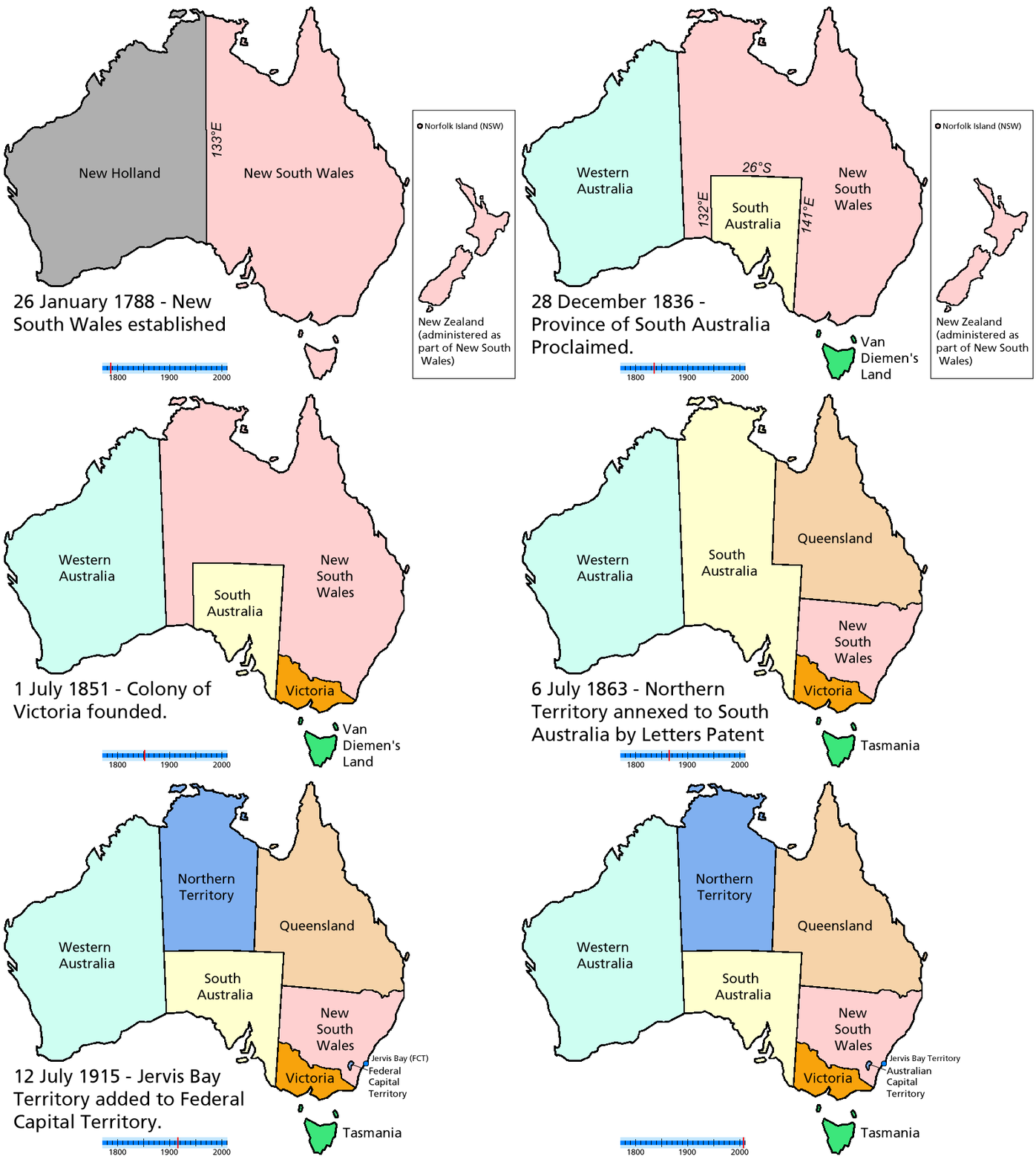
I received this link by e-mail from one of my Anglospheric contacts in the United States. It is a historically changing map or Australia. Great fun and, dare I suggest it, something children who are learning history might enjoy playing with.
 Tory Historian maintains that the American Thanksgiving celebration ought to be an Anglospheric fesitivity. It grew out of the Harvest festivals of this country (and many others) and there is no getting away from the fact that many of the ideas the Pilgrim Fathers carried with them to the new land were those of England and became the seeds of Anglospherism.
Let us not push it too far but celebrate the day with the somewhat anachronistic picture above and a quotation from the editorial that the Wall Street Journal publishes every year, which is a version of the records kept by Nathaniel Morton and based on the account by William Bradley, governor of the Plymouth Colony.
Besides, what could they see but a hideous and desolate wilderness, full of wilde beasts and wilde men? and what multitudes of them there were, they then knew not: for which way soever they turned their eyes (save upward to Heaven) they could have but little solace or content in respect of any outward object; for summer being ended, all things stand in appearance with a weatherbeaten face, and the whole country, full of woods and thickets, represented a wild and savage hew.It was merely the beginning.
If they looked behind them, there was a mighty ocean which they had passed, and was now as a main bar or gulph to separate them from all the civil parts of the world.
 It is not often that I do more on this blog than make announcements, mostly about the Journal (and yes, I am looking for articles, preferably very soon and, if possible, about the Anglosphere) but I was present at Jonathan Aitken's talk and was greatly intrigued by one or two things he said.
Mr Aitken told a number of highly entertaining stories, including one about a dinner at which there were present former Prime Minister Harold Wilson, former President Richard Nixon, Marcia Falkender (Baroness Falkender or Forkbender as Private Eye used to call her) and Mr Aitken himself.
The highlight of the dinner was, apparently, the two politicians singing, as a duet, Sir Joseph Porter's song from HMS Pinafore, "When I was a lad..". Clearly a dinner to remember.
Mr Aitken spoke at length about being a speechwriter (that being one half of the advertised title) and how seriously he took his duties when he wrote speeches for John Selwyn Lloyd, Chancellor of the Exchequer, political fixer and, later, Foreign Secretary.
Being a speechwriter is not easy, as one has to produce speeches that sound as if the person who is saying them wrote them himself (or herself, Margaret Thatcher famously went over her speeches many times, changing them and honing them till they became her own). The young Mr Aitken consulted the man who was then and probably until now the greatest speechwriter, Ted Sorensen, who worked for JFK.
The point Mr Aitken was making is that a speechwriter has to get into the speech-maker's head and that is what Ted Sorensen maintained he did. In question time I asked whether the movement was only one way or whether the speechwriter also shaped the speech-maker.
Mr Aitken thought about it and agreed that there was a great deal of it. For instance, JFK was not a particularly eloquent personality though he had a dry wit, whose flavour his speech writers managed to capture. But the great orator with vision and ideas was largely created by Ted Sorensen and Arthur Schlesinger.
The whole concept is fascinating. I see it as something like the famous Escher drawing of one hand drawing the other, which is drawing the first, the two in slightly different positions.
This evening's meeting of the Conservative History Group will take place in the Wilson Room, not the Thatcher Room. Don't know what the speaker, Jonathan Aitken, will think of that.
The Wilson Room is in Portcullis House and the meeting will start at 6.30 pm. The title of Jonathan Aitken's talk will be: "Confessions of an old speech-writer and speechmaker". Should be very interesting and entertaining.
 It has been suggested once to Tory Historian that, perhaps, another time and day should now be chosen for Remembrance as this time and day are too closely connected with the First World War. Naturally, Tory Historian disagreed. If there is no need to change there is every need not to change and the words "the eleventh hour of the eleventh day of the eleventh month" have come to mean much more than just the ending of that terrible conflict.
Having listened to the prayers led by the Bishop of London and the other parts of the ceremony by the Cenotaph Tory Historian remains certain that this is the time we must dedicate to remembering the sacrifices made and being made by so many on our behalf.
As ever, there are excerpts from two poems to be quoted. The first is by the Canadian medical officer John McCrae, who wrote the poem in 1915 and died of pneumonia towards the end of the war. It is odd to recall that more people of influenza in 1918 throughout the world than were killed in the Great War, terrible though the casualties were. In fact, the Second World War was the first war in history in which direct casualties were higher than those of attendant and subsequent illness. Whether that is a reflection on medical or military developments remains to be an open question.
In Flanders fields the poppies blowFor personal reasons Tory Historian finds Lawrence Binyon's lines particularly moving:
Between the crosses, row on row
That mark our place; and in the sky
The larks, still bravely singing, fly
Scarce heard beneath the guns below.
They shall not grow old, as we that are left grow old.We should never forget them but this is the time we really remember.
Age shall not weary them, nor the years condemn.
At the going down of the sun and in the morning
We will remember them.
 Tory Historian has already attended a bonfire and fireworks event and can report with some disgust that there was no Guy on the fire. This is a relatively new development as for many years this particular bonfire did have a Guy and one year the fireworks culminated in a picture of Guido Fawkes himself slowly disappearing.
Why so many of these events have abandoned any historical link to the festivities is a mystery. Some people consider it to be the result of political correctness.
Tory Historian thinks it has more to do with the curious development that is unique to Britain whereby all celebrations, all entertainments have been separated or are being separated from their meaning, historical, social or simply seasonal.
This does not work with the celebrations that the various ethnic minorities have, no matter how hard people like Mayor Livingstone try but otherwise it has taken hold. Nothing needs to have a reason any more.
There is nothing like this anywhere in the world, not in Europe, not in Asia, not in America; developed and industrial countries retain their knowledge of history and traditions. Why is Britain the exception? Why are people satisfied with amusing themselve to death? Then again, the tale of the Catholic Plot, the attempted terrorist outrage, the arrest of the plotters, their torture, confession and horrific execution is a strange and grisly event to celebrate.
Remember, remember,And there is no reason. Grisly and unpleasant but part of our history.
The fifth of November,
Gunpowder, treason and plot.
I see no reason
Why gunpowder treason
Should ever be forgot.
 The Russian myth of the Third Rome grew out of the fall of Constantinople to the all-conquering Ottoman army in 1453. In 1510 the monk Filofei wrote to the Grand Duke Vasili III: “Two Romes have fallen. The third Rome stands and there shall be no fourth.” Recently, during the usual falling out between various Orthodox priests and patriarchs, the theory was denounced but the Russians do not really care.
Moscow remains the third Rome. After all, the Russians never did get Constantinople though given the number of them who seem to be domiciled in Istanbul one wonders whether they are using a different method to the same end.
All this is a preliminary to a paean of praise by Tory Historian to the city of Istanbul, known for many centuries as Constantinople, the second Rome. It is not a city that buzzes nowadays though the melancholy mentioned by Orhan Pamuk is not exactly discernible. Quite simply, Istanbul is what Vienna was in the twenties and thirties – an imperial city that has lost its role.
When, in 1923, the Turkish Republic was formed, Kemal Atatürk was so anxious to break with the Ottoman past and to create a new, secular state that he settled on a new capital, Ankara. For the first time in many centuries Constantinople was not the heart of a great empire (though Byzantium was considerably less than great by the time of the final conquest in 1453). It is taking a long time for the city to come to terms with that but it is also taking a long time for Turkey to settle down with its own Turkish identity, no matter how strongly people feel it inside them. The uncertainty over the mildly Islamist party taking power and the whole row over the Armenian massacre of 1915 are evidences of that uncertainty.
One must wish Istanbul well because it is such a glorious and fascinating city. Surely, it will reacquire a role for itself but there is no doubt that its role is tied in closely with Turkey’s ability to define more securely her identity and her own role in the world. In that, too, one must wish the country well. It is, at present, the one fully secular Muslim country and if that experiment fails, there is little hope for peace between Islam and the West.
Of course, one could argue that there was rarely peace between Islam and the West and why should there be.
In the meantime Istanbul is extraordinary in the way one can quite literally walk though several centuries in one afternoon’s progression through the city. There are slums of the kind one would see in Third World countries cheek by jowl with highly respectable middle class areas that remind one irresistibly of Eastern and Central Europe.
The public transport is excellent and the food is uniformly superb whether it is a borek-seller in a street or a restaurant that boasts of its “Ottoman” food.
Antiquities, whether Byzantine or Ottoman have not been well preserved though efforts at restoration are being made and clearly there is a renewed interest in the city’s pre-Ottoman history, which is all to the good.
Functioning mosques are beautiful and well-kept as well as surprisingly welcoming, something not a few tourists seemed to abuse. Courtesy requires that one obeys the rules of the place of worship one visits. If women do not like wearing headscarves they do not have to go into the Blue Mosque.
Tory Historian’s abiding memory is sitting outside a Greek monastery (not functioning but relatively well preserved, drinking coffee and looking at the Turkish flag flying proudly as at four o’clock the muezzins began their call for prayer (largely ignored by the population at large). Oh well, of course, there is the other abiding memory of discussing Anatolian rugs over a little glass of chai in the Grand Bazaar.
The next two speaker meetings of the Conservative History Group are as follows
Monday 19 November, 6.30pm
JONATHAN AITKEN
"Confessions of a speech-maker and speechwriter"
Thatcher Room, Portcullis House
Tuesday 4 December, 6.30pm
ALISTAIR COOKE
"The history of the Carlton Club"
Boothroyd Room, Portcullis House
The latest copy of the Conservative History Journal has just been sent to members. Anyone who has not received their copy yet should email info AT conservativehistory DOT org DOT uk
October 12 seems to be a particularly sombre day. Looking at the BBC site "On this day" we find that this is the day on which the USS Cole was attacked in 2000 and the Bali nightclub explosions killed dozens of people.
Though the number of casualties was smaller, in many ways for Britain the biggest and most horrific anniversary is that of the Brighton bomb in 1984. Aimed to kill the Prime Minister and any member of the Cabinet that got in the way, it did kill 4 people and injure many more, some, like Lady Tebbit, permanently.
Miraculously, the Prime Minister survived and came out to address briskly the assembled media. It was a frightening day for many of us.
It only needs to be added that the perpetrators were caught, tried and sentenced only to be released as part of the dubious peace process.
On a more cheerful personal note: Tory Historian will be away for a week or so, visiting Constantinople or Istanbul, depending on which bit of history you happen to approve of.
 Tory Historian has been reading about social mobility in Victorian England. The book in question is Kathryn Hughes’s biography of Mrs Beeton, author of that famous cookery book and manual of domestic arrangements. It seems to have been one of those biographies that Eng.Lit. reviewers liked more than readers if the comments on Amazon are anything to go by – lukewarm at best.
Indeed, the book is probably a little too long. Ms Hughes is given to padding. Writing about the fact that the Mayson-Dorling family (Isabella’s mother and step-father who had 21 children between them and jointly) decided to send the girls to a boarding school in Heidelberg that provided a better education than anything they might have found in England at the time and that certain families that had been the Maysons’ neighbours in the City did the same, she writes:
This decision of friends and neighbours to send their daughters to the same school on the other side of Europe might seem quaint to modern eyes but it made sense.She then proceeds to enumerate the various ways in which it made sense and, indeed, she is right: it did make sense. But there is a great deal too much of this condescension at the expense of the early Victorians and inhabitants of early nineteenth-century England with too many comments about how odd it must all seem to modern eyes. One must assume that a person who has decided to read about Mrs Beeton is not going to be too astounded by the fact that the world was a somewhat different place 150 or 200 years ago.
In the midst of all this chocolate box prettiness it is worth remembering the odd fact that by the time the last of these quaint young ladies had died – Isabella’s sister Esther Mayson, as it turned out, in 1931 – Hitler was only two years away from becoming Chancellor and the infamous Nazification of Heidelberg University was on its way.Actually, it is not worth remembering at all in the particular circumstances of trying to understand how several Victorian families chose to educate their daughters. The chocolate box prettiness is introduced quite gratuitously by Ms Hughes and the young ladies in question can be regarded as quaint only if we take the rather bizarre view that whatever we see around us at this moment is the absolute norm. Surely, no historian or biographer can think that way.
Elizabeth Jerrom, the woman whom Benjamin Mayson would marry, was born on 24 May 1815, three weeks before the great victory of Waterloo. Her parents Isaac and Mary were domestic servants working for one of the big houses around Marylebone, part of the feverish development of gracious squares that had been built towards the end of the last century to house the newer aristocracy during the ‘London’ part of their wandering year. When the couple had married eleven months earlier at St Martin-in-the-Fields, they had signed the register clearly, confident in themselves and their new merged identity. The same, though, cannot be said of their witnesses. William Standage, Mary’s father, has done his best but the sprawling scratch he makes in the register is indecipherable: underneath the parish clerk has been obliged – tactfully, crossly? – to write out his name properly, for the record. Mrs Beeton is only twenty years away from people who would have been happier signing themselves with a cross.William Standage was, in fact, a highly prized and very well paid groom to the Duke of Richmond and horses figure a great deal in Isabella Beeton’s family. Isaac and Mary Jerrom did very well in the changing new world that Ms Hughes is slightly disdainful of (clerks and shop girls careering round the City in cabs – faugh!). Isaac kept a livery stable, hiring out horses and coaches to those who could not afford their own and ran a hackney cab business. Mary ran a respectable lodging house – a not infrequent combination at the time, which made a good deal of sense.

Lord, grant that Marshal Wade,
May by thy mighty aid,
Victory bring.
May he sedition hush and like a torrent rush,
Rebellious Scots to crush,
God save the King.
 Sadly, we all seem to be writing far too many obituaries these days. The old generation is going. Tory Historian, on the whole, is not in particular sympathy with Lord Gilmour’s “wet” politics, while recognizing that his rather paternalistic “one nation conservatism” does have a serious historical background and a following in the party.
In fact, one might say that a good many of those wet policies are now the policies of the Conservative leadership, though we have yet to see how attractive the electorate will find them.
Having read the excellent and exhaustive obituary in the Daily Telegraph, with an excellent photograph that conveys the man’s personality in one shot, Tory Historian is left with something of a puzzle.
What exactly motivated Sir Ian Gilmour, later Lord Gilmour of Craigmillar? Was it noblesse oblige? Was it a feeling of distaste for the commonness of the new Conservative Party with people like Margaret Thatcher and Norman Tebbit in charge? Surely not.
How is it that he managed to find himself on the wrong side in every debate, except one? For some incomprehensible reason he was quite tough in Cold War politics, while you would expect him to try to find compromises and see good things in the Soviet leadership. But he did not and that is greatly to his honour. Not much else is.
No need to despair: the next issue of the Conservative History Journal has gone to the printer and will be ready for the Party Conference with subscribers receiving their copies after that. More copies will be available from the Conservative History Group.
It is full of goodies, including two cartoons of the Suez Group, one by Vicky, that have not been published for fifty years or more and are the property of Lady Biggs-Davison, the widow of one member of the rebellious group, Sir John Biggs-Davison.
Then there is an article by Alistair Cooke on one of the dames formidables of the Conservative Party, an early organizer (as women could not, at that time, be agents), who ensured that Ramsay Macdonald was re-elected in 1931.
There is an interview with Jonathan Aitken by Mark Coalter, a regular contributor to the Journal with Aitken telling entertaining stories about the 1963 Conservative Party Conference; a piece about the Ukrainian-born MP, Josef Terlezki; two articles with relevance to the present situation, one about the eighteenth century Scottish Prime Minister, Earl of Bute and the other about Anthony Eden’s long wait to inherit Churchill’s mantle. Eden was not, perhaps, the most successful of our twentieth century Prime Ministers.
And, as they say, much, much more.