
The Codebreaker Girls – Only 99c!
1 month ago
 This autumn sees a number of important anniversaries; the fiftieth anniversary of the Hungarian Revolution and of the Suez crisis, as well as of the Melbourne Olympics with its notorious water polo match.
Then there are the less important non-round anniversaries. October 23, 1942 saw the start of the Battle of El-Alamein and October 24, 1945 witnessed of the beginning of that glorious institution, the United Nations.
In 1945, representatives of 50 countries met in San Francisco at the United Nations Conference on International Organization to draw up the United Nations Charter. Those delegates deliberated on the basis of proposals worked out by the representatives of China, the Soviet Union, the United Kingdom and the United States at Dumbarton Oaks, United States in August-October 1944. The Charter was signed on 26 June 1945 by the representatives of the 50 countries. Poland, which was not represented at the Conference, signed it later and became one of the original 51 Member States.By the time Poland became a founding member it had become clear that the country was not going to have an independent existence. In the Soviet Union they were busy imprisoning all those who were returning or were being returned from POW camps and those who had been displaced persons.
The United Nations officially came into existence on 24 October 1945, when the Charter had been ratified by China, France, the Soviet Union, the United Kingdom, the United States and by a majority of other signatories. United Nations Day is celebrated on 24 October each year.
the only slogan sillier than “My country right or wrong” is the “United Nations right or wrong.For once, Tory Historian has to admit that Nye Bevan got it just right.
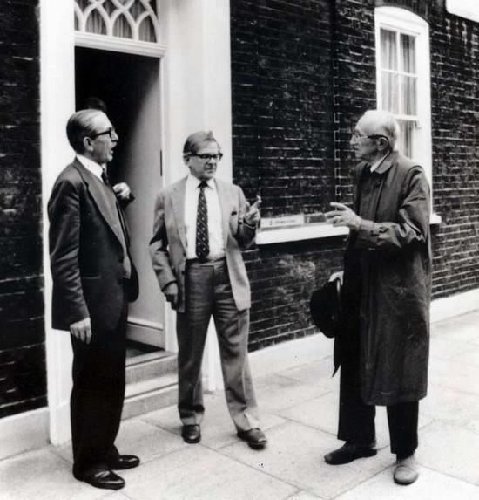 Tory Historian thought that readers of this blog would like to see this rather jolly picture of the three great men, who between them did more than anyone to create the Thatcherite revolution and the revival of the Conservative Party’s fortunes (well, so it looked at the time).
The last of them, Lord Harris of High Cross (the one with the moustache) died yesterday of a heart attack. His end was swift and painless and he was active almost to the last minute, having been sighted in the House of Lords just a day or so before it.
The last couple of times Tory Historian sighted the great man was at meetings of the Bruges Group. One was addressed by Jim Bennett, author of “The Anglosphere Challenge” and founder of the Anglosphere Institute and the other one by that stalwart Conservative historian and Anglspherist, Andrew Roberts on the subject of his new book: “The History of the English-Speaking Peoples Since 1900”.
On both those recent occasions Ralph was greatly excited by the plethora of new ideas he was being presented with and by the notion that political discourse, of which he sometimes despaired, was moving into completely new and fascinating directions.
He was the first in the queue to buy Andrew Roberts’s book (sending Tory Historian off to get him a glass of wine).
On both occasions one could not help wishing for an old age that continues to be so full of intellectual vim and curiosity. And so it has proved for him. Way to go, Ralph.
What will replace the old guard?
Time to look at some other countries, says Tory Historian, guided as ever by recent reading. The historian in question is the late great Professor Leonard Schapiro, whose analysis of Russia and the Soviet Union have been equalled by few.
Professor Schapiro’s oft reiterated argument was that free, just and democratic societies could exist only if there was a full understanding and acceptance of the rule of law within them. In particular, he was an admirer of the English common law, that had spread across the Anglospheric countries of the world (though, to be fair, he did not use that expression) and of the adversarial form of political and legal institutions in this country.
Born in pre-revolutionary Russia, Schapiro trained as a lawyer in England, served in Intelligence during the Second World War, later teaching government and politics at the London School of Economics, specializing often in Russian and Soviet history, politics and literature. He also translated Turgenev’s “Spring Torrents” and published a highly regarded biography of that writer. (Actually, now that I think of it, the man’s career is rather depressing for the rest of us who could not possibly keep up with that.)
Anyway, back to that reading matter. I have been reading and, in some cases, re-reading, Schapiro’s essays on various subjects and was greatly struck by his comments on the Nuremberg Trial in the first of those: “My Fifty Years of Social Science” first published in 1980.
In so far as there is any kind of an idea of what that nebulous term, international law, means, (apart from the obvious matters of various agreements on behaviour at sea, in the air etc etc), it has grown out of that first international trial for crimes against humanity and the creation of the United Nations within a couple of years of it. Professor Schapiro was an opponent of both initiatives:
So far as I was concerned the most powerful single factor that rid me of any illusion that the Soviet Union might have changed after the war was the Nuremberg trial, and the way in which it entered into the fabric of international relations. Nuremberg was both an appalling travesty of international law, a craven acquiescence in and tacit acceptance by the Western powers of the principle that the grim record of the Soviet Union in its treatment of its population was beyond criticism.Opponents of the Tribunal and the Trial have also pointed out that the leading Soviet judge was Major-General Nikitchenko who had been a judge at some of the show trials of the thirties and the main Soviet prosecutor was General Rudenko, an active participant in the Katyn massacre of Polish officers, one of the charges he tried to indict Germany for at Nuremberg. (The main prosecutor at the Soviet show trials, whose hysterical outbursts defined that whole ghastly episode in Soviet history, was Andrei Vyshinsky, who later became the Soviet representative at the United Nations.)
International law was traduced by the introduction of the new principle of law which certainly did not exist at the time the acts were committed that waging an aggressive war is an international crime. As regards the violation of human rights, the Western allies acquiesced in a Soviet demand for an amendment to the agreement setting up the Tribunal. This consisted in the removal of a comma, and this had the result of placing it beyond doubt that the violation of human rights was only an international crime when it was committed in furtherance of acts of aggression but not otherwise – thus precluding even the possibility that Stalin’s atrocities might one day be condemned by the international community.
 Probably this will not count as Conservative history in any shape or form but it links in well with the previous posting about J. H. Elliott and Claudio Véliz, who gave the Anglosphere Institute’s inaugural lecture in Washington DC yesterday.
Today is the anniversary of Christopher Columbus’s landing on the island he named San Salvadore and the beginning of the exploration of the New World by the Old. It used to be called Discovery of America but Tory Historian understands that those are words not much in vogue these days. And, of course, one doesn’t quite know how to react to Columbus Day. It is celebrated in the United States by Italian-Americans (and there is a splendiferous memorial to the man himself at the bottom of Central Park, in Columbus Circle, in New York City) but in Latin American countries it is called various other things: Día de la Raza (Day of the Race – an odd name, given the descent of various peoples in Latin America), Discovery Day (not unreasonable though it does raise the question of what was discovered by whom and who knew about it before) and the newly named Día de la Resístancia Indigena (Day of the Indigenous Resistance) in Venezuela.
None of which manages to destroy the importance to European and, subsequently, world history of the day on which Columbus and others set foot on “a small island of the Lucayos, called, in the language of the Indians, Guanahani”.
For modern historians the argument has, as this blog has indicated before, shifted somewhat from the rather fruitless victim status competition to a discussion of the difference between the way the Spanish and British empires developed and the continuing difference between the countries of the Anglosphere and Hispanosphere.
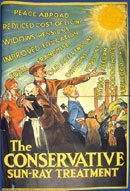 Tory Historian duly notes that co-blogger Iain Dale has already used the image sent by one of our readers. Nevertheless, it is worth saying on this blog as well:
The present leader of the Conservative Party was not as original as he thought he was in his references to the sun being a Tory voter (at least, I think, that is what he said).
The poster on the left is one from the 1929 election. I am not sure it is a particularly useful example to look to. The Conservatives did not do particularly well. They won by a small margin the popular vote but lost 132 seats.
Labour under Ramsay Macdonald won a total of 287 seats and formed the government with the Liberals regaining some influence in what was a hung parliament.
 Yet more memories from Tory Historian’s education. Another name to conjure with was J. H. Elliott, who had written about Imperial Spain. Professor Elliott, I am delighted to report, is still alive and very active, having just produced a new tome: “Empires of the Atlantic World”.
This is a comparison between the Spanish and the British Empires in the Americas and some speculation about the reasons why they might have developed differently. As the TLS review by Fernando Cervantes points out, there is also a certain amount counter-factual speculation towards the end of the tome.
What would have happened if Henry VII had agreed to sponsor Christopher Columbus’s first voyage or if it had been an English expeditionary force that conquered Mexico? Would there have been a reversal in the two countries? Would England have remained Catholic, the strongest and most active of them in Europe? Or would the inherent national characteristics triumphed and there would have been a direct reversal?
“Would Latin America be a thrifty and pluralistic society, firmly entrenched in the capitalist economy of the First World, while North America was a collection of heavily indebted enclaves of outmoded forms of baroque culture?”How much of the different developments depended on the greater and more integrated control from Madrid than from London (though many of the local agents managed to lose instructions from both)? According to the reviewer this control worked towards the benefit of the Latin American colonies at the beginning. In the seventeenth and early eighteenth century they flourished, were considerably more civilized and, even, humane, especially towards the native population and the slaves. Once the control disappeared, however, it was the North American colonies that began to flourish, using the ideas they had imported and the structures under which they had lived. And the problem of slavery has not yet been tackled properly in many of the Latin American countries.
“According to Véliz, the dominant cultural achievements of Europe's English- and Spanish-speaking peoples have been the Industrial Revolution and the Counter-Reformation, respectively. These overwhelming cultural constructions have strongly influenced the subsequent historical developments of their great cultural outposts in North and South America. The British brought to the New World a stubborn ability to thrive on diversity and change that was entirely consistent with their vernacular Gothic style. The Iberians, by contrast, brought a cultural tradition shaped like a vast baroque dome, a monument to their successful attempt to arrest the changes that threatened their imperial moment.”It will be interesting to see to what extent Professor Elliott agrees with Claudio Veliz.
It is always sad to report the death of a talented historian, especially one as young as Ewen Green, whosed death at the age of 47 of multiple sclerosis has just been reported.
Dr Green has been a remarkable historian of the Conservative Party in the twentieth century, starting with "The Crisis of Conservatism", published in 1995. This was followed by "Idologies of Conservatism" in 2002 and the very recent short biography of Margaret Thatcher.
As the obituary in today's Guardian says:
In a sense, it completes a trilogy. The first book looked at Edwardian politics through Thatcherite spectacles, detecting the emergence of a radical strain of Conservatism. After the variations developed in the second, the final book suggests that, in the perspective of history, Thatcherism itself was not quite as novel as it first seemed.Some of our readers might feel that another comment made by the author of the obituary is a little too amusing though very apt:
His originality lay in seeing there had been too much concentration on the ideas and politics of the left in 20th-century Britain, probably because many historians were themselves left of centre. He saw that the response of the right was in need of proper investigation, especially by historians who were not of the right themselves.We expect numerous comments on whether Dr Green was, indeed, "the most stimulating historian of the 20th-century Conservative party".
His whole career revolved around the paradox that he became the most stimulating historian of the 20th-century Conservative party without ever being tempted to vote for it.
 As my co-blogger put up a posting that is seriously modern (though, I suppose, both Blair and Brown might be on their way to being history), I thought I might stay in the second half of the twentieth century as well. (OK, Iain, just joking. I know RAB Butler is history.)
The intriguing story of George Blake, one of the most successful Soviet spies, being awarded £4,690 by the European Court of Human Rights because the Attorney General had taken too long to bring about the government’s action against Blake to prevent him from profiting by his treachery brings back all kinds of memories of the Cold War. But above all, it raises problems of the naming of matters.
The Daily Telegraph has two articles on the subject, one by Joshua Rozenberg on the legal side of the decision and the other one by Phillip Knightley, a brief summary of Blake’s career.
Both the articles refer to Blake as a double agent. Now, the truth is that there is no such thing as a double agent. There are, or have been in the past, people who will spy for the highest bidder and may, therefore, spy for several countries and organizations simultaneously. But in the world of ordinary espionage there is but one true employer.
Blake was a Soviet agent who pretended to be a British Intelligence officer, the better to carry out his work for his real paymasters and ideological controllers. He was also a man responsible for numerous deaths of Soviet officers whom he had tried to persuade to defect to the West. Curiously enough, Mr Knightley describes the operation that was set up in Berlin but does not mention what might have happened to the unfortunate victims of the KGB-run sting operation.
That brings me to another problem of vocabulary: who is an agent and who is a spy? It used to be really easy to define: our people were agents, theirs were spies. Any film of the thirties, forties or fifties will tell you that. There was the odd complication, as one can see in the novels of Buchan, for example, or Erskine Childers’ “Riddle of the Sands” about the distinction between those who spied for their country and could, therefore, be called German agents, and those who spied for Germany, though they were British. The latter were clearly spies and traitors.
This distinction between agent and spy exists in most countries and languages. It is, however, being eroded in Britain. Not only we keep talking about double agents when we really mean enemy spies but there is a curious tendency to refer to British agents as British spies (and not by the Russians, either).
William Boyd’s latest book, “Restless”, for instance, centres on a seemingly ordinary elderly English lady who turns out to be Russian by birth who was a British "spy" during the war in occupied France. Undoubtedly a dangerous assignment and one that the survivor might not want to talk about subsequently. But the implication from the blurb is that the lady in question has tried to bury the truth as being shameful and traumatic while her daughter is shocked and upset when she finds out.
Oh really? Most people are rather intrigued and not a little proud if they find out that their parents were British agents fighting the Nazis during the war. On the other hand, according to Mr Boyd those agents were really spies and, therefore, morally dubious. Much depends on the name.
I didn't see it but I understand Tony Blair gave a brilliant speech this afternoon. However, one passage which people may not have picked up on was when he described Gordon Brown as a "Great Servant of the State". Those of you who know your history will be aware that this is exactly hwo Harold Macmillan described RAB Butler - and it wasn't meant as a compliment. Of course, Rab Butler never got to be Prime Minister. I understand Cherie looked particularly pleased at that point.
 Tory Historian is one of those thousands who studied the Tudors’nStuarts for A-level and is, therefore, a paid up member of “Sir Geoffrey Elton is the greatest historian ever” club. After a week of rather hard, concentrated work on various projects, a reading of the great man’s “The Practice of History” seemed in order.
An admission is in order: I had no idea until I looked up Elton’s biography, that he was of a German Jewish family, which had moved to Prague before fleeing again to Britain. Another loss to Germany and gain to Britain as a result of that insane ideology.
A couple of quotations, I think, for readers to contemplate. A characteristically wry comment at the very beginning:
[M]ost books on history have been written by philosophers analysing historical thinking, by sociologists and historiographers analysing historians, and by the occasional historian concerned to justify his activity as a social utility. This contribution seeks to avoid the last, ignores the second, and cannot pretend to emulate the first. It embodies an assumption that the study and writing of history are justified in themselves, and reflects a suspicion that a philosophic concern with such problems as the reality of historical knowledge or the nature of historical thought only hinders the practice of history.This is a very misleading comment as far as Sir Geoffrey himself is concerned. In actual fact, he spent a great deal of time (though not as much as he did on the unravelling of the Tudor years) on thinking and writing about history, its meaning and importance.
There is something markedly a-historical about the attitudes embedded, for instance, in the classic minds of India and China, and any history of historiography must needs concentrate on the Hellenic and Judaic roots of one major intellectual tree. No other primitive sacred writings are so firmly chronological and historical as is the Old Testament, with its express record of God at work in the fates of generations succeeding each other in time; and the Christian descendant stands alone among the religions in deriving its authority from an historical event.One could not compete with the elegance of that statement. I would put it simpler: history is studied in cultures which are based on a sense of curiosity. “What happened then?” – is a question all those who have had to deal with children know all too well. It is the first question of an historian.
On the other hand, the systematic study of human affairs, past and present, began with the Greeks. Some sort of history has been studied and written everywhere, from the chronicles of Egypt and Peru to the myths of Eskimos and Polynesians, but only in the civilization which looks back to the Jews and Greeks was history ever a main concern, a teacher for the future, a basis of religion, an aid in explaining the existence and purpose of man.
The Conservative History Group will be holding a fringe meeting at the Party Conference at 5pm on Monday 2 October. Lord (David) Trimble will be the guest speaker and will talk about the history of the Ulster Unionists. The meeting will be chaired by Keith Simpson MP.
Venue: Granville Suite, Trouville Hotel, Priory Road, Bournemouth
It is outside the secure zone and you do not need a conference pass to attend.
 Bear with me. These musings will be worth reading, particularly when they are turned into an article for the Journal.
The theme of what is English or what is important to all the countries, Britain, America and those of the Empire and Commonwealth, understandably, preoccupied many of the film-makers. The ideas are there in straightforward war films like “In Which We Serve” – duty of service but also private affection and love of those close to one with little emotion displayed – or “The Way Forward”, which shows the birth and growth of the new, more democratic army, with even the officer, played by David Niven, being one who had risen from the ranks.
The most successful if somewhat eccentric of the “what we are fighting for” films are those made by Michael Powell and Emerich Pressburger (himself a Hungarian), such as “The Life and Death of Colonel Blimp”, a strongly argued case for ordinary decency that uses the image, created by David Low and so despised by the Left, of the bumbling old-fashioned colonel, out of date in the brave new world. The film makes it clear: being out of date is not the worst thing that can happen to one, if it means adhering to old-fashioned honesty and decency.
Churchill did not like the film and, I think, I can understand why. The trouble with Blimp is that he is not terribly bright, while the only highly intelligent decent man in the film is his German friend, played by Anton Walbrook, who escapes from Nazi Germany and tries, without much success, to warn his British friend of the evil that is brewing in that country. I can imagine that Churchill was not too keen on any film that perpetuated the great British assumption that intelligence is somehow bad and suspect.
The Powell-Pressburger films deserve a posting all to themselves but I do need to mention their most audacious attempt to build up a picture of England as the country that is worth fighting for with the true values that needed to be carried on beyond this battle against evil: “The Canterbury Tales”.
While Churchill was not very fond of “The Life and Death of Colonel Blimp” he was, predictably, enamoured with the various historical films of those years, his favourite one being “That Hamilton Woman”, which Tory Historian has never seen, despite it stellar cast.
It is normal for countries to produce historical films during a war and even as one looms on the horizon. What the historical theme might be depends largely on the way that country sees itself. Most of the British ones dealt with the previous times when the country faced up to a strong enemy on the Continent, the two favourite topics being the Spanish Armada and the Napoleonic Wars.
Another film Churchill was rather fond of was “The Young Mr Pitt”, also seen by Tory Historian on that Bank Holiday week-end (one to remember, clearly). Film critics, of whom Tory Historian is most definitely not one, tend to be a bit sniffy about this film. Oh dear, they say, it is so simplistic. We know so little about the reality of the political battle between Fox and Pitt. Not enough is made of the great battles won by Nelson. And, honestly, how … well, really, … how one-sided.
War films do need to be simplistic to a great extent. You can’t afford to let doubts creep in when the country is at risk, as it was when “The Young Mr Pitt” was made in 1941. Unusually for Reed, the shooting and the post-production took a long time and the film was not released till 1942 by which time the United States, part of the targeted audience, was at war.
If “Night Train to Munich” was a pre-Dunkirk film, this one is definitely post-Dunkirk. The mood is mostly dark, though, clearly, there are a few victories reported, notably that of the Nile and Trafalgar. Pitt, we have to remember, died when the Continental menace still loomed large.
“The Young Mr Pitt” is a remarkably skilful film, with quick episodes following one another to give an impression of the great prime minister’s career rather than a historical dissection of it. It is not inaccurate, merely impressionistic.
There is a clear link to Churchill, Pitt the Younger being the one man on whom the salvation of the country depends, as the scene where his temporary successor Addington is harassed by MPs shows. There is, also, the clearly designated American connection, it being of great importance to show that Britain at all times fights for the principles the United States was founded on and lives by.
At the very beginning of the film we see Pitt the Elder, the Earl of Chatham, speaking in the House of Lords against the war with the Colonists, proclaiming: “You will never conquer America.” He refers the ideas of liberty, the language and religion that the two countries have in common. This is echoed later by the younger Pitt, when he denounces revolutionary and Napoleonic France as being inimicable to English ideas of liberty and wanting to impose its language and its irreligion on this country.
That, in a way, is the summary of what Britain is fighting for: her language, her religion, her ideas of liberty.
Unlike other war-time films, this one does not show the people en masse in a good light, taking its cue from Shakespeare and his fears of the mob. Individuals, like the two pugilists who support Pitt through thick and thin, or William Wilberforce (played by John Mills) who longs for peace but has to accept war, come out well. Even Fox offers to serve under Pitt when it becomes clear that nothing but all-out war will serve Napoleon’s purposes.
But the people – oh the people are fickle. If there is a victory, they support Pitt. As soon as things go wrong, they throw bricks at his windows and rotten eggs at his carriage. One wonders whether this was a realistic picture of the mood in Britain in 1941 (without the bricks and the rotten eggs).
The film hinges on the great Robert Donat’s performance. Carol Reed had enticed him back to film-making because they both considered this to be important war work. He himself was of English, Polish and German descent, which accounts for the slightly odd surname but, like Leslie Howard, managed to play the quintessential English hero with no difficulty.
In “The Young Mr Pitt” his performance is superb and all the film’s shortcomings are swallowed up in that. He plays the aged Earl of Chatham as well as Pitt the Younger, whom he takes through from his early political years, when the bouncy young man can barely control his elation at being made prime minister at the age of 24 and has pillow chases up and down the stairs with the young siblings of Lady Eleanor Eden with whom he is obviously in love, through the hard-working, hard-drinking dark days, to the triumph of his post-Trafalgar speech at the Guildhall. The shadow of his early death hangs over that event and Pitt’s defiant toasting of his friends with wine rather than the medication poured out to him by his doctor.
As I have mentioned in a previous posting, Pitt the Younger is presented as a romantic hero, the man who sacrifices his personal happiness and his life to his country and the idea of liberty, which his country represents. The country’s liberty and that of its individual people, that is what Britain fought for in the Napoleonic Wars and that is what it was fighting for in 1941. A simple, comprehensible, and all-embracing idea.
 This is turning into a more serious experiment than predicted. I ought to have known that I could not do a blog of readable length on so many related subjects.
“Night Train to Munich” is often described as almost a continuation of Hitchcock’s “The Lady Vanishes”, which also stars Margaret Lockwood. The Reed film had Rex Harrison instead of Michael Redgrave who had other commitments and revived the cricket-loving Charters and Caldicott as played by Basil Radford and Naunton Wayne.
It is, of course, a truism among film critics (of whom Tory Historian is most definitely not one) that Alfred Hitchcock was one of the greatest and few can come up to his standard. Well, in this case, the truism is wrong. “The Lady Vanishes” is a delightful film, full of the usual Hitchcockian touches and also full of the man’s ineffable silliness. Plots? What plots?
“The Lady Vanishes” takes place in a country that is vaguely Ruritanian, gives the impression of being Switzerland but is possibly Germany. Or not. This lack of precision or any worry about it diminishes the tension of the story. After all, it is only fairyland and the good will triumph while the bad will come to a no good end.
“Night Train to Munich” is very different. It is timed and positioned precisely, taking place in the last few months before the outbreak of World War II, finishing in the train journey that takes place in the night of September 3, 1939 and a chase through Germany the following day, with a final escape to Switzerland.
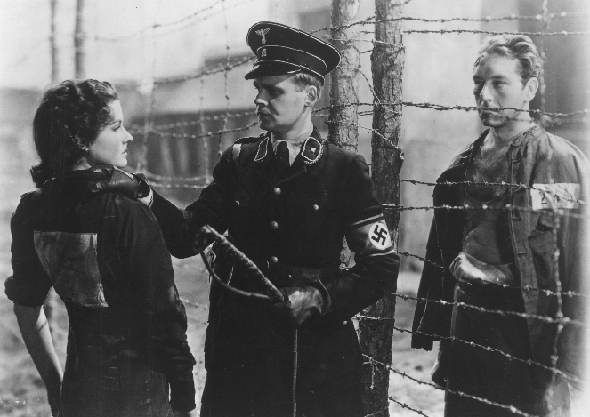
Briefly: the British manage to spirit out a Czech scientist, who is working on a development in arms manufacturing that will revolutionize warfare, just ahead of the invading Germans. But the Gestapo arrests his daughter as she is trying to reach the airport and sends her to an internment camp.
Immediately, one must note two very precise and realistic aspects. When the Germans talk about Czech steel production being superlative and their need for the armaments manufacturing in Czechoslovakia, the film tells the truth. The Czechoslovakia of the late thirties was one of the best producers of arms in Europe and the Germans were fully aware of this. As they took the factories of Sudetenland over, they transferred some to Austria and used others in situ. Czech tanks and vehicles were invaluable in the invasion of Poland and, later, of the Soviet Union.
Then there is the internment camp. The film was made in 1940 but already there is a depiction of the viciousness of the Nazi regime. Reed was so attentive to detail that he asked the advice of someone who had managed to get out of an internment camp and come to Britain.
The daughter, Lockwood, manages to escape and join her father but they are both kidnapped by Gestapo agents. The second half of the film consists of the elegant but deadly British agent, Rex Harrison, trying to rescue them and bring them back to Britain. He is motivated largely by patriotism, a desperate desire to improve Britain’s chances in the war that is drawing ever closer, feelings of anger because he had, in his opinion, failed in his duty and, needless to say, growing love for the stunning Margaret Lockwood.
There is, of course, a great deal of hokum but, also, some telling points. The film was released in June 1940 and was, possibly, not as successful as it should have been because of the timing. As Reed himself pointed out, it was a pre-Dunkirk film shown in the post-Dunkirk time. The mood had become darker and victory was no longer seen to be easy or, indeed, probable.
Nevertheless, the propaganda must have been effective in trying to provide both a negative and a positive reason for fighting, that is, trying to explain what we are fighting against and what we are fighting for.
The Nazis are not all spectacularly evil in this film, though there is a good deal of nastiness in the depiction of the internment camp. There are also wryly amusing moments when Nazi officers say things like: “This is very urgent as any day now Poland will provoke us into invading it in self-defence.” (There is a telling echo of this statement in the conversation William Pitt has with the French ambassador Talleyrand in “The Young Mr Pitt” about the French invasion of the Low Countries.) On the other hand, there is no obvious disdain for the Germans either. Some are stupid, dishonest, and even, brutal. But others are intelligent and, in their own way, patriotic. It is the system that has been imposed on their country, the system of lies, hatred and brutality, that is shown to be evil.
There is also a reasonable indication that many Germans are dissatisfied with the Nazi regime and hanker after the freedom, which Britain represents. That is the crux of the positive argument: what we are fighting for, the most difficult of all things to define.
When Margaret Lockwood manages to get to England from her internment camp, it is still summer and the war is merely looming. She talks happily of people laughing and feeling relaxed, unafraid. Well, one might say, they have not been occupied, unlike her own country, Czechoslovakia. But later, much emphasis is laid on the fact that the Nazis had been brainwashed, taught to repeat slogans; that they are no longer capable of thinking for themselves, unlike the British, who remain free and, therefore, ingenious in their ability to fight the enemy.
The two somewhat bumbling but basically very decent cricket-lovers, Charters and Caldicott, represent England at her best. They are smart, though not too smart; courageous though not foolhardy; decent and honest but capable of all necessary deviousness when faced with the enemy. At one point they find themselves dressed in SS uniforms, marching reasonably well behind Rex Harrison, also in disguise.
The values are conservative with a small ‘c’ – freedom, the right to live your life as you want to, decency, openness, courage and, if necessary, deviousness against the enemy. Above all, there is the determination not to give in (though this is matched by an equal determination on the other side). These are Anglospheric ideas, the link between British and American attitudes emphasised for propaganda purposes.
This posting is by way of an experiment, in that it is the first version of an article that will appear in the Conservative History Journal, though in a somewhat amended version. My great hope is that some of our readers will also start sending in pieces that might go up on the blog first (fully accredited, of course) and develop into a long article or even a pamphlet in due course. (Hint: the fiftieth anniversary of the Suez debacle is coming.)
Now, off with that first person singular and on with Tory Historian’s hat.
Bank holiday week-end used to mean the Notting Hill Carnival to Tory Historian, who lived in that area long before it became really fashionable (some of it was even then but we don’t talk about that) and invaded by politicians, journalists and hangers-on. Nowadays, attitude to the Carnival tends to be: “been there, done that, might go again if there is a visitor”.
Something else was called for. Luckily, the National Film Theatre (an excellent institution and the only cinema that shows films worth seeing) is having a two-month Carol Reed season.
Sir Carol Reed, known chiefly for “The Third Man” and “The Fallen Idol” was one of this country’s greatest directors, versatile, imaginative and wonderfully skilled in his craft. His earlier films gave the most entrancing picture of middle-class England with all the good points and bad. Firsts for Tory Historian: the film of Priestley’s “Laburnum Grove”, an unexpectedly tense and humorous send-up of middle-class life in the London suburbs of the early thirties and “Kipps” in which Michael Redgrave portrays H. G. Wells’s draper’s assistant who goes on to greater things.
During the war, Reed, like many others turned his attention to war work, commonly known as propaganda. He made a number of superb films as a civilian, later joining the Army Kinematographic Service, where he made official training films and such classics as “The Way Ahead”.
In the immediate aftermath of the war he made some of the finest dark thrillers of which “The Third Man” is the greatest, going on to vast extravaganzas like “The Agony and the Ecstasy” and “Oliver”.
On Bank Holiday week-end the NFT showed “Night Train to Munich” a spy thriller aimed at the American audiences as much as the British ones (Reed being one of the few British directors whose films were popular in the States), “The Young Mr Pitt” a biopic of the great Prime Minister and a seventeen-minute short, “A Letter from Home”, made under the auspices of the Ministry of Education for foreign consumption. Let me deal with the short film first. It featured a young and heart-breakingly beautiful Celia Johnson as a mother whose husband is at sea and children in New York, being looked after by an American family. Celia Johnson's own husband, Peter Fleming was away for the six years of the war.
She sends the little ones a loving letter, describing her day, which is full of the “same old boring things”. The film shows the reality of those boring things, the nightly raids, the casualties, the difficulties of getting even the simplest meal together, sleeping in the shelter, learning to deal with incendiary bombs and, above all, the determined, unvanquishable spirit of Londoners.
Made in 1941, it was intended to convince Americans of the reality of the hardships Britain was suffering from but also of the indomitability of the people. As the other two films, particularly “The Young Mr Pitt”, the short film emphasises the commonality of Britain and America – the war the former is fighting is for the ideas and principles espoused by the latter.
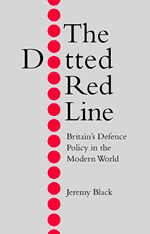 Being a Tory Historian, one is naturally interested in ideas that are Tory, rather than the more modern Conservative. Reading Professor Jeremy Black’s most recent book: “The Dotted Red Line” about British defence policy Tory Historian found the following interesting comments in the Introduction:
“[T]he distinctive Tory approach to defence began in the early days of the Tory party in England, at the close of the seventeenth century and in the opening decades of the eighteenth. Furthermore, defence and foreign policy were not then on the margins of party positions, but indeed were central to them. The Tory position was based on hostility to continental nterventionism associated with the rival Whigs; instead, the Tories counselled caution over foreign commitments, and particularly alliance politics and warfare on the European continent.”Interventionism on the European continent, the Tories judged, led to an increase in the army and centralized government, both politically dangerous. Instead, they focused on a “blue water” policy:
“an expansion of naval strength, and its use in the unilateral pursuit of national interest, and particularly in pursuit of maritime hegemony and colonial gains outside Europe.”These two, sometimes contradictory, sometimes complementary aims have continued to bedevil foreign policy decisions, in particular those made by the Conservative Party at various times.
 Unfortunately the National Gallery exhibition, Rebels and Martyrs – The Image of the Artist in the Nineteenth Century closed yesterday and Tory Historian, preoccupied with other matters, did not manage to see it until the last day.
The verdict: so-so. Some very nice pictures that we do not get to see very often, such as paintings by the Nabis group (though nothing by the Pre-Raphaelites who, though active later, had somewhat similar ideas) and a certain amount of information.
It is the information I have issues with. It was inadequate and unoriginal. Something like this: up to the second half of the eighteenth century artists were perceived to be little more than craftsmen and spent most of their time trying to rise in society. At that point, partly under the influence of the French Revolution and partly of new romantic ideas the concept of the artist and, particularly, the poet as a solitary genius outside society and misunderstood by it, was born. The artist no longer had ambitions within society but beyond it. This developed through the nineteenth century, taking different forms, such as the bohemian and the dandy, eventually acquiring the strange, almost mad attributes of the surrealist, the Secessionist and other ists of the twentieth century. Throughout all this, the artist was also seen as the martyr, tortured by the uncomprehending bourgeois society that also held the purse strings and the narrow-minded critic. Naturally, this artistic angst was linked to rebellion and left-wing politics.
That is a reasonable summary but leaves out rather a lot. For instance, what happened to irony? Is it not ironic that artists should profess to have ambitions beyond society and yet suffer so acutely when society misunderstood? The irony deepened with those artists who became quite successful. Some analysis along those lines would have been very welcome.
Then there is the question of politics. Undoubtedly, some artists, like Gustave Courbet became involved in left-wing politics, particularly the various French revolutions that culminated in the Paris Commune of 1870. But romanticism, as such, the precursor of all this rebellion and martyrdom was not necessarily on the left. Quite the opposite.
The romantics of the early nineteenth century in Europe were rebels against the ideas of the Enlightenment, the French Revolution and the Bonapartist regime. Though Napoleon himself became the idol of a number of them, the ideology he represented was alien.
Romanticism is individualistic; it emphasises individual people and nations – the precise opposite of the Enlightenment and of the French Revolutionary ideology that saw all development as one and all individuals as necessarily submissive to the Will of the People.
It is not coincidental that Romanticism placed so much emphasis on history with many of the artists, far from being forward looking and left-wing, turning their backs on the modern world. Even those who did not, looked at national history, at the differences between nations, at the need to keep those differences going. A very backward, conservative idea.
The left-wing aspect of Romanticism developed partially later on, as a response to the Treaty of Vienna and the European order established in the years after it. The nationalists of the 1830s and 1840s may have seemed radical but were, in fact, often harking back to an older order when their countries were independent and they had rights that had been destroyed by greater powers.
In other words, the concept of the Romantic Artist is a deal more complicated than the straightforward summary that the exhibition tried to convey. As it happens, Tory Historian also managed to see one of Sir Carol Reed’s superlative films made during the Second World War: “The Young Mr Pitt”. Robert Donat, acting with his usual under-stated sincerity, made William Pitt the Younger into a romantic hero, who sacrifices first his chance of happiness, then, effectively, his life for his country and the ideal of liberty.
The film itself purveyed another concept of Romanticism – liberty. The country that was fighting for it under Pitt and under Churchill, when the film was made, was Britain. What an irony for all those Continental Romantics.
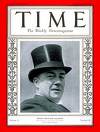 For various reasons Tory Historian is not a great fan of Stanley Baldwin (possibly that attitude has grown out of a long-held conviction that Lord Curzon ought to have become Prime Minister in 1923).
All the same, one must give credit where it is due and this is an excellent summary of what ought to be the mainspring of conservative political thinking:
"A government is not in power, it is in office, put there by the will of the people."Let us remember this every time some pipsqueak of a politician blathers on about the difficulties he or she faces in "running the country".
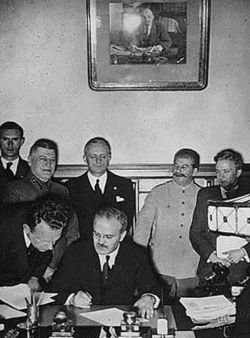 One of Tory Historian’s many weaknesses is an almost insuperable lack of interest in the actual military history of World War II. That is balanced by an abiding fascination with the politics around the various agreements before, during and after, particularly if these involved shenanigans to do with the great dictators.
Thus of the three anniversaries to be marked today – start of the Blitz (1940), start of the Battle of Stalingrad (1942) and signing of the Nazi-Soviet Pact (1939) – it is the last of them that is of particular interest.
The Pact, signed by Vyacheslav Molotov, who had replaced the Jewish Maxim Litvinov as Soviet Foreign Minister in May of that year and by Joachim von Ribbentrop, his German counterpart. Though it is sometimes referred to as the Stalin-Hitler Pact, the two tyrants never met.
The Nazi-Soviet Pact can be considered to be the real beginning of the Second World War. Whatever may have happened before that, once that was signed there was no way back. Though nominally a non-aggression treaty, it had secret clauses that referred to countries between Germany and the USSR falling into one or other sphere of influence.
In practice, that meant being invaded and there was a great deal of territorial rearrangement in the subsequent months.
The treaty stayed in force till June 22, 1941, that is Barbarossa Day, when Nazi Germany invaded what was then the Soviet Union (in fact, of course, eastern Poland, then western Ukraine that had been independent till 1938) and the deadly war between the two monstrous regimes began.
 Tory Historian sometimes finds it difficult to take the “martyrs” of the British labour or revolutionary movement seriously. There seems to be so few of them and so many potentially difficult situations are resolved peacefully in this country. Long may that continue.
Take the Tolpuddle Martyrs, for instance. Six of them and all came back after being deported. All that oppression during the French wars, real though it was, pales into insignificance when compared to what was going on in France at the same time. Think of how many people were killed in the suppression of La Vendée and in Lyons.
The one event that does merit sorrowful attention is the Peterloo Massacre of August 16, 1819, a clear example of panic and disorganization that resulted in 11 dead, one of them a woman, another a child carried by another woman and 400 injured. Still not on the La Vendée scale or the various massacres in Russia, let alone the Soviet Union, but something to talk about.
The most interesting part of it, however, is the outcome. The original meeting was called to advocate parliamentary reform, to widen the franchise. The horror of the Peterloo Massacre made those discussions more urgent, though it was not till 1832 that the Great Reform Act was passed, instituting a succession of constitutional reforms that would, in 1928 finally result in full and equal voting rights for all adults in the country.
Possibly a more important development was the move to establish civilian police forces in Britain, the most important of which was the Metropolitan Police Force, signed into existence on September 29, 1829. The Home Secretary, Sir Robert Peel, is said to have been greatly influenced by the events on St Peter’s Field, in August of 1819.
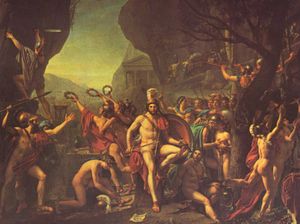 Tory Historian was brought up by an historian father, who had an overwhelmingly high opinion of western civilization and its progenitors, the Greeks of ancient times. Inevitably, the battles against the Persians, Thermopylae, Marathon, Salamis and Plataea were all names, familiar as household words (as the Bard said about another great battle).
Today is the anniversary of the Battle of Thermopylae. Well, to be quite precise, the anniversary of its beginning. The Greek army, led by the Spartan King Leonidas, held up the vast Persian army for seven days before finally succumbing to the overwhelming numbers.
The battle has remained an epitome of strength through patriotism, training and obedience as well as final sacrifice. The memorial on the battlefield, with the words of Simonides on it, says it all:
Oh foreigner, give a message to the LacedaemoniansThe battle may not have been successful from the Greek point of view but its length and the severe Persian losses allowed the Athenians to prepare for the subsequent, ultimately victorious fighting.
that here lie we, their words obeying.
 Michael Barone is one of the leading commentators in the United States and he seems to be something of an Anglophile. At least, he writes frequently and, usually, with approval on aspects of British life.
Here is his response, rather than review, to William Hague’s much lauded biography of William Pitt (readers will need to scroll down). Barone is greatly taken by Hague’s description of Pitt’s constant emphasis on the need for a long-term solution.
One of the most interesting aspects of the book, in Tory Historian’s opinion, is the special insight into the parliamentary activity of Pitt’s day that is given by a man with political and parliamentary experience.
It is outside the scope of this blog to comment on the politics of the Conservative Party as it is in 2006 rather than 1806, but one wonders what conclusions the author of this excellent biography has drawn to influence his own attitudes and statements as Shadow Foreign Secretary.
Charles Moore’s article in Friday’s Daily Telegraph dealt with the present Middle Eastern crisis and the somewhat incredible comparisons certain misguided British politicians (alas, the one he singles out is a great supporter of the CHG, Sir Peter Tapsell) have been making between Israel’s actions against Hezbollah and the German Nazis’ actions against the Jews in 1943.
Inevitably, Mr Moore looks at the background to the fact that, no matter which way one looks at it, European countries have next to no say in what is likely to happen in southern Lebanon or Gaza.
Part of the reason is recent politics and a refusal to understand that in order to be strong in international affairs one must be strong militarily but that is outside this blog’s scope.
However, all roads lead back to the Suez crisis:
“This week marks the 50th anniversary of the beginning of the last Middle East crisis in which Britain acted without concerting with America. On July 26, 1956, Gamal Abdel Nasser, the president of Egypt, nationalised the Suez Canal. Britain accounted for a third of the ships passing through the canal at that time, and we feared that Nasser had put his foot on our windpipe. Eden, perhaps reeling from his good fortune in having employed the young P. Tapsell, concocted a secret plot with France and Israel to regain control of the canal by violence and bring about the fall of Nasser.
Ignoring the delicacies of a presidential election in America and a president, Dwight D. Eisenhower, who had publicly made it clear that his country opposed force, we went ahead and invaded Egypt on November 5. Furious at having been deceived, America immediately refused to support the pound in the markets, and we crumpled almost overnight.
The then chancellor, Harold Macmillan, who supported the attack from the first but ratted on it in November, wrote in his diary on August 18: "…if Nasser 'gets away with it', we are done for… It may well be the end of British influence and strength for ever." Well, Nasser did get away with it, and British power in the Middle East did collapse.
We have now passed half a century in which the ultimate responsibility for these decisions has passed from us (and from France) to America. Unless we seriously propose to try to regain that responsibility, either alone or in concert, we do well to try to work closely with America rather than acting like a querulous octogenarian. Mr Blair's efforts in Washington yesterday to search for a ceasefire that prefers durability over immediacy are perfectly sensible.
Yet Mr Blair is bayed at by all parties and most of the media. It is as if, having relinquished power, we Europeans now wish our own powerlessness upon the rest of the world. We make vaporous and offensive Nazi comparisons. We preach that unilateral action is always wrong. That position can be maintained only by people who do not have to make life-and-death decisions. It is cheap and immoral.”
Who says we can learn nothing from history?
 It is a little unfortunate that Tory Historian was so busy on other matters as to miss one of the crucial dates for this country and the Conservative Party in the twentieth century.
Thursday saw the fiftieth anniversary of President Gamal Nasser’s nationalization of the Suez Canal. This act, in itself not unexpected, triggered off what turned eventually into a political crisis in Britain and made it clear to all the participants that the war-time alliance between Britain, France and the United States was no longer active.
It also led to the resignation of the Prime Minister, Anthony Eden.
We hope to see serious discussion on this blog in the next couple of months about the events that led up to the attempted invasion of the Canal by Britain, France and Israel and what the significance of those events might be. But, in the meantime, we could not pass the anniversary of the event that began it all, unmarked.
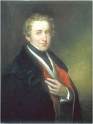 Yesterday Tory Historian attended a wonderfully interesting meeting of the Conservative History Group on the subject of Chamberlain’s reputation. A write-up of that will follow as soon as it is practicable.
Central to our understanding of the crisis that took up the second half of 1938 is the double appreciation that despite the fact that Churchill wrote the history of the period, Chamberlain was probably right politically and from the point of view of defence matters; and that he had public opinion on his side.
This led me to an interesting comment made by Sir Robert Peel:
“No minister ever stood, or could stand, against public opinion.”It is not so much public opinion that remains the problem more its expression by the media and other political interpreters. In Peel’s day there were still those immediate expressions of public opinion, the mob and the meeting. Over the last few decades both have largely disappeared. On the other hand, we now have the growing power of the blogosphere (still in its infancy in Britain) that might turn into another weapon of public opinion that circumvents its “interpreters”.
“Public opinion is a compound of folly, weakness, prejudice, wrong feeling, right feeling, obstinacy, and newspaper paragraphs.”As the French so aptly say: plus ça change, plus c’est la même chose.
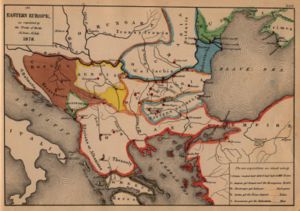 Disraeli again, I am afraid (there will be postings about Peel and others, I promise), as today is the anniversary of the signing of the Treaty of Berlin, the ending of the month-long Congress of Berlin in 1878.
“The treaty recognised the complete independence of the principalities of Romania, Serbia and Montenegro and the autonomy of Bulgaria, though the latter remained under formal Ottoman overlordship and was divided between the two principalities of Bulgaria proper and Eastern Rumelia, undoing Russian plans for an independent "Greater Bulgaria". The Ottoman province of Bosnia-Herzegovina as well as the former Sanjak of Novi Pazar were placed under Austro-Hungarian occupation, though formally remaining a part of the Ottoman Empire.”One could argue that the treaty launched many of the problems that culminated in the First World War and the subsequent unstable peace treaties but that would be a little unfair to the Earl of Beaconsfield whose negotiating skills elicited Bismarck’s admiring comment: “Der alte Jude, das ist der Mann.”
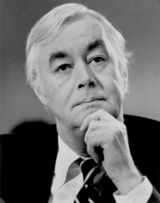 Whenever I want to get depressed about American rather than British politics (well, after all, isn’t that what being Tory Historian is all about?) I think about the fact that Hillary Rodham Clinton is the successor to Daniel Patrick Moynihan as New York Senator.
Moynihan was a Democrat and it is useful to recall that until recently the division between conservative and “liberal” thinking was not along party lines. Moynihan, for instance was a man who believed in freedom internally and externally, individual responsibility and small government.
I particularly like this quotation that, I hope, will elicit comments from readers.
“The central conservative truth is that it is culture, not politics, that determines the success of a society. The central liberal truth is that politics can change a culture and save it from itself.”Where does the British Conservative Party fit in that equation?
 Undoubtedly many of this blog’s readers will disagree with it celebrating American Independence Day. It is undoubtedly true that at the time many Tories opposed the presumptuous Colonists’ Rebellion and it was a Whig, though one who has been seen as one of the founders of Conservative political thought, Edmund Burke, who spoke most eloquently in their favour.
It is, however, the 230th anniversary of the ringing proclamation of what can be seen as modern conservative values:
“We hold these truths to be self-evident, that all men are created equal, that they are endowed by their Creator with certain unalienable Rights, that among these are Life, Liberty and the pursuit of Happiness.--That to secure these rights, Governments are instituted among Men, deriving their just powers from the consent of the governed, --Whatever one’s views are on the Colonists’ Rebellion; whatever one’s views are on the way the United States developed in the eighteenth century and subsequently; few of us can fail to be touched by those words.
That whenever any Form of Government becomes destructive of these ends, it is the Right of the People to alter or to abolish it, and to institute new Government, laying its foundation on such principles and organizing its powers in such form, as to them shall seem most likely to effect their Safety and Happiness.
Prudence, indeed, will dictate that Governments long established should not be changed for light and transient causes; and accordingly all experience hath shewn, that mankind are more disposed to suffer, while evils are sufferable, than to right themselves by abolishing the forms to which they are accustomed. But when a long train of abuses and usurpations, pursuing invariably the same Object evinces a design to reduce them under absolute Despotism, it is their right, it is their duty, to throw off such Government, and to provide new Guards for their future security.”
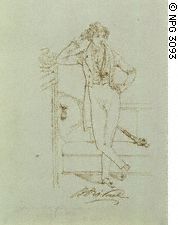 A long article on Benjamin Disraeli in the New Yorker by Adam Gopnik, loosely linked to the two most recent biographies: Christopher Hibbert’s “Disraeli: The Victorian Dandy Who Became Prime Minister” and William Kuhn’s “The Politics of Pleasure: A Portrait of Benjamin Disraeli”.
The article concentrates on Disraeli as adventurer who has lived his own dream and links him in various ways to modern politics. Specifically, there is a discussion as to whether he is the progenitor of Anglo-American conservatism of the present.
Mr Gopnik comes to the conclusion that he is not but his analysis of what the latter consists of is so inadequate as to make that conclusion questionable. Does he really understand what happened in Britain in the eighties and the nineties?
“Mrs. Thatcher’s ideological brilliance was to insist on Manchester-school politics to the exclusion of all else; the people who brought her down were the heirs of Disraeli, anxious about her rejection of the public welfare and more than a little snobbish about her openly middle-class antecedents.”Up to a point Lord Copper, as they said in Evelyn Waugh’s “Scoop”.
 Re-reading Harold Nicolson’s diaries for 1938 as part of separate research, I came across the entry for June 27:
“Anthony Crossley [Conservative MP for Oldham] takes me to task for being so anti-Chamberlain. He says I am working for his fall. He says that the Conservatives realise this and simply hate me. I say, ‘But surely, Anthony, they are always so polite when I meet them?’ ‘Yes,’ he answers, ‘that is part of their technique.’”Nicolson is generally acknowledged to be one of three members of the House (Churchill and Leo Amery being the other two) who opposed consistently the Munich Agreement and refused to cheer when the Prime Minister reported back on it.
“How difficult it is to decide! Vita takes the line that the Sudeten Germans are justified in claiming self-determination and the Czechs would be happier without them in any case. But if we give way on this, then the Hungarians and the Poles will also claim self-determination, and the result will be that Czechoslovakia will cease to exist as an independent State.By and large Vita Sackville-West was not interested in politics and could not be bothered to work her way through the various arguments often reacting emotionally to events. In this case, however, she managed to articulate the argument that was used by many people and quietly approved of by many more.
Vita says that if it is as artificial as all that, then it should never have been created. That may be true, although God knows how we could have refused to recognise her existence in 1918. It all seemed such a reality in those days.”
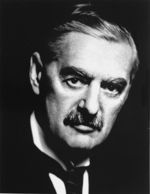 The next speaker meeting of the Conservative History Group will be held on Tuesday 18 July at 6.30pm in the Boothroyd Room of the House of Commons. The subject will be "The Reputation of Neville Chamberlain". Speakers are Robert Self and Professor John Charmley. If you'd like to attend please email info@conservativehistory.org.uk to register. If you're not already a member you will be expected to join on the evening!
 This posting may be seen as perhaps being somewhat irrelevant to Conservative history but it covers a subject that is so important that Tory Historian took a unilateral decision on posting it.
Today is the 65th anniversary of what turned out to be the crucial event of the Second World War – the German invasion of the Soviet Union, carried out despite the vows of eternal friendship of the 1939 Molotov – Ribbentrop Pact. It was the start of that monumental battle between the two most monstrous regimes of European history.
The one person who recognized fully the importance of the invasion was the Prime Minister, Winston Churchill, who displayed more relief at the turn of events in the immediate aftermath than he was to do even after America’s entry into the war.
Curiously enough, Stalin, who had never trusted anybody in his political career (and probably not before that, either) seems to have trusted Hitler. There are numerous accounts of his refusal to believe the news of the Nazi attack as it was being brought to him. He had, previously, refused to believe warnings sent to him by the British government and his own agents in the West that Hitler was planning an attack and probably in June.
There are various accounts of what happened immediately in the Soviet government and the top echelons of the party but, it seems, that panic set in and there was an immediate decampment from Moscow. Stalin’s greatest fear, shown in his refusal to set up a home guard as the capital itself became endangered during the autumn, was that people might turn against him.
This was not completely wrong. 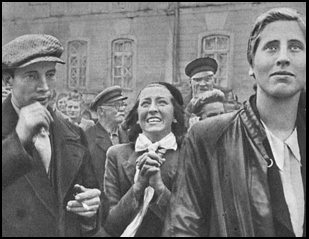 The people of Russia and other states of the Soviet Union are no less patriotic than anyone else but they had suffered considerably more from their own government than others. The propaganda picture of the people of Riga welcoming German invaders does not tell a complete lie. The German troops were welcomed at first in the Baltic states, in Byelorussia (now Belarus), in the Ukraine and even Russia itself.
We have to remember that it is not accurate to say that Germany invaded Russia in June 1941. They did not get to Russia itself for a number of weeks, despite the fact that the troops rolled forward unchecked, the air force had been destroyed and the trains that ought to have been bringing troops to the west were fully occupied carrying prisoners from the newly conquered countries to the east.
When the German troops crossed the border they were crossing from western to eastern Poland, both of which had been devastated by the two separate invaders. They then moved into the Baltic states who had lost around a third of their population into the Soviet gulags, moved on the Byelorussia and the Ukraine, both of which had suffered unspeakably from collectivization and the purges of the late thirties.
The Germans were seen as liberators and their drive to round up and murder the Jewish population was not always unpopular. Though many people, as in other countries, tried to help their Jewish neighbours and friends, many others saw the destruction of the Jewry as a just punishment for the fact that the Communist power, as they thought, had been imposed largely by Jews. Alas, there are too many people in that part of the world who still think that way.
While many in the higher echelons of the German army felt that they should capitalize on these feelings, disband the collective farms and install autonomous local governments, the Nazi ideology prevailed. The Slavs were also described as untermensch and treated accordingly. The horrors of the Nazi occupation of large chunks of the Soviet Union have been described by many.
Stalin’s own reaction was interesting. He first broadcast to the people on July 4. My mother, who was a teenager in Moscow at the time, has told me that his appeal to “brothers and sisters” caused panic. Things were far worse, the Russians reasoned, than anyone had told them if the old tyrant saw them as his brothers and sisters.
This is not the place to describe the subsequent developments of the war on the eastern front but a few aspects might be recalled, as we are often told that the EU is a direct and necessary reaction to the evil nationalism of, well, somebody called the Nazis.
We need to remember Stalin’s refusal to sign the Geneva convention and refusing to see Soviet PoWs as nothing more than traitors. All offers to help them by the Red Cross and the British government were refused. The severe maltreatment by the Germans of the Soviet prisoners cannot be excused but neither can Stalin’s own refusal to help.
We need to remember the lines of Smersh (Smert’ Shpionam – Death to Spies) machine gunners who stood behind the Soviet troops, mowing down those who tried to retreat from the German onslaught.
And we must recall that it was Stalin’s appeal to pure patriotism that made the Russians and many others fight on against all odds and through unimaginable losses until the victory of 1945.
We must also recall the nationalism of many other countries who fought the Nazis and its suppression by the Soviet “liberators”. The story of the doomed Warsaw uprising is just one of several one could recite.
Another 40 years elapsed before the second tyranny was overthrown.
The next issue of the Conservative History Journal will be out in just a couple of weeks. Almost all the material has now come in and the editor is busy doing the final bits of editing as well as looking up illustrations. So, for all those folks who are starved of intellectual entertainment: help is on its way.
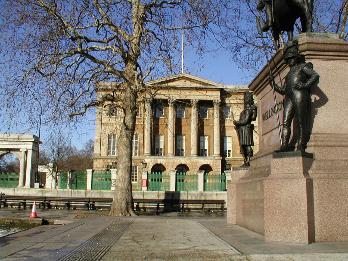 Yesterday, as all our readers know without doubt, was Waterloo Day and time for Tory Historian’s annual pilgrimage to Apsley House, where a great deal of jollification seemed to be going on.
Firstly, there were guards in appropriate uniforms; the Battle of Waterloo had been laid out on a large table in the Waterloo Gallery and enthusiastic children were helping no less enthusiastic adult experts to put away the model soldiers; there were also guided tours with good accounts of the battle and the history of the house, all listened to with rapt attention by other children and, naturally enough, their parents.
All of which makes me go off on that well-worn tangent: the teaching of history. For once, I’d like to concentrate not on the disgraceful lack of teaching in schools but on the assumption made by too many writers and organizers of events that the only way children’s interest can be kept is by jokes, hectic entertainment and as little information as possible. Some museums, I am sorry to say, have taken that view recently as well – entertainment rather than education.
But all evidence shows that interestingly presented historical information can capture and usually keep children’s attention. Why should they not find the Battle of Waterloo or the Napoleonic Wars in general interesting? The novels based on those wars sell in their millions. The reality is considerably more exciting.
Last year, when the anniversary was slightly more round that this year I became involved in an argument with a fan of the Emperor from the Continent. His argument was that, writing from a British point of view, I naturally assumed that the man’s defeat was a good thing for Europe and for freedom. But Britain was fighting not just for her existence as a country but also from a political and legal system that, despite the various problems, was more advanced than any of the Continental ones.
Even so, as Andrew Roberts points out in his “Napoleon and Wellington”, there were politicians and writers who, despite Napoleon’s growing despotism continued to support him against their own government, which happened to be of another party. Shades of more modern political and military debates there.
On the Continent, my correspondent maintained, the situation was different. With all his faults Napoleon was bringing some of the still untarnished ideas of the French Revolution with him – enlightenment, freedom of religion, destruction of feudalism. His defeat reversed all those processes, at least temporarily and returned power to feudal overlords.
What of the national wars of liberation, I asked, fought with increasing ferocity in several parts of Europe? That, too, in his opinion, was led by the local aristocracy who saw their power slipping away.
As they used to say in exam papers: discuss.
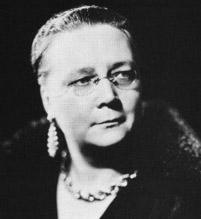 The fact that today is the birthday of one of the best-known detective story writers, Dorothy L. Sayers (1893 – 1957), gives me the chance to make a little detour in conservative history, not entirely unexpectedly, in the direction of that literary genre.
I have already expressed the view that the classic detective story is a peculiarly conservative form of literature, whatever the political views of the author (Julian Symonds, for instance, was one of the plethora of left-wing men of letters) and whatever the particular point of view expressed in the novel.
A detective story depends on the existence of a society that understands certain basic rules. In fact, everybody must understand and more or less agree on those rules, including the criminal. And the most important of those is that human life is not to be taken by another human being. That is a crime against nature as well as against society. The natural order of things can be restored only by the apprehension and punishment (in some form or other) of the criminal.
Dorothy L. Sayers is not, as it happens one of my favourite detective story writers. She was too verbose, too snobbish and there was more than a trace of anti-semitism in almost all her novels. There were many other aspects to her literary work – her religious as well as literary essays, a religious play for the BBC and, of course, her translation of Dante.
Still, she is mostly known as the writer of the Lord Peter Wimsey books (and a few stories with Montague Egg). Interestingly enough, the book that implicitly explores a conservative view of the world is one that does not have a murder in it, and that is “Gaudy Night”.
A tale of various ill deeds in an Oxford College, modelled on Somerville, it deals with subjects such as whether women should pursue careers or devote their lives to families; and whether personal relationships are of greater importance than the truth in academic pursuit.
There are many problems with the book, not least the fact that it is too long. But it does provide a vision of conservatism that is almost political: balance between the various factors. Balance between rationality and imagination, between the need to pursue career and the need to give to one’s family and, above all, balance between devotion to impersonal truth and devotion to individual human beings.
 It wasn’t all that long ago but seems to have been forgotten in the rush to declare the Conservative Party of the past the nasty party and its members, people who were barely seen to be human by the rest of the population. Really? How did that nasty, much-hated party of non-human aliens manage to win four elections, producing at least one landslide in 1983?
On June 9, the party led by Margaret Thatcher, took 397 seats to Labour’s 209 with the SDP Liberal Alliance managing 23. Michael Foot, presumably not wearing his famous donkey jacket, called the result a tragedy for the country. Well he would say that, wouldn’t he?
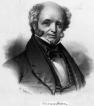 Thanks to the American correspondents of this blog we have another interesting opinion on what is the oldest political party in the world (not to be confused with the "oldest established permanent crap game in New York"). This is from Michael Barone of U.S. News & World Report, one of the best American journalists and commentators writing at present.
"My money is on the Democrats being formed in 1832 (Martin Van Buren's first Democratic National Convention) and the British Conservatives in 1846 (when Disraeli left Peel over repeal of the Corn Laws and led the Conservatives into 20 years in the wilderness; I'm following Lord Blake)."Hmmm. Martin Van Buren again. That man was responsible for a great deal in modern politics, including the expression OK, which came from the OK or Old Kinderhook (Van Buren's nickname) Clubs of his supporters.

A sign of this blog's success is the fact that our readers are offering their own articles for posting, in the hopes that further discussion will be generated. This one is by Tim Roll-Pickering, who has his own blog on matters political.
The Liberal Party was founded in 1859. Labour in 1900. The Liberal Democrats in 1988. Or looking further afield, the US Republicans in 1854, the Irish Fine Gael in 1933 and the Australian Liberal Party in 1945.
But what year was the Conservative Party founded? And is it truly "the oldest political party in the world"?A variety of dates are on offer, but for the purpose of this piece the biggest question is just how far today's Conservatives are the old Tory Party continued?
(One could also ask if there was a single Tory party between the 1670s and the 1830s, encompassing all of Harley and Bolingbroke, Bute, North and Pitt the Younger. Fortunately for our purposes this does not cause a problem when comparing with the dates for the US Democrats.) The Pittite Tories dominated British politics from the 1780s until the 1830s, but from 1827 onwards they fell apart under the leadership of Canning, Goderich and Wellington.
In the 1830s Peel sought to build the new force of Conservatism on a wider basis than in previous years - but was it merely the Tory Party by another name or a new party that took the place of the old?
With no formal constitution there is nothing one can look to for a simple resolution. The continuing use of the term "Tory" as a shorthand or abuse for Conservatives creates the impression of the two being one and the same, even when members in later generations felt very sure of the difference between the two words. Was this a new party? If so then it is to the early 1830s that the Conservatives' foundation can be dated.
However, dating the formation of the Party at any point after the accession of William IV removes the claim that it is the oldest in the world.The US Democrats also have a claim here. Their foundation date is equally confused by their relationship to earlier parties. Today they cite 1792 as their foundation date, claiming to be a direct continuation of the Jeffersonian Republican Party.
Others have argued that they were founded in the 1820s when the original Republican Party fragmented. Since all this falls between the 1783 and 1830s dates for the Pittite Tory Party, this is less of an issue in this dispute. What remains is the question of whether or not Peel's Conservatives were the continuation of the Pittite Tories and what date can be cited for the party's foundation.
And there is one other matter that is sometimes overlooked. The foundation of the Liberal Democrats is invariably dated to 1988 due to the merger of the Liberals and Social Democrats. What about the 1912 merger of the Conservatives and Liberal Unionists to form the "Conservative & Unionist Party"? Can one make a consistent case to accept the former and ignore the latter?
John Barnes, who is a notable historian of the Conservative Party (and knows every detail of it, so far as I can make out) has sent this piece about Sally Ward, an undeservedly little known Conservative woman politician in the hopes that it will stimulate discussion on the subject, which will, in due course, influence the autumn edition of the Journal:
Alderman Mrs Sally Ward was for one term Member of Parliament for Cannock. As a farmer’s wife, she spoke regularly in debated on agriculture and became known as “The Farmer’s Wife MP”. She attempted to return to the House after the Second World War, but was unsuccessful in both the 1950 and 1951 General Elections. Thereafter she contented herself with service on the Staffordshire County Council and was elected to an Aldermanic seat. Small in stature she was a lively personality and a forceful platform speaker. She played an active part in the politics of the Walsall north Conservative Association, serving as its President.
Sarah Adelaide Ainsworth was born on Christmas Day in 1895. She was educated at the Orme Girls' School in Newcastle and during the First World War served as a VAD nurse. She married a farmer, William Ward, in 1921 and they had one child. They farmed at Walsall Wood.
She was elected for Cannock in the 1931 General Election and was defeated in 1935. During the Second World War she served from 1940 to 1943 as a Commander in the ATS serving with the Royal Artillery. After the war she was appointed to the staff of the Ministry of Labour where she dealt with welfare in industry. Her attempts to return to national politics were unsuccessful.
Adopted for Lichfield and Tamworth, she was defeated in February 1950, polling 24,681 votes but losing by 4,518. Sensing that she was unlikely to take the seat even though she was the local candidate, she turned her attention to Birmingham Perry Bar. In October 1951 she again went down to defeat in a straight fight and thereafter she concentrated on local politics. She had been elected to the Staffordshire County Council in 1950 and from 1956 until 1964 she chaired the Welfare Services Committee.
She was awarded an OBE in 1952 and made a CBE in 1961. She remained on the County Council until her death on 9 April 1969.
