

The Codebreaker Girls – Only 99c!
2 months ago
 Tory Historian was once again taking time off and almost missed this extraordinarily witty and touching tribute in the Economist to Bill Millin, the man who piped in the D-Day landing at Sword Beach and who died on August 17, aged 88.
ANY reasonable observer might have thought Bill Millin was unarmed as he jumped off the landing ramp at Sword Beach, in Normandy, on June 6th 1944. Unlike his colleagues, the pale 21-year-old held no rifle in his hands. Of course, in full Highland rig as he was, he had his trusty skean dhu, his little dirk, tucked in his right sock. But that was soon under three feet of water as he waded ashore, a weary soldier still smelling his own vomit from a night in a close boat on a choppy sea, and whose kilt in the freezing water was floating prettily round him like a ballerina’s skirt.And so Mr Millin piped through that terrible advance and into Normandy.
But Mr Millin was not unarmed; far from it. He held his pipes, high over his head at first to keep them from the wet (for while whisky was said to be good for the bag, salt water wasn’t), then cradled in his arms to play. And bagpipes, by long tradition, counted as instruments of war. An English judge had said so after the Scots’ great defeat at Culloden in 1746; a piper was a fighter like the rest, and his music was his weapon. The whining skirl of the pipes had struck dread into the Germans on the Somme, who had called the kilted pipers “Ladies from Hell”. And it raised the hearts and minds of the home side, so much so that when Mr Millin played on June 5th, as the troops left for France past the Isle of Wight and he was standing on the bowsprit just about keeping his balance above the waves getting rougher, the wild cheers of the crowd drowned out the sound of his pipes even to himself.
Three times therefore he walked up and down at the edge of the sea. He remembered the sand shaking under his feet from mortar fire and the dead bodies rolling in the surf, against his legs. For the rest of the day, whenever required, he played. He piped the advancing troops along the raised road by the Caen canal, seeing the flashes from the rifle of a sniper about 100 yards ahead, noticing only after a minute or so that everyone behind him had hit the deck in the dust. When Lovat had dispatched the sniper, he struck up again. He led the company down the main street of Bénouville playing “Blue Bonnets over the Border”, refusing to run when the commander of 6 Commando urged him to; pipers walked as they played.In the comments to the article there is information about a projected memorial to Billy Millin and his bagpipes at Pegasus Bridge.
He took them across two bridges, one (later renamed the Pegasus Bridge) ringing and banging as shrapnel hit the metal sides, one merely with railings which bullets whistled through: “the longest bridge I ever piped across.” Those two crossings marked their successful rendezvous with the troops who had preceded them. All the way, he learned later, German snipers had had him in their sights but, out of pity for this madman, had not fired. That was their story. Mr Millin himself knew he wasn’t going to die. Piping was too enjoyable, as he had discovered in the Boys’ Brigade band and all through his short army career. And piping protected him.
Tory Historian was enthralled by the story of the marine who first served in the Anglo-Sudan war, went on to the Western Front in the First World War, retired but felt he could not live without serving his country so he spent 18 months in the Royal Irish Constabulary.
During the inter-war years he was appointed skipper of a private ocean-going yacht and in 1929 undertook and led a big game hunting party in central Africa.Good grief!
At 63, he got involved in the Spanish Civil War, joining the Spanish non-intervention Organisation as a sea observation officer and helped escort ships into Spanish ports.
At the outbreak of World War Two in 1939 he volunteered for service aged 64 and was commissioned and made responsible for security at the Admiralty.
He won the Defence Medal and War Medal and in 1945 he resigned his commission shortly before his 70th birthday. He died at his Suffolk home in 1968 aged 93.
Here is an interesting quote from an article Noel Skelton published in the Spectator on May 3, 1924, entitled Private Property: A Unionist Ideal.
It follows that the extent of the distribution of private property is the measure, on its economic side, of a civilization's stability and success. Similarly, character and a sense of responsibility are rooted in a man's possession of 'something of his own'. A democracy withoug scope for the development of economic character and responsibility, cut off from private ownership, cannot be expected to understand the material foundations of civilization.This is the exact opposite of the idea that reliance must be put on the state and property should be held by it in the people's name and for the people's good.
A delightful collection of colour photographs taken in Russia in the early twentieth century by the chemist and photographer Sergey Prokudin-Gorsky, who had made numerous innovations in photography and started a systematic photographic documentary of the Russian Empire. About half of the photographs and plates were confiscated by the authorities when Prokudin-Gorsky left the Russia in 1918 to settle eventually in France where he continued his work. The remaining half is now in the Library of Congress. Here are some more of the images. There are so many and they are so fascinating that choosing one seems impossible.
 Tory Historian has, once again, been out of action and, therefore, a few dates have not been noted. August 21 was the anniversary of the birth of the last Hanoverian king, William IV and August 22 was the anniversary of the death, in battle, of the last Plantagenet King, Richard III. Tory Historian seems to have written about him several times (far too often some readers might say). Here is the link to all the postings on the subject.
This is actually a quotation within the book. Richard A. Gaunt in his Sir Robert Peel - The Life and Legacy quotes an obituary from Blackwood's Edinburgh Magazine of September 1850:
The death of Sir Robert Peel was an event so sudden, so unexpected, and so distressing that it excited a universal feeling of sympathy in the British heart, and stilled for a season every voice but that of melancholy among the immense multitudes to whom his public career had made him known. It stifled, during the first paroxysm of grief, even the loud wail of national distress: it obliterated the deep lines of party distinction: it caused to be forgotten the most painful feelings of extinguished confidence. All classes hastened to pay tribute to the eminent statesman who lay extended on the bed of premature death ... But there is a time for all things. There is a time for sorrow, and there is a time for justice. There is a season for sympathy with the agonised hearts of mourning relaties, and there is a season for calm reflection on the acts of public men. Death at once renders them the province of history.As to how long the gap between the sympathy and the calm reflection ought to be is hard to judge. Indeed, we have no clear views on it and never have had. Much depends on the attitude one takes to the particular public figure.
This comes from David Torrance's Noel Skelton and the Property-Owning Democracy and concerns the founding of the 1922 Committee and the death of a coalition.
The Carlton Club meeting of 1922 was integral to the development of the Conservative Party as a more democratic organisation, and to a country struggling to come to terms with the realities of the post-war era. A revolt by a group of junior ministers was the first hint that something was afoot, and in October backbench Conservatives decided to overthrow their leader, Austen Chamberlain, and withdraw from the coalition. Following speeches from Andrew Bonar Law, a Canadian Scot, and Stanley Baldwin, a half-Scots laird who affected a 'man of the people' image, MPs voted 185 to 85 in favour of discontinuing the six-year coalition and filed out of the Pall Mall club to face the consequences. It triggered an immediate general election and marked, in effect, the beginning of modern British politics.One has to admit that several events are described as marking the beginning of modern British politics so one need to take them with a pinch of salt. Nevertheless, there is some truth in it.
 World War II ends definitively with Japanese surrender. On August 15 the Emperor broadcast to the people of Japan announcing this fact. Some Japanese soldiers and officers, shocked by the surrender and by the actual fact of the Emperor's broadcast, committed suicide. It was later established that the execution of Allied POWs continued for some time.

The Conservative History Group wants to publish the next issue of the Conservative History Journal at the end of November. So, here is your chance to contribute an article on any aspect of conservative history - not just the party or the politicians but other topics; not just in Britain but in other countries. The glory of being a published author awaits you.
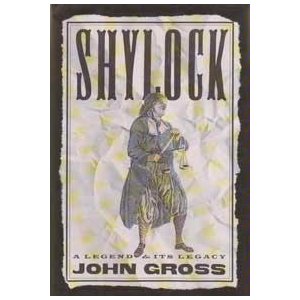 Tory Historian has been wading into literary studies of a kind by reading a fascinating book by that well-known man of letters, John Gross, on Shylock (a review in the Independent). Among other many fascinating things even in the first third, Tory Historian found this aperçu:
Between them, Antonio and Shylock represent two extreme versions of Economic Man, one benevolent, the other malign. Jekyll-Antonio embodies the fantasy that you can enjoy the benefits of economic enterprise and confer them on your society, without being competitive and self-assertive. Hyde-Shylock is the capitalist as total predator conferring good on no one except himself. They are twin aspects of the same phenomenon; and a tremendous amount of the play's energy is pent on keeping them apart.Antonio is the merchant of the title who has trading interests all over the world and is known for lending money without interest, which annoys Shylock for the very good reason that it undercuts his own business and that of people like him.
 From the USS Augusta, in mid-Atlantic President Harry S Truman announced the dropping of the first atomic bomb on Hiroshima. It was dropped from an American B-29 Superfortress, known as Enola Gray. The second picture, from DefenseImagery.mil and reprinted with their permission, shows an aerial view of the USAAF North Field on Tinian Island from which B-29 bombers flew throughout World War II. That included the two that flew to Hiroshima and Nagasaki.
 The two bombs undoubtedly brought the war in the Pacific to a much speedier conclusion and inaugurated a completely new age in military thinking and international affairs.
Reading David Torrance's book about Noel Skelton I came across a number of quotes from various Conservative (and, funnily enough, Labour) politicians, all in their own way exhorting the idea of "property-owning" democracy. John Buchan, who was also a long-standing friend of Skelton's, put it most succinctly in my opinion:
In a 1933 speech Buchan said he "believed in a property-owning democracy. Unless a man owned a certain amount of property he could not have real freedom. The vital task before a civilized state was not to do things for a man, but to put him in a position to do things for himself".This theme continues to resonate both in Britain and developing countries where, it has now been accepted by many people, though not by governments or NGOs, nothing will improve until the idea of property becomes a strong basis of economic life.
Tory Historian's attention was called to a review in the Wall Street Journal of a book that will be borrowed from London Library at the first possible opportunity: Joel Mokyr's The Enlightened Economy. The reviewer, Trevor Butterworth who is the editor of STATS.org and a columnist for Forbes.com, thinks this is the tome that should be read by all those who are interested in financial and economic matters.
The theme of the books is a question: why, of all European countries, many as advanced if not more so, it was Britain that had the Industrial Revolution?
Here is a paragraph from the review that points towards some of the answers:
But the power of knowledge would not, by itself, have given Britain its formidable economic edge; the Continent, too, had an array of scientific genius as brilliant as any in Scotland and England. (Think only of the French chemist Antoine Lavoisier.) The reason for Britain's exceptionalism, Mr. Mokyr says, lies in the increasing hostility to rent-seeking — the use of political power to redistribute rather than create wealth — among the country's most important intellectuals in the second half of the 18th century. Indeed, a host of liberal ideas, in the classic sense, took hold: the rejection of mercantilism's closed markets, the weakening of guilds and the expansion of internal free trade, and robust physical and intellectual property rights all put Britain far ahead of France, where violent revolution was needed to disrupt the privileges of the old regime.Rent seeking remains a constant problem, perhaps a greater one in the Britain of the twenty-first century than that of the eighteenth.
 On July 30, 1990 Ian Gow, Conservative MP, a strong opponent of the Anglo-Irish Agreement, an erstwhile close friend and colleague of Airey Neave's, a man who worked closely with the Prime Minister, Margaret Thatcher, was assassinated by a bomb planted under his car in his constituency. Direct violence entered British politics again as it had done with the assassination of Airey Neave.
In the Guardian Jonathan Aitken and Edward Pearce called him "a Thatcherite romantic" and said
With the assassination yesterday of Ian Gow, the House of Commons has lost one of its most admired and courageous characters. In government he had played a pivotal role in the making of the Thatcher revolution, while on the backbenches he was one of those rare parliamentarians who could captivate both sides of the House with a stylish humour that was sui generis.Mrs Thatcher lost one of her strongest supporters in her fight for her position though, apparently, Mr Gow had decided that her premiership had run to its natural close and she ought to resign. Perhaps, with him around the resignation and events surrounding it would not have been quite so messy. Perhaps.
David Torrance, author of the book about Noel Skelton that so fortuitously arrived in the post the other day, has an article in the Scottish edition of The Times (channelled here by his publisher BiteBack). He writes about the hero of his book, a man who was a Unionist, Scottish and British, a Conservative and the man who saw clearly the importance of property-owning democracy, which is the exact opposite of socialist re-distribution by the state in whatever form.
 The poet, essayist, MP, irascible Catholic, Hilaire Belloc was born on July 27, 1870 in France but became a British subject in 1902.
 As this is the Conservative History blog, perhaps one should stick to the political poems, few of whom are better than Lord Lundy [scroll down], who
from his earliest yearsWell, we know what happened to Lord Lundy:
Was far too freely moved to Tears.
It happened to Lord Lundy then,It was that terrible tendency to be far too freely moved to tears.
As happens to so many men:
Towards the age of twenty-six,
They shoved him into politics;
In which profession he commanded
The Income that his rank demanded
In turn as Secretary for
India, the Colonies, and War.
But very soon his friends began
To doubt is he were quite the man:
They let him sink from Post to Post,What could be more conservative and, therefore, anti-utopian and anti-political than Belloc's famous quatrain about an election:
From fifteen hundred at the most
To eight, and barely six--and then
To be Curator of Big Ben!. . .
And finally there came a Threat
To oust him from the Cabinet!
The Duke -- his aged grand-sire -- bore
The shame till he could bear no more.
He rallied his declining powers,
Summoned the youth to Brackley Towers,
And bitterly addressed him thus--
"Sir! you have disappointed us!
We had intended you to be
The next Prime Minister but three:
The stocks were sold; the Press was squared:
The Middle Class was quite prepared.
But as it is! . . . My language fails!
Go out and govern New South Wales!"
The accursed power which stands on PrivilegeReaders of the blog may well have other favourites. They are welcome to post them.
(And goes with Women, and Champagne and Bridge)
Broke and Democracy resumed her reign:
(Which goes with Bridge, and Women and Champagne)
Since the sixtieth anniversary of the beginning of the Korean War (too often forgotten by commentators) was marked by Tory Historian, it is worth pointing out that it ended on July 27, 1953 with the signing of a peace agreement at Panmunjom. It lasted three years and cost around 5 million lives.
... a very interesting looking book by David Torrance, a previous contributor to the Conservative History Journal, about Noel Skelton and property-owning democracy. Once I have read it I shall try to interview David for the Journal or the blog.
 Tory Historian remembers this very well, indeed. One of the great non-events of the year, for which we may be thankful, though questions were raised at the police handling of the planned but failed second series of blasts on the London tube.
Tory Historian returns with a round-up of recent finds in the historical and archaeological world.
Of greatest interest to TH is this collection of Victorian photographs of golfers playing at St Andrews.
Ladies are pictured wearing enormous frocks and wielding their clubs while spectators look on.The album was auctioned on July 13 by Mullock's Auctioneers at St Andrews as part of a Golfing Memorabilia sale.
The women were playing for the Ladies' Monthly Medal in September 1884 and the clubhouse can be seen in the background.
The distinctive sandy beach is also shown in some of the snaps of the course that will host the Open Championship later this week.
Other photographs show a match played between a pair of "strangers" and two locals.
 Now we need to move further back in history and in the news items. On July 5 it was reported that the earliest illustrated Bible has been found in an Ethiopian monastery and is being preserved by a British charity, the Ethiopian Heritage Fund.
recently unearthed a clay fragment dating back to the 14th century BCE, said to be the oldest written document ever found in Jerusalem.It is, indeed, a fragment but its historical significance may well turn out to be very big, indeed.
The minuscule fragment contains Akkadian words written in ancient cuneiform symbols. Researchers say that while the symbols appear to be insignificant, containing simply the words “you,” “you were,” “them,” “to do,” and “later,” the high quality of the writing indicates that it was written by a highly skilled scribe. Such a revelation would mean that the piece was likely written for tablets that were part of a royal household.That is not all. Nearer home, a huge treasure trove of more than 52,000 coins dating from the third century AD was found by that ever-useful person, a man with a metal detector near Frome in Somerset. Admittedly, the actual find was made in April but it has only just been announced because archaeologists from the British Museum have been working through it and local officials have been making comments about how wonderfully well the scheme they had set up for the finding of local treasures has been working.The find was uncovered in a fill taken from the Ophel area, which lies between the Old City’s southern wall and the City of David. The Ophel digs are being carried out by Dr. Eilat Mazar of the Hebrew University Institute of Archeology, through funding from US donors Daniel Mintz and Meredith Berkman of New York.
According to Mazar, the fragment was discovered over a month and a half ago during wet sifting of the Ophel excavations, but was only released to the press this week because researchers wanted to wait until analysis of the piece was complete so as to be absolutely certain of the details of the find.
The most ancient piece of writing found in Jerusalem before the Ophel fragment was a tablet unearthed in the Shiloah water in the City of David, dating back to the eighth century BCE – nearly 600 years “younger” than the Ophel find.
The remains of a thousand years of maritime trade, as well as the products of dozens of wars, are crumbling in the mud and silt at the bottom of the Baltic Sea. In addition to items with great cultural and historical value, the depths conceal the rusting remains of poison gas grenades, high explosive shells and aircraft bombs, all of which represent obstacles to pipeline construction. "It was not an easy situation," says Nord Stream spokesman Steffen Ebert. "We were under considerable time pressure."The Baltic Sea can yield all sorts of interesting objects, even champagne. Swedish divers found about 30 bottles of 220 year old bubbly in a shipwreck off the Island of Aaland.
