Andrew Roberts's parallel biography of Napoleon and Wellington, concentrating on the Battle of Waterloo (though the actual battle occupies but a chapter) deals with a number of fascinating subjects, including the posthumous reputations of the two men, both the various cults that have grown up around each and the far more interesting historical analyses.
There is no question that both were interested in how history would judge them. Napoleon seems to have spent his exile on St Helena not just in re-fighting Waterloo but in lining up ever changing culprits for his defeat. Oddly enough it was never the Duke, who, in Napoleon's view ought not to have done any of the things he had done or made any of the decisions he had made because they were clearly wrong. A clear example of the supposed French attitude of "yes, it may work in practice but does it work in theory?".
Wellington responded by analyzing at great length though only in private (in public he remained indifferent to the various barbs from Napoleon's worshippers and praised the man as a great general as well as an admirable reformer) the Russian campaign in which he pointed out every mistake Napoleon made as he had perceived them. The memorandum was published posthumously and may be said, according to Mr Roberts, to be Wellington's response to Napoleon's criticisms of Waterloo. There is an obvious difference between the two: Wellington was analyzing Napoleon's mistakes in a campaign that was a catastrophic defeat, Napoleon was analyzing mistakes made by the unquestioned victory of Waterloo.
There is some indication that Wellington may have inspired and even contributed to an important article in 1843 in "the foremost Tory intellectual publication of the day", the Quarterly Review, by Sir Francis Head, a regular contributor to the publication who had been at Charleroi and Waterloo, that destroyed several recent publications, including one by Clausewitz that "proved" that both Wellington and Blucher had been "surprised, outmanoeuvred, and out-generalled" by Napoleon.
In exile Napoleon was convinced that the Bourbons would have to recognize him and allot him necessary honour. It was the Orleanists who brought his body back to Paris and had it buried with great pomp and circumstance and very shortly after his conqueror's death, the nephew, Louis-Napoleon, proclaimed himself Emperor and apparently restored the legitimacy of the Bonapartist rule. Then again, it is better to draw a veil over the Second Empire and its less than glorious final demise.
Whatever the effects of Napoleon's rule and career, his ideas and and thirst for glory may have had on France and French history (and that, let us face it, a never ending discussion that cannot be fitted into one paragraph), Mr Roberts thinks that his political ideas were ultimately triumphant. Here are the final two paragraphs of this excellent book:
In one of his administrative rather than military phases, the first consul predicted that the Code Napoléon would be remembered long after his victories were forgotten. In the Prussian Rhenish provinces the Code lasted until 1900, and it still forms the basis of much of European jurisprudence today, a legal system that has already established its legislative primacy over British domestic law-making. As the authors of the 1993 edition of the legal textbook French Administrative Law point out: 'Napoleon may perhaps be thought of as the principal .... inspiration of the European Court [of Justice], which is itself buttressed by the principles of administrative law that his own institution, the Conseil d'Etat, has evolved during the last 190 years.Well, up to a point as Mr Roberts might admit today. (The book was published in 2001.)
Napoleon's programme, of a politically united Europe controlled by a centralised (French-led) bureaucracy, of careers open to talent and of a written body of laws, has defeated Wellington's assumptions of British sovereign independence, class distinctions and the supremacy of English common law based upon established, sometimes ancient, precedent. 'I wished to found a European system, a European code of laws, a European judiciary,' wrote Napoleon on St Helena. 'There would be but one people in Europe.' There is some irony in the fact that Waterloo was fought a mere twelve miles from Brussels, the capital of today's European Union. For, although Wellington won the battle, it is Napoleon's dream that is coming true.
Certainly the thinking behind the organization that has evolved into the European Union was just that: an imposition of a Napoleonic, French-led system on as much of Europe as can be managed. But things have not really turned out that way and the system is showing some signs of fraying, interestingly enough for the same reasons as the Napoleonic empire could not really have survived. In its own way the EU is also in need of further "conquests" though these are not achieved through warfare but economic and political force majeure and, more importantly for the future, there are strong signs of nationalist opposition to any further advances of the system. The dream of "but one people in Europe" remains just that - a dream.
First, I have to report that yesterday I went to the National Film Theatre to see a rarely (well, hardly ever) shown British film The Reluctant Widow, based on one of Georgette Heyer's Regency novels. Both Wikipedia and IMDB give a bizarre misinterpretation of what happens in the film, even calling the heroine Helena when she is Elinor. It is a little perplexing why anyone should put up a plot summary of a film they had not seen or know anything about. The summary of the book's plot shows that the film kept close to it with a few changes, some of which work and some of which are superflous.
Georgette Heyer disliked all that she heard about the film or saw when it was being made and she refused to see the finished product or sell the film rights ever again. That is a great pity as her books really cry out for dramatization. The film had all the Heyer atmosphere and characteristics as well as being highly entertaining (as are the novels). In addition, and Miss Heyer would have appreciated this, it is meticulously researched as far as design, clothes, uniforms, architecture and views of London is concerned. The Art Director responsible for that was Carmen Dillon, a woman of great stature who made her name in what was then a man's world, was the Art Director on some of the best known British films like The Importance of Being Earnest (for which she won the Best Production Design Award in Venice) and Richard III as well as winning the Oscar for the Art Direction of Hamlet, the first woman ever to do so.
The plot, which revolves round espionage during the 100 Days with an urgent despatch to the Duke of Wellington in Brussels stolen in London and having to be retrieved by the hero and, as it turns out, the heroine, inevitably takes one back to the subject of Waterloo. (Though, it would seem that the book's plot is about Wellington's plan to march in the Peninsula in 1813. Unquestionably, I shall have to read the book.)
Fortunately, there are many events and exhibitions that have to do with the anniversary and an excellent one is a free exhibition at the National Portrait Gallery, entitled Wellington: Triumphs, Politics and Passions.
As one would expect, much of the exhibition revolves round various portraits from very early ones to the famous 1844 daguerreotype. One of the big draws is the panoramic view of Wellington's state funeral in 1853 by Henry Alken and George Augustus Sala, which will be displayed in full for one hour on Thursday, June 18. At present one can see sections of it in the display case and in full on the screen above.
The funeral was watched by an estimated million and a half people and, as the notes say, reminded people of Wellington's days of glory, the somewhat more ambiguous record as a Prime Minister having been forgotten. One can draw certain parallels with the Churchill funeral of just over fifty years ago, as this blog wrote about it on the day of the anniversary. There is one important difference between the two farewells, both to great men, both symbols of their age: Wellington's victory in 1815 ushered in an age of British supremacy in the world in matters political, economic and ideological; Churchill's victory in 1945 saw the end of that age. Farewell to him was also a farewell to that.
Of particular interest were portraits and paintings by soldiers and young officers who were with Wellington in the Peninsula. Edmund Wheatley, a junior officer in the King's German Legion kept a diary and sketchbook for his fiancée, later wife, that has since been published. Wheatley was at Waterloo as well and left his account of that, too, as well as some pictures.
Thomas Staunton St Clair, an officer in the 94th Regiment of Foot, sold his sketches to a consortium of London publishers.
Other officers invited artists to paint battle scenes or portraits.
The most interesting couple of exhibits in the section on Waterloo are the two prize winners in a competition announced in 1815 by the British Institution on the theme of "successes of the British army". The winning entry was a truly hideous work by James Ward, entitled Waterloo Allegory for which I can only find the design as an illustration.
Possibly, the sheer hideousness of the work made the British Institution re-think matters and, unexpectedly, they announced a second prize, which went to George Jones, a former soldier though also a professional artist, who produced an interesting and fairly realistic painting that centred on the Duke of Wellington. George Jones, it seems, was so taken by the theme that he kept painting it over and over, earning the nickname "Waterloo Jones". To be fair, he also painted other wars and campaigns.
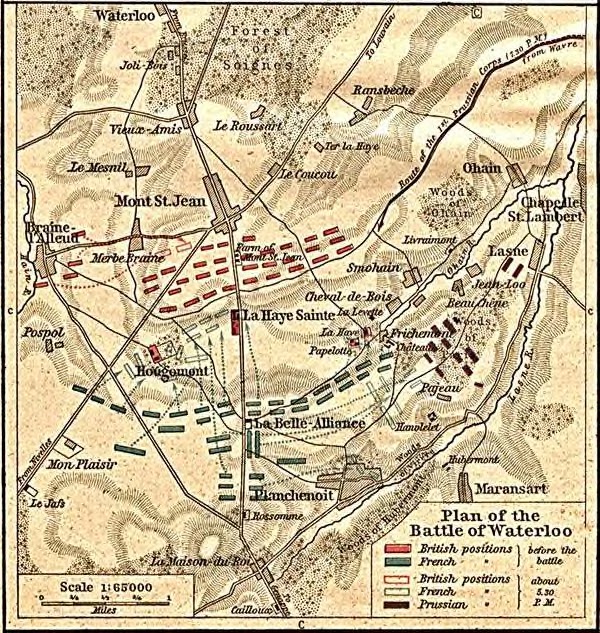
The Battle of Waterloo - the final battle of the long Napoleonic wars that engulfed Europe taking over from the Revolutionary wars before that. It resulted in a comprehensive defeat for Napoleon who left the battle field knowing (whatever he may have dreamed later) that he would now have to go into real exile and stay there. 


As every school child should know yesterday was Waterloo Day. Tory Historian decided on a picture and a map. Well, how can you discuss or even think about a battle without a map?
As to why a day late? Tory Historian has a reasonable excuse - the technology, clearly on the liberal side, proved to be recalcitrant.
Links
Followers
Labels
- 1922 Committee (1)
- abolition of slave trade (1)
- Abraham Lincoln (2)
- academics (2)
- Adam Smith (2)
- advertising (1)
- Agatha Christie (4)
- American history (33)
- ancient history (4)
- Anglo-Boer Wars (1)
- Anglo-Dutch wars (1)
- Anglo-French Entente (1)
- Anglo-Russian Convention (2)
- Anglosphere (19)
- anniversaries (175)
- Anthony Price (1)
- archaelogy (8)
- architecture (8)
- archives (3)
- Argentina (1)
- Ariadne Tyrkova-Williams (1)
- art (14)
- Arthur Ransome (1)
- arts funding (1)
- Attlee (2)
- Australia (1)
- Ayn Rand (1)
- Baroness Park of Monmouth (1)
- battles (11)
- BBC (5)
- Beatrice Hastings (1)
- Bible (3)
- Bill of Rights (1)
- biography (21)
- birthdays (11)
- blogs (10)
- book reviews (8)
- books (78)
- bred and circuses (1)
- British Empire (7)
- British history (1)
- British Library (9)
- British Museum (4)
- buildings (1)
- businesses (1)
- calendars (1)
- Canada (2)
- Canning (1)
- Castlereagh (2)
- cats (1)
- censorship (1)
- Charles Dickens (3)
- Charles I (1)
- Chesterton (1)
- CHG meetings (9)
- children's books (2)
- China (2)
- Chips Channon (4)
- Christianity (1)
- Christmas (1)
- cities (1)
- City of London (2)
- Civil War (6)
- coalitions (2)
- coffee (1)
- coffee-houses (1)
- Commonwealth (1)
- Communism (15)
- compensations (1)
- Conan Doyle (5)
- conservatism (24)
- Conservative Government (1)
- Conservative historians (4)
- Conservative History Group (10)
- Conservative History Journal (23)
- Conservative Party (25)
- Conservative Party Archives (1)
- Conservative politicians (22)
- Conservative suffragists (5)
- constitution (1)
- cookery (5)
- counterfactualism (1)
- country sports (1)
- cultural propaganda (1)
- culture wars (1)
- Curzon (3)
- Daniel Defoe (2)
- Denmark (1)
- detective fiction (31)
- detectives (19)
- diaries (7)
- dictionaries (1)
- diplomacy (2)
- Disraeli (12)
- documents (1)
- Dorothy L. Sayers (5)
- Dorothy Sayers (5)
- Dostoyevsky (1)
- Duke of Edinburgh (1)
- Duke of Wellington (14)
- East Germany (1)
- Eastern Question (1)
- economic history (1)
- Economist (2)
- economists (2)
- Edmund Burke (7)
- education (3)
- Edward Heath (2)
- elections (5)
- Eliza Acton (1)
- engineering (3)
- English history (56)
- English literature (34)
- enlightenment (3)
- enterprise (1)
- Eric Ambler (1)
- espionage (2)
- European history (4)
- Evelyn Waugh (1)
- events (22)
- exhibitions (12)
- Falklands (3)
- fascism (1)
- festivals (2)
- films (13)
- food (7)
- foreign policy (3)
- foreign secretaries (2)
- fourth plinth (1)
- France (1)
- Frederick Burnaby (1)
- French history (3)
- French Revolution (1)
- French wars (1)
- funerals (2)
- gardeners (1)
- gardens (3)
- general (17)
- general history (1)
- Geoffrey Howe (2)
- George Orwell (2)
- Georgians (3)
- German history (3)
- Germany (1)
- Gertrude Himmelfarb (1)
- Gibraltar (2)
- Gladstone (2)
- Gordon Riots (1)
- Great Fire of London (1)
- Great Game (4)
- grievances (1)
- Guildhall Library (1)
- Gunpowder Plot (3)
- H. H. Asquith (1)
- Habsbugs (1)
- Hanoverians (1)
- Harold Macmillan (1)
- Hatfield House (1)
- Hayek (1)
- Hilaire Belloc (1)
- historians (38)
- historic portraits (6)
- historical dates (10)
- historical fiction (1)
- historiography (5)
- history (3)
- history of science (2)
- history teaching (8)
- History Today (12)
- history writing (1)
- hoaxes (1)
- Holocaust (1)
- House of Commons (10)
- House of Lords (1)
- Human Rights Act (1)
- Hungary (1)
- Ian Gow (1)
- India (2)
- Intelligence (1)
- IRA (2)
- Irish history (1)
- Isabella Beeton (1)
- Isambard Kingdom Brunel (1)
- Italy (1)
- Jane Austen (1)
- Jill Paton Walsh (1)
- John Buchan (4)
- John Constable (1)
- John Dickson Carr (1)
- John Wycliffe (1)
- Jonathan Swift (1)
- Josephine Tey (1)
- journalists (2)
- journals (2)
- jubilee (1)
- Judaism (1)
- Jules Verne (1)
- Kenneth Minogue (1)
- Korean War (2)
- Labour government (1)
- Labour Party (1)
- Lady Knightley of Fawsley (2)
- Leeds (1)
- legislation (1)
- Leicester (1)
- libel cases (1)
- Liberal-Democrat History Group (1)
- liberalism (2)
- Liberals (1)
- libraries (6)
- literary criticism (2)
- literary magazines (1)
- literature (7)
- local history (2)
- London (14)
- Londonderry family (1)
- Lord Acton (2)
- Lord Alfred Douglas (1)
- Lord Hailsham (1)
- Lord Leighton (1)
- Lord Randolph Churchill (3)
- Lutyens (1)
- magazines (3)
- Magna Carta (7)
- manuscripts (1)
- maps (9)
- Margaret Thatcher (21)
- media (2)
- memoirs (1)
- memorials (3)
- migration (1)
- military careers (1)
- monarchy (12)
- Munich (1)
- Museum of London (1)
- museums (5)
- music (7)
- musicals (1)
- Muslims (1)
- mythology (1)
- Napoleon (3)
- national emblems (1)
- National Portrait Gallery (2)
- nationalism (1)
- naval battles (3)
- Nazi-Soviet Pact (1)
- Nelson Mandela (1)
- Neville Chamberlain (2)
- newsreels (1)
- Norman conquest (1)
- Norman Tebbit (1)
- obituaries (25)
- Oliver Cromwell (1)
- Open House (1)
- operetta (1)
- Oxford (1)
- Palmerston (1)
- Papacy (1)
- Parliament (3)
- Peter the Great (1)
- philosophers (2)
- photography (3)
- poetry (5)
- poets (6)
- Poland (3)
- political thought (8)
- politicians (4)
- popular literature (3)
- portraits (7)
- posters (1)
- President Eisenhower (1)
- prime ministers (27)
- Primrose League (4)
- Princess Lieven (2)
- prizes (3)
- propaganda (8)
- property (3)
- publishing (2)
- Queen Elizabeth II (5)
- Queen Victoria (1)
- quotations (31)
- Regency (2)
- religion (2)
- Richard III (6)
- Robert Peel (1)
- Roman Britain (3)
- Ronald Reagan (4)
- Royal Academy (1)
- royalty (9)
- Rudyard Kipling (1)
- Russia (10)
- Russian history (2)
- Russian literature (1)
- saints (7)
- Salisbury (6)
- Samuel Johnson (1)
- Samuel Pepys (1)
- satire (1)
- scientists (1)
- Scotland (1)
- sensational fiction (1)
- Shakespeare (16)
- shipping (1)
- Sir Alec Douglas-Home (1)
- Sir Charles Napier (1)
- Sir Harold Nicolson (6)
- Sir Laurence Olivier (1)
- Sir Robert Peel (3)
- Sir William Burrell (1)
- Sir Winston Churchill (17)
- social history (2)
- socialism (2)
- Soviet Union (6)
- Spectator (1)
- sport (1)
- spy thrillers (1)
- St George (1)
- St Paul's Cathedral (1)
- Stain (1)
- Stalin (3)
- Stanhope (1)
- statues (4)
- Stuarts (3)
- suffragettes (3)
- Tate Britain (2)
- terrorism (4)
- theatre (4)
- Theresa May (1)
- thirties (2)
- Tibet (1)
- TLS (1)
- Tocqueville (1)
- Tony Benn (1)
- Tories (1)
- trade (1)
- treaties (1)
- Tudors (2)
- Tuesday Night Blogs (1)
- Turkey (3)
- Turner (2)
- TV dramatization (1)
- twentieth century (2)
- UN (1)
- utopianism (1)
- Versailles Treaty (1)
- veterans (2)
- Victorians (13)
- War of Independence (1)
- Wars of the Roses (1)
- Waterloo (5)
- websites (7)
- welfare (1)
- Whigs (4)
- William III (1)
- William Pitt the Younger (4)
- women (11)
- World War I (20)
- World War II (54)
- WWII (1)
- Xenophon (1)