Really, Tory Historian ought to start a series on insults or, rather, two series: one of literary insults and one of political ones. Whenever people moan and wring their hands about modern life becoming crude and modern politics so rude and unpleasant, TH snorts. Have you had a look at eighteenth century cartoons and political pamphlets, asks TH. Or nineteenth century ones, at that. The idea that a world in which MPs can complain because their opponents have displayed less than overwhelming courtesy to them, in which audiences at political meetings are not allowed even the slightest heckle, in which people are arrested and imprisoned for "insulting" and "upsetting" comments on social media is a particularly outspoken or, heaven forfend, rude one is laughable.

Anyway, on to literary insults, which are, TH is happy to say, alive and well though not, perhaps, as interesting as those of the past.

Reading about the literary magazine of the early twentieth century, The New Age and its extraordinary editor, A. R. Orage as well as the highly talented contributors in a period that can, with some justification, be called journalism's greatest, TH came across the name of Beatrice Hastings.

This lady, whose real name was Emily Alice Haigh and who was born in South Africa (according to the DNB but in Hackney according to Wikipedia) but lived her life in England and France, ought to be better known as she seems to have been an important part of literary and artistic life of that period in the two countries. Above all, she contributed a great many articles and ideas to The New Age under various pseudonyms, introduced in that magazine a number of important modernist writers, including Ezra Pound (though, to be fair, she seems to be the only person to say so) championed various causes, some less popular than others (she seems to have been one of the first to get excited about Lenin and his mob while The New Age was definitely on the other side), lived with Orage and later on with Modigliani, who painted her on numerous occasions and had an affair with Katherine Mansfield, which must have ended rather badly.

In 1936 her literary career and reputation appeared to be on the wane and she attributed it to the Machiavellian machinations of Orage (by then dead) and the lack of gratitude displayed by various literary luminaries who had preferred to be on the right side of a man whom she compares to various dictators and who, in her opinion, had no creative or editorial talent at all. She poured out her venom in a pamphlet published by the Blue Moon Press of Red Lion Street and entitled The Old "New Age": Orage - and Others.

Her description of Orage's talent or "pen" on page 6 of her pamphlet comes high on the list of serious literary insults:
... and what a flat, ponderous, stilted, maundering, when not coy, conceited and facetious, when not plagiaristic or outright thievish "literary" pen he had ...
TH is quite envious of that list of insulting epithets. How long did it take to put them together, one wonders.

Not content with annihilating Orage, Beatrice Hastings (to give her the right pen name) went on to do the same to Richard Aldington, best known as an imagist poet but also a novelist and literary critic. In 1933 he published a novel, entitled All Men Are Enemies: A Romance. Beatrice Hastings maintained that he had appropriated and used a title she had given in 1909 to a polemical publication: Woman's Worst Enemy - Woman.

In a note on page 9 of her pamphlet she writes:
Addington exploits this title [Woman's Worst Enemy - Woman] in one of his books, without naming me. That this silk-fingered, scratch-nailed, sob-stuffing, eaten-brained curate of the feminine soul is accepted by women as a champion shows what enemies to themselves they still are.
Ouch!

Finally, Katherine Mansfield, a close friend and lover of Beatrice Hastings's:
I never knew until this month of Jan. 1936, that Katherine Mansfield came back on the paper [The New Age]. The sketches published in 1917 look like the incredibly vulgar stuff I rejected.  .... That she must have fancied she was triumphing over me, although I never knew that she was offered to the readers in place of "Alice Morning" [another of Beatrice Hastings's pen-names] is not completely amusing; and it rather gladdens me to reflect that when Francis Carco's terrible study, Les Innocents, showed her that she was detected and classified, she had to reflect that poor Sophie Brzeska .... had been Fate's innocent instrument of revenge. After that book, Katherine began to play saint, prate about God and, as Olive Moore says, "twittered" her way out of a world she had fouled wherever she went.
Ah those literary and artistic rows of yesteryear!

Beatrice Hastings's end was tragic but, somehow, appropriately flamboyant. She drank too much, had squandered her inheritance, saw herself as betrayed and spurned by the literary establishment, against which she railed. At the end of October,1943 she

burned her correspondence, stuffed a towel under the door, cradled her little white mouse in her hand and turned the gas on.
She had left her possessions to her "devoted friend" Doris Lillian Green and her Literary Estate to the British Museum "or the first public library that puts in a claim". Oh but those letters! What joy it would be to read them. Surely, a woman who can write such elegant literary insults deserves renewed interest.

The next Conservative History Group event will take place on October 30 at 6.30 pm in Committee Room 2 in the House of Lords. That means having to go through St Stephen's Entrance so it may be as well to be prepared for a long queue.

Dr Caroline Shenton, Director of the Parliamentary Archives, will be talking about her book The Day Parliament Burned Down an account of the great fire of the building in October 1834, so memorably recorded by J. M. W. Turner, who set up his easel across the river and sketched furiously while firemen fought the blaze. This is the first book to give a full account of the event.

If you want to reserve a place at the event, click here and if you want to pre-order a copy of the book, in order to ask Dr Shenton to sign it on the night (Parliamentary rules say that they cannot be sold during the event) you can do so either through Amazon here or by e-mailing Dr Shenton directly on cshenton_AT_hotmail.co.uk.


A fascinating sale of duplicates (as I understand it) of some of the best, most talented and ... that terrible word .... iconic posters commissioned and used by London Underground and London Transport in the past will be held on October 4 at Christie's in South Kensington and the pre-sale exhibition will be held there from September 28 to October 3. A number of the best graphic artists were given their first outlet or made successful by the remarkable policy of commissioning the best.

The three examples are respectively by George Sheringham, Andrew Power and Annie Gertrude Fletcher.

Curiously, the Daily Mail article gives no examples of Edward McKnight Kauffer, possibly the best of the artists whose career was made by London Transport. Here is one example.

We have just had Open House week-end in London and Tory Historian tried to visit a new place or two. Only one new place was managed: the fascinating and gorgeous Apothecaries' Hall.

Time was short so the second visit was to the Guildhall and the Roman Amphitheatre beneath the Art Gallery, both thoroughly recommended.

Naturally, there was a good deal of explanation of what the amphitheatre was used for and how it fitted in with Roman British life. Interestingly, the actual amphitheatres across the Roman empire were built out of public funds but the entertainment in them (if you can call events that involved the slaughter of hundreds of people and animals entertainment) was provided by rich nobles or even by the Emperor, especially in Rome itself. This was a way of bribing the populace, bread and circuses (panem et circenses) being a great Roman invention, much in use to this day.

Tory Historian, naturally, thought of the bread and circuses that were provided this summer by way of the Olympic and Paralympic Games, both descendants of certain ancient entertainments. There is, however, a great difference: they are still bribes to keep the populace happy but these days the bribes are paid for by the populace. They bribe us, thought TH, with our own money. In the case of those Games with our children's money as well.

Browsing through the internet Tory Historian came across this site: British History Online and found the London page of especial interest. The links read to a large selection of primary sources.

The US Constitution was adopted by the Constitutional Convention in Philadelphia, Pennsylvania on September 17, 1787 and ratified by Conventions of eleven States. The first ten Amendments, otherwise known as the Bill of Rights (shades of the earlier English Bills) were adopted in 1791.

There was a time when every school boy and girl knew the name of the first railway casualty. William Huskisson, MP for Liverpool and former Cabinet Minister was attending the opening of the Manchester-Liverpool railway on September 15, 1830. He got out of his carriage and went to another one to speak to the Duke of Wellington (yes, yes, him again). As he climbed in he slipped and fell into the path of the Rocket, Stephenson's great engine, which ran over his leg and caused severe bleeding of which he died though he was immediately taken to a hospital by Stephenson himself.

That is all one mostly knew about him though Huskisson did have quite a distinguished career.

160 years ago, on September 14, 1852 died the 1st Duke of Wellington, one of this country's great military commanders and no mean politician. In fact, he is one of the few exceptions to the rule that military commanders do not make good politicians even though as they rise to the top they have to play at politics more and more.

His was the last heraldic state funeral held in Britain.

For a number of reasons, not unconnected with recent events, Tory Historian decided to look up the comment, ascribed to General Sir Charles Napier in William Napier's History of Sir Charles Napier's Administration of Scinde, published in 1851, on the subject of sati or suttee or, in plain words, the habit of burning of widows on their husbands' funeral pyre (prohibited by Sikhism, incidentally).

This burning of widows is your custom; prepare the funeral pile. But my nation has also a custom. When men burn women alive we hang them, and confiscate all their property. My carpenters shall therefore erect gibbets on which to hang all concerned when the widow is consumed. Let us all act according to national customs.
It seems that no suttee took place then or afterwards while the General remained in charge.

There is a strong possibility (though at present no more than that) that the archaeological dig in Leicester has, apart from making all sorts of other interesting discoveries, may have uncovered the body or, rather the skeleton of Richard III.

The University of Leicester has made a statement about it in which they explain:

We have exhumed one fully articulated skeleton and one set of disarticulated human remains. The disarticulated set of human remains was found in what is believed to be the Presbytery of the lost Church of the Grey Friars. These remains are female, and thus certainly not Richard III. The articulated skeleton was found in what is believed to be the Choir of the church. The articulated skeleton found in the Choir is of significant interest to us. Dr Jo Appleby has carried out a preliminary examination of the remains.
So this could be the remains of the last Plantagenet king and the statement proceeds to give reasons why that is very possibly so. What of that crucial question: was he a crookback or not? The fifth point made states:
The skeleton found in the Choir area has spinal abnormalities. We believe the individual would have had severe scoliosis – which is a form of spinal curvature. This would have made his right shoulder appear visibly higher than the left shoulder. This is consistent with contemporary accounts of Richard’s appearance. The skeleton does not have kyphosis – a different form of spinal curvature. The skeleton was not a hunchback. There appears to be no evidence of a “withered arm”.
Before we all start rejoicing in our mighty victory over Tudor propagandists we need to point out that the skeleton will be subjected to rigorous scientific, including DNA tests. Apparently, the two Henries managed not to eliminate all those related to the York family and there are descendants of Richard's mother's family around. Results are expected in 12 weeks or so.


I have been reading a book by S. K.Romanyuk, called Russian London (Русский Лондон), the only guide to the London various Russians lived in. It goes through various themes: first contacts, the royals, the church, emigrés, ambassadors and so on.

Mr Romanyuk is the complete Anglophile. To him there can be nothing wrong with Britain and if there is a dispute he takes the British side, even attempting to exonerate the British authorities in the somewhat dubious story of Nicholas II and his family to whom Britain apparently refused to give shelter. A muddled story, as Mr Romanyuk rightly says and in his opinion if anyone needs to be blamed it had better be David Lloyd George.

Naturally there are a few pages about Peter the Great and his stay in London, particularly in Deptford but in other parts as well. Bearing in mind recent comments about London being put on the map in the last couple of weeks, I was interested to read that "at the time [Peter's arrival in 1698] London was Europe's largest city: with a population of 675,000 at the beginning of the eighteenth century".

After some description of the devastation caused by the Great Fire and of the rebuilding that was going on, Mr Romanyuk adds that London was also a great sea port. In the year of Peter's arrival 13,444 ships had visited it.


Tory Historian remains convinced that this is the most exciting news story of the last few weeks: archaeologists are close to finding the body of Richard III in Leicester, where he was buried after the Battle of Bosworth Field.

The dig to recover the body of the king, who was defeated at the Battle of Bosworth by Henry Tudor in 1485, has already unearthed the long-lost Franciscan Friary where he was buried.

The church, which is also called Grey Friars, was known to be where Richard III was buried but its exact whereabouts had become lost over time.

Now archaeologists say the dig will move into the third week and say they are getting ‘tantalisingly close’ in their search for the body.
The article gives a more detailed description of the finds already made, all of them of great importance to anyone who cares about England's (and Britain's) history, though why should an article, published on September 10 be giving information about an open day on the site that took place on September 8, is something only sub-editors of the Daily Telegraph can elucidate. The BBC, one may add, had it right: they reported that 1,500 people queued to see the exhibits and part of the site.


As a matter of fact, quite a few detective novels hide interesting ideas, particularly political ones with those that display them for all to see being the least readable ones. I was alerted to a little known writer of the thirties, R. C. Woodthorpe, by Martin Edwards, who is considerably better known as a writer and a critic. The particular book he mentioned was Silence of a Purple Shirt or, as it is known in the United States, Death Wears a Purple Shirt.

Dorothy L. Sayers was very complimentary about Woodthorpe's books and rightly so: they are highly amusing and the writing is sly, witty and polished. The plot of this particular one is, on the other hand, a little lame. The beginning is excellent in a Buchanesque way. Thee events coincide: the Leader (always referred to with a capital L) of a rather noxious movement, Keep Britain Free, whose members sport purple shirts, has been arrested for no apparent crime; a young boy has disappeared with his nurse and, almost certainly, it is a case of kidnapping; and an important member of the Purple Shirts has been murdered with another, less important member, being arrested on serious circumstantial evidence. The latter happens to be the estranged husband of the niece of Nicholas Slade, a writer whose satirical output is considerably less well known than his first, somewhat romantic novel, The Gods Are Just.

Nicholas Slade and his confidential clerk, Alfred Hicks, start an investigation into the murder as they both assume that the nephew by marriage could not have committed the crime.

Thereafter the plot disintegrates despite some very funny descriptions and episodes as well as a few barbed comments about the literary world. The solution to the crime(s) is neat though not altogether surprising but the holes in the plot are too big to overlook. Several important characters's behaviour remains unexplained; the reason for so much of the action in the past and the present taking place in a strange but delightful hotel on an island is not given; hints about certain people being possibly connected to the Purple Shirts are never followed up.

Most frustratingly we never find out how it is that a ridiculous organization that is full of self-important and childish characters, has no money and cannot impose discipline on its members despite the sub-military behaviour manages to build up a superb intelligence service. Whatever the Home Secretary does, wherever he goes, whatever instructions he gives, the Purple Shirt leaders know within the hour. Is there somebody close to the HS, or A Certain Person, as he is variously referred to, who is a member of the organization? If so, we never learn the truth.

There are, however, some interesting aspects to the novel. Nicholas Slade goes to the headquarters of the Keep Britain Free movement in Hampstead and finds that he dislikes them more than he had done before. Though the movement is a clear reference to Oswald Mosley's British Union of Fascists (founded in 1932 and the book came out in 1934) the political ideology that is propounded at their headquarters are similar to those one would have heard in various Communist organizations of the period. (Well, it's not like there is that much difference between national and international socialism.) The Leader's comment about writers becoming as important as dustmen, no more but no less so, in the new order remind one of Lenin rather than Mussolini or Hitler and the notion of the corporate state being of far greater importance than the individual is central to all those isms and ologies.

Listening to the mildly insane burbling of the Purple Shirts, Nicholas Slade manages to formulate to himself what it is he does not like:
Slade, feeling that the more he heard of the Purple Shirt programme the less he liked it, sat on. He sat patiently, and gloomily envisaged the promised new State, which would deprive him of his cherished Times, employ him in writing propaganda, and, if he jibbed, or incautiously made a joke at its expense, hand him over to a soft of drumhead court-martial and have him put against a wall and shot. It was a dismal prospect. 
Slade was not over much in love with the established order of things. Indeed, he had satirized it in many of his books. But there you were ... That was exactly where the shoe pinched. Slade could satirize the existing State, cartoonists could caricature it, the writers of funny columns could lampoon it ... and no one seemed to mind. 
Slade and Woodthorpe can see the difference in the basics but, for all of that, can also see that not everything is rosy in the garden.

After all, the plot is triggered off by a stupid and, probably, illegal order by the Home Secretary, not a man to be admired, to arrest the Purple Shirts' Leader, who bears the unlikely name of Duke Benedict (this was four years before P. G. Wodehouse's glorious creation, Roderick Spode) for nothing at all. Eventually, after several months in prison, he is charged with making seditious speeches. The only immediate outcome is that the Purple Shirts suddenly become quite popular as they are seen to be victims of the Establishment.

Slade is shocked but nor surprised to find that the political establishment that includes the Home Secretary and Scotland Yard is prepared to pervert the course of justice and to let an innocent man go to the gallows in order to protect the real killer's identity. In the end, the innocent man is released but the real killer goes unpunished except, possibly, in his own conscience. This is not a novel that supports the powers that be or the existing order of things. What it does support is the idea of how they ought to be.


It is not great literature that tells us how people lived at any time, it is the secondary or what is rather disdainfully referred to as genre version of it. Detective stories are, apart from everything else, a mine of useful information about the past. Then there are non-fiction books devoted to themes such as gardening or, most of all, cookery.

Browsing through the shelves of a second-hand bookshop I came across a copy of Agnes Jekyll's Kitchen Essays as reprinted by Persephone Books. This is a fascinating collection of essays about food and cooking, originally published for a year in The Times and collected, in response to popular demand, as a volume in 1922.

Intrigued by the essays themselves and the name of the author, I proceeded to search for information. Mr Google yielded a certain amount, mostly to do with the book in my hands, which had already informed me that Agnes Jekyll was "the daughter of the Pre-Raphaelite patron William Graham", married to soldier-diplomat Herbert Jekyll and "the guests at her first dinner party [the subject of one of her essays] were Browning, Burne-Jones and Ruskin". She was also Gertrude Jekyll's sister-in-law and the biographer of that formidable lady described Agnes as "an artist-housekeeper".

All very interesting but that does not, for example, explain why Lady Jekyll, as she became, was also Dame Agnes Jekyll. Even the publishers say vaguely that she was " created DBE for her involvement in numerous good causes".

I abandoned Mr Google and the internet and went back in true conservative fashion to the printed word, the Dictionary of National Biography, to be quite precise. Its entry on Agnes Jekyll was, naturally enough, shorter than that on her sister-in-law but full of information.

To start with, dates. Dame Agnes Jekyll was born in Ayrshire in 1861 and died at her home near Godalming in 1937. Her father was a Liberal MP as well as an art collector and her husband, Sir Herbert Jekyll was in the Royal Engineers with an extensive political and diplomatic career on the practical side. Among other assignments he was sent to inspect fortifications in Ceylon and Singapore and his wife travelled with him each time, whether to Paris, Dublin, Gibraltar or further afield.

They settled near Godalming where Lady Jekyll became a well known political and artistic hostess with what was considered to be an exceptional aptitude for presentation of food and wine as well as general housekeeping. But that was not all.

The mystery of her Damehood is explained. She was given a DBE in the New Year Honours of 1918 for her war work, which consisted partly of the chairmanship of St John of Jerusalem's warehouse for hospital supplies in Clerkenwell. Apparently she prided herself on answering every demand for supplies promptly. She was also one of the first volunteers to provide ambulance service when the air raids on London started.

Her public career neither began nor ended with the First World War. From 1884 to her death she was a member of the East End maternity hospital committee. For ten years she was chairwoman of the visiting committee of the Borstal Institution for Girls at Aylesbury and, according to the DNB, served frequently on juries if women were in the dock. I find this hard to understand as I do not think one can choose either the frequency of one's jury service or the cases on which one sits.

From 1925 she was a magistrate on the Guildford Bench and sat on the panel of children's courts. In response to her obituary, published in The Times on January 29, 1937, a letter described her as "exceptionally able amateur" and added that she would have been a great public servant had she been a man. That, one must admit, is a curious comment and shows how early the notion that public servants are only those who make a professional and paid career out of it. Amateur Dame Agnes may have been but she was a great public servant, all the greater for not getting any money for her various activities.

In all that period she managed to run a large and hospitable home and bring up three children. Of course, there were servants of different variety. The essays show an interesting society in which servants were still around but there were far fewer of them and they were becoming more noticeable as crucial members of the household.

The lady of the house, in Agnes Jekyll's estimation, has to run matters herself, be aware of the food that is prepared, think ahead about provisions and inject new ideas and menus. It is up to the cook to deal with the practical matters though there is one delightful essay with some helpful recipes, entitled "In the Cook's Absence".

Other essays deal with new names and ideas for old recipes, favourite or otherwise (Gigot de six heures being somewhat more complicated but also more attractive than roast mutton with caper sauce), tea time dainties, dinners before theatre and suppers after, cooking for bachelors and for those who have found themselves considerably poorer after the war, picnics in winter as the average English hostelry was as unspeakable then as it remained for many decades afterwards, Christmas and Easter goodies, Italian food, cooking for the too fat or the too thin, and breakfast food.

What emerges is a clear picture of a hastily changing society or, maybe, a society that tried to return to pre-war norms and failed to do so, not least because the people themselves no longer liked those. In a number of essays the author talks about the pleasure of serving food in bright and heat-preserving pottery dishes (marmites for soup turn up repeatedly in the recipes) rather than on silver that, presumably, made every dish, regardless of what it was intended to be, tepid and somewhat tasteless. Finding bright pottery for the table and the kitchen, patterned table cloths and napkins was no longer just for bohemians but for the respectable middle classes as well.

At the same time the recipes are difficult: they tend to be far too complicated, made possible by the continuing presence of servants in the kitchen, aspic is still much used and the number of dishes that require the use of a salamander before serving is high. I may consider making one or two of the dishes. On the other hand, I know I shall re-read the book at some future date and enjoy the style and the descriptions, even the mild witticisms as much as I did the first time round.


While having the usual discussion about Lord Acton - he said "power tends to corrupt and absolute power corrupts absolutely - I looked up his notable quotations and found an absolutely splendid one:

The one pervading evil of democracy is the tyranny of the majority, or rather of that party, not always the majority, that succeeds, by force or fraud, in carrying elections.
It comes from his essay The History of Freedom in Antiquity.

Today is the anniversary of the Battle of Bosworth Field that brought to end the reign of the Plantagenets and introduced a completely new dynasty which led to other dynasties though none of it can be seen as entirely legitimate. History Today has reprinted an article from 1985 about the actual battle and the various problems that surround it. In fact, as far as TH can make out, next to nothing is known about it.

What seems rather extraordinary is that the author of the article should so easily accept the Tudor myth of Richard III, the relentless tyrant and usurper.Surely, Polydore Virgil's account, written many years later and under the reign of Henry VII who was not known for his tolerance of people that doubted his right to the throne, cannot be taken as gospel truth and neither can the account of the supposed hunchback (not shown in the portrait that is a copy of one made in his life time) and monster given us by Sir Thomas More.

Here are a couple of links to previous postings on the subject: a report on a trip to the fifteenth century, courtesy of the RSC and on Shakespeare's handling of some thorny issues and the story of a trip to Leicester which mingles German expressionism with that city's celebration of the man their predecessors saw as the rightful king.


This picture of Alexis de Tocqueville, one of the truly great political writers of modern history, was found on a Facebook site, entitled Federalist Papers. It sums what is wrong with a great deal of modern politics and predicts the failure of liberal constitutionalism in its ability to deal with mass democracy.

Without going into the arguments about detective stories being a peculiarly conservative genre, I should just like to quote something I found in a novel by William Morton alias William Blair Morton Ferguson, a man of may talents. In fact, if ever I am called upon to name a true denizen of Grub Street, it would be him, and that is a form of praise, ladies and gentlemen. Here are his achievements in the film industry and here is a partial list of his novels.

The novel I have in mind is The Mystery of the Human Bookcase and it is not, pace its title, a horror story in the Poe mould but a very straightforward detective yarn with two excellent characters: Kirker Cameron, New York Commissioner of Police who, unusually, is not there for political reasons but because he is good at his job, having been trained at the Paris Sûreté and worked with Scotland Yard and Jerome Bland, the District Attorney who is not as smart or imaginative as Cameron but is completely honest and contemptuous of politics.

Anyway, they have found the body and discovered that it was, apparently, that of a well-known thriller writer, despised by Mr Bland and rather liked by Mr Cameron, who gives the following explanation:
Man was so made that he must torment himself with mysteries and enigmas and thus the detective story always had been popular. It was the most ancient form of self-torment, and, as Bland might remember, the first three ever written could be found in the Aeneid, Herodotus and the Jewish Apocrypha. 
This novel was first published in 1931 but one cannot help wondering whether the author had seen Dorothy L. Sayers's introduction to the first volume of Great Short Stories of Detection, Mystery and Horror. It starts with the words:
The art of self-tormenting is an ancient one, with a long and honourable tradition. Man, not satisfied with the mental confusion and unhappiness to be derived from contemplating the cruelties of life and the riddle of the universe, delights to occupy his leisure moments with puzzles and bugaboos.  
In the next paragraph she says:
Both the detective-story proper and the pure tale of horror are very ancient in origin. All native folk-lore has its ghost tales, while the first four detective stories in this book hail respectively from the Jewish Aporcypha, Herodotus, and the Aeneid. 
They are: The History of Bel and The History of Susanna from the Apocryphal Scriptures, The Story of Hercules and Cacus from The Aeneid, Book VIII and The Story of Rhampsinitus' Treasure-House from Herodotus Book II.

An extraordinary amount of excitement and patriotic fervour was erupting around me as I was reading Peter Whittle’s Being British – What’s Wrong With It?. Team GB (an expression that would have been guaranteed to bring nausea to any right-thinking or, for that matter, left-thinking of the old school person before the vocabulary of Cool Britannia permeated public discourse) was winning medals. All doubts about the pharaonic and overweening arrogance that created the mega-farce of the London Olympics for which we shall be paying for decades to come have been dispelled, at least momentarily. Britain was winning medals and nothing else could possibly matter. One person on another forum jubilantly wrote about the first couple of gold medals “because we are GREAT Britain” as if that was the definition of this country’s greatness.

It occurred to me, not for the first time, what a peculiar position sport occupies in our political and social consciousness. As far as sport is concerned all the virtues, so eloquently extolled by Peter Whittle in his book, that have been abandoned or made to seem embarrassing, become acceptable. People are allowed to wave flags and cheer their country (though some problems arise with people who appear to think that certain sportsmen and women are Scottish if they win and British if they lose). Even the BBC joins in.

There is another difference: for a short time the people who are presented as heroes and role models are not vacuous celebrities but people who have, necessarily, kept the old virtues of hard work, self-discipline and aspiration. This will not last. Soon we shall go back to endless gossip about celebrities, including loutish footballers, and the accepted “virtues” of instant gratification and celebrity for no apparent reason. Of course, Olympic medal winners are not particularly useful as role models in another way: very few people can achieve those standards. If we do want children and young people to aspire to achievement we need to present them with models they can emulate with some hope of success.

The cult of celebrity is not particularly new as a swift reading of past publications can tell us but as Peter Whittle points out, its overwhelming importance that excludes and dismisses the more traditional virtues that allowed people to achieve things in life is something new and immensely harmful to several generations of children in this country who find themselves unable to compete either with their coaevals from other countries or from the private educational sector.

Other problems raised in Being British – What’s Wrong With It? are the deliberate destruction by the self-hating political elite of pride in one’s country and one’s culture, the whole idea of multiculturalism related to it, mass immigration that is both cause and effect of it, the dismissal of working class virtues, their destruction through all the above and the overwhelming and rapacious welfare state, and, above all, complete ignorance of the country’s history. Of these I personally consider the last to be the most important. (Well, I would, wouldn’t I?) Not knowing or understanding the past means an inability to understand the present or to imagine a future.
Once or twice I found myself vigorously shaking my head in disagreement. For instance, history tells one that riots were a reasonably frequent part of English life till late in the nineteenth century as was criminality. All too often when Britishness is invoked the reference is to a relatively short period of around 100 – 120 years from around 1820 to the beginning of the Second World War, when the state took over the running of people’s lives, never properly letting go again and stifling all the many very good qualities that those people possessed. Nor am I impressed by any sentimental feeling towards the 1950s. A swift look at the films and books of the period will show a decade of greyness and depression despite the political hype (for how else would one describe Harold Macmillan’s famous comment about never having so good and one of net emigration. People did not simply talk about wishing to leave as they appear to do now according to the author of Being British but actually did so in large numbers.
Nevertheless, the main argument of the books is entirely accurate. Britain has created many good things in the country and in the world though often those who did the creating were the ones who found many of the solid British virtues tiresome and stifling, a curious contradiction noted by George Orwell many years ago, but those achievements have been deliberately denied and belittled by a weird self-hating elite. The people of the country have been deprived of their history, of their pride and self-respect. Given that this is a country and a culture that has been admired and emulated across the world (though not the NHS) it is strange and disturbing to see its denigration at home.

However, Peter Whittle (who is, incidentally, a good friend as well as the Director of the New Culture Forum) sees many causes for hope. The future might be brighter than the immediate past. People seem to be refusing to knuckle under: they remain stubbornly proud of their country and its achievements, they want to learn about its history and they are waking up to the importance and necessity of all that has been taken away from them. Let me recommend this book to anyone who is perturbed by what has been going on and would like to see the hopeful signs to develop into something more lasting.
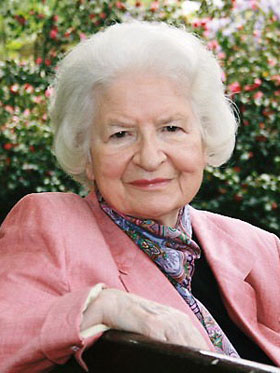


.... Phyllis Dorothy James, a.k.a. P. D. James, the pre-eminent detective story writer of the day, a. k. a. Baroness James, who sits on the Conservative benches in the House of Lords. Many happy returns.

It is well known to all Wodehouse aficionados, of whom Tory Historian is one, that Bertie Wooster once wrote a column in his Aunt Dahlia's weekly journal, Milady's Boudoir, entitled "What the Well-Dressed Man is Wearing". In the same way this article could be called "What the Well-Read MP is Reading".

In fact, it is called rather prosaically Keith Simpson's Summer Reading List and is a long list of books that Mr Simpson, Chairman of the Conservative History Group, thinks MPs might enjoy reading on their summer hols.

Few real surprises. As Mr Simpson says, there is a natural bias towards politics, history and conflict with a few lighter touches at the end, though at least two of these are books written by wives and daughters of politicians. The biography of W. T. Stead will be on TH's reading list, despite the mediocre reviews as will, possibly the books about China in the thirties.

The history of the Intelligence Division of the War Office, on the other hand, sounds fascinating.

The death of the man whom many considered to be the finest military historian of our age was announced yesterday. Sir John Keegan, author of several books of great importance, journalist and critic, died at the age of 78 after a long illness. That it was nobly born I can testify to, having met him once and, indeed, sat next to him at dinner. All I can add to the many obituaries that will undoubtedly appear in the next several days is that the man was absolutely charming to talk to. (And yes, I am aware of the fact that many highly knowledgeable people consider his analysis of what was going on in the various wars fought at the moment was less impressive than his historical writing but it is as an historian that we honour and remember him.)

Here are two obituaries: in the Daily Telegraph whose columnist he was for so many years and in History Today.


Thomas Gainsborough, one of the most English of artists and a man who helped to create an image of England and the English died on August 2, 1788. Here are two self-portraits, one, in the National Portrait Gallery, a straightforward one and the other, in the National Gallery, of the artist and his family.

Repeatedly I have written that the detective story is an essentially conservative genre, not because it necessarily upholds the social or political mores of the day (many, many even of the Golden Age stories do no such thing) but because it relies on a certain moral assumption and that is the wrongness of taking another life. In other words, it assumes that individuals matter, that the personal is of greater importance than the collective and in a century when millions of lives could be disposed of for political ideology, this assumption mattered.

Every now and then, however, one comes across the more left-wing point of view. This is not necessarily voiced by left-wing writers. Nicholas Blake, in reality C. Day Lewis, may have been left-wing and may have quoted advanced poetry in his books but his attitude to murder was no different from that of Dorothy L. Sayers, who also quoted poetry but was right-wing in politics.

There are some oddities. Timothy Fuller, for instance, in the one novel I have read, Reunion with Murder, calmly produces a plot in which a man is deliberately murdered because he is not terribly nice, his wife is unhappy being married to him (no particular reason), he is a Republican and dislikes FDR. And anyway, decides, Jupiter Jones who is the detective of the series, a terrible war is coming and what's a dead body or two extra.

That is, obviously, contrary to all the basic assumptions that underlie the detective story. If a violent death does not matter all that much, if people are justified in killing somebody simply because his politics is not the accepted liberal one and his wife is not terribly happy, then what exactly are we talking about?

Let us now talk about a novel by the socialist theoreticians G. D. H. and Margaret Cole. Almost all their detective stories are credited to both of them but there is some doubt on the subject. Curtis Evans, an expert on the subject, has tried to analyze which one of them wrote which novel and came to the conclusion that the collection of short stories Mrs Warrender's Profession and the one novel about that lady, mother of a private detective, Knife in the Dark, were written by Margaret on her own.

On the whole, I agree with him. The style is lighter and not particularly didactic, which was usually her husband's. The plot takes place in late November 1941 in the mythical university town of Stamford, an amalgam of Oxford and Cambridge. The war is not much discussed except in terms of immediate discomfort. This is where a woman's touch becomes obvious. The town seems to have a good many refugees from occupied Europe and Germany as well as the usual bombed-out evacuees, who play no part. There is, however, a great deal of resentment of the foreign refugees, both in rather general and more specific terms. The latter revolves round food and accommodation. There is rationing and some shortages; the refugee women not only buy up food that is in short supply but are more skilful at bargaining than the middle class English ladies who, one assumes, did not shop themselves before the war and are not up to standing up to the tradesmen. I suspect Margaret Cole knew more about this than Douglas Cole.

On the other hand, I do wonder whether any woman would really write about young men (in the plural) going off the rails to the point of trying to commit suicide because they had been "led on" by a highly attractive older woman. That strikes me as an essentially male assumption but I might be wrong.

If you have not read Knife in the Dark and intend to do so, stop right here because I am going to discuss the plot and there will be spoilers. The victim is the young wife of a decent, hard-working don who is also greatly taken up by the problem of the refugees, something she resents with a passionate fury. Steve on Mystery*File describes Kitty Lake as a nymphomaniac but she is not. She does have one affair and she seems to enjoy herself flirting with young undergraduates and RAF cadets, stationed in the town, but it leads to nothing though some of the more impressionable ones go through agonies and attempt suicide. Other young men fall in love with her but it is made quite clear that she is really in love with her husband but for some reason he has built a wall between them - a somewhat sentimental and melodramatic idea that is never resolved because Kitty is murdered.

What follows is a great deal of discussion and investigation by the police with a shockingly large number of people ready to blame the foreigners, all or some of them, because Kitty had been so nasty to and about them and because, as one undergraduate says, you can never quite tell with foreigners. Mrs Warrender is shocked by what she perceives as a pogrom mentality.

She works out who the murderer is, though almost too late, and takes certain actions that ensure punishment being meted out to the right person. On the whole, her methods are not adequate. There is one clue, which is fairly laid out but it is not enough on its own. For the rest she relies on intuition or divine inspiration (the atheistic version, given the Coles' politics).

Patricial Craig and Mary Cadogan do not think highly of the novel in The Lady Investigates, arguing that the motive for the murder is very weak and implausible.
Gordon Lake gives in to a murderous impulse because he has taken exception to his wife's treatment of refugees. He is a humane person who resents the infliction of further cruelties on those who have suffered in occupied Europe. 
Kitty Lake is rude to the Polish Jewess Marta Zyboski, so Gordon Lake waits in the dark with a little Maori dagger and that is the end of Kitty. 
As a matter of fact, that is not what triggers off the murderous impulse but the discovery that Kitty Lake has been doing her best to get Marta Zyboski, an irritating woman who has realized that the British system may be benign but is not helpful, interned as enemy spy. She is also proved to be instrumental in getting Marta's sixteen year old son interned and nearly killed, something that shocks Mrs Warrender and even the Chief Constable who is convinced that foreign refugees are probably Nazi agents and generally no better than they should be.

It is the knowledge that his wife has behaved in a way not dissimilar from the Nazis whom the country is fighting that provides that murderous impulse. While the refugees are not shown to be necessarily attractive or admirable, their treatment receives strong implicit criticism. What Craig and Cadogan seem unable to understand that to left-wing political ideologues like the Coles (or, probably, just one of them) the idea of murder for righteous, impersonal but, nevertheless, morally urgent reasons is perfectly understandable. This is not the thinking of the usual run of detective story writers but, in its insistence on moral absolutes, this is still a traditional example of the genre.


Dorothy L. Sayers crops up on this blog regularly so readers will not be surprised to learn that Tory Historian is reading another book about the great lady, detective story writer, theologian, literary critic, conservative thinker and all-round good thing (no, that is not a reference to her physical shape). This one is by David Coomes, media executive (not sure how else one can describe him) and erstwhile head of BBC Religious Department, entitled Dorothy L. Sayers - A Careless Rage for Life.

The book has more about Sayers as the writer of religious texts and plays but there is a chapter or two about the detective stories and more than that about the rest of her life. Mr Coomes seems to have been entranced by her personality while reading her huge correspondence, which is being published under Barbara Reynolds's editorship.

What appealed to TH, however, was a paragraph at the end of Chapter 1, a hilarious and terrifying account of the "battle of the scripts" that preceded the creation and broadcasting of Dorothy L. Sayers's famous and notorious sequence of plays The Man Born to be King, about which TH blogged some time ago. (TH remains of the opinion, pace some commenters, that there were better detective story writers than Miss Sayers but few as erudite on other subjects.)

Mr Coomes quotes Miss Sayers's opinion that "What we make is more important than what we are", then goes on:

It is the comment of someone who obsessively guarded her private life. Most people would say:: What we make is because of what we are ... because of we have experienced, endured, wept and laughed over, been defeated by, despaired of, embraced, rejected, come through.
That may be true but TH is compelled to agree with Miss Sayers - whatever went into the creation of what one makes, that is what matters most. Furthermore, would it not be wonderful if writers, artists and actors would remember that dictum and talk less about themselves in endless interviews and self-analysis. What we make is more important than what we are. Let that be every writer's motto.

Let's face it, from a conservative point of view, anything that concerns Jane Austen is important and she died on July 18, 1817.

Some other important things happened on this day, as well.

For example, in 1872 the Ballot Act received its Royal Assent, thus introducing the concept of secret ballot into British politics. Sadly, one must admit, that concept is being eroded at the moment through the indiscriminate and badly supervised use of the postal ballot.

In 1920, the Cenotaph, Sir Edward Lutyens's great memorial to the dead of World War I that has since become a memorial to all those who died in battle, was unveiled.

And in 2009 and last World War I veteran, Henry Allingham died.


No, not Hitler's but Macmillan's whose fiftieth anniversary we remembered yesterday. A couple of days ago the Conservative History Group was addressed by the man who knows absolutely everything about that day, the historian D. R. Thorpe, author of a trilogy or prime ministerial biographies, Eden, Macmillan and Douglas-Home as well as that of Selwyn Lloyd, the Chancellor of the Exchequer who was, in some ways, the cause of it all.

As an amusing incidental point, it needs to be mentioned that Supermac won the Orwell Prize last year. What would George Orwell have made of that?

Richard Thorpe's knowledge of the events of that evening 50 years ago is such that he thinks it would be his special subject on Mastermind, should such an event occur in his life. Most of his knowledge is there in the books he has written but one or two interesting points can be made on the basis of his talk.

The roots of that night, he said, lay in the William Wallace case of 1931, the first in legal history when a conviction for murder was overturned on appeal. It was largely because of that case that Selwyn Lloyd, then a young lawyer, became a fervent abolitionist and, subsequently, joined Sidney Silverman's campaign against capital punishment. It also meant that under Macmillan he could take any job but that of Home Secretary, as he explained to the Prime Minister. So, when Macmillan decided, probably erroneously, in 1962 in the wake of disastrous by-election results, to get rid of his "sound money" Chancellor of the Exchequer, Selwyn Lloyd and put in an expansionist one, Reginald Maudling, he had a problem on his hands. Selwyn Lloyd had been Foreign Secretary under Eden and, briefly, under Macmillan so the Home Office would have been the obvious place to move him to but that could not be done. What to do?

Macmillan's answer was to offer the man a peerage (though not the Lord Chancellorship as he did not think Selwyn Lloyd was a notable enough lawyer, an ironic idea given subsequent developments) and the chairmanship of Martin's Bank. Whether the latter was in the Prime Minister's gift is unclear and it was never tested as both offers were refused and Selwyn Lloyd retired to the back benches, to the applause of all.

However, Macmillan found that he had to bring the reshuffle forward by some months because of RAB Butler's deliberate indiscretion to a friendly journalist and also he extended it in order not to make it seem like a simple sacking of the Chancellor. Seven Cabinet Ministers were sacked and thirty-nine posts were affected. All in all fifty-two people were moved around and a great deal of bitterness trailed the Prime Minister thereafter. And RAB Butler lost the slender chance he might have had of succeeding as leader of the party. But then, in my opinion, he did not have what it takes to be a Prime Minister.


One final thought: it is extraordinary how potent satire is. My own image of Selwyn Lloyd has always been the bumbling fool portrayed by John Wells. It was salutary to find out that he was a man of principle and strong convictions as well as one of the better Chancellors this country has ever had.


One of the most important British and Irish battles fought in 1690 with William III's forces triumphing over those of James II, thus putting the final touch to the Protestant or, as it is mostly known, Glorious Revolution.

Tory Historian has been reading Lewis Stevens's biography of Rosa Newmarch, An Unforgettable Woman. Mrs Newmarch was a remarkable woman and is not as well known as she ought to be, though there are signs that interest in her career is growing.

She was at the heart of English cultural, especially musical life of the late nineteenth and early twentieth century, wrote several important books and hundreds of articles as well as translating books, songs and opera librettos from various languages, particularly Russian and many analytical programme notes for the Queen's Hall Prom concerts and a few others. She was friendly with Sir Henry Wood, Sir Edward Elgar and  Sir Granville Bantock and many others, too numerous to list as they say.

It is hard to tell what Rosa Newmarch's greatest achievement was but TH would place high her promotion of Russian music and Russian culture in general, as well as the introduction (with Wood and Bantock) of the music of Sibelius and of Janáček. Enough there for several life-times.

What caught TH's attention among all these matters is a short paragraph on what might be called the vagaries of publishing.

Several of Mrs Newmarch's books had been published by Bodley Head (John Lane Ltd) but in 1912 its manager, Herbert Jenkins, decided to set up his own publishing firm and Rosa Newmarch, a friend as well as an author went with him. This is what Mr Stevens says (and his own style leaves something to be desired):
Herbert Jenkins was immediately successful with several popular works including his own witty and amusing series of Bindle novels, which sold well and established him financially, so that he could embark on more ambitious literary, if less remunerative, publications. Although Herbert Jenkins died in 1923, the firm thrived as a small publishing house until 1964 when it combined with another publisher [Barrie & Rockliffe], becoming Barrie and Jenkins. That was subsequently taken over by Hutchinson, which in turn merged with Century and later Random House. 
As it happens, Bodley Head was also eventually acquired by Random House. That paragraph sums up the history of British publishing in the second half of the twentieth century - a catastrophe many of us watched as it unfolded. Hardly any small or medium sized publisher retained its independence and the pretence that the various component parts of the conglomerates retained their own imprints was believed only by the very gullible.

What goes around comes around. Twenty-first century technology changed much of that. Indeed, even towards the end of the last century small publishers started springing up, using the ever more skilful desktop publishing methods; authors rejected by the big boys and girls decided to publish their own work and the words "vanity publishing" were used only by those big boys and girls. (After all, Herbert Jenkins published his own books, Hogarth Press published the Woolfs and their various friends and relations and so on. Nobody called that vanity publishing.)

Print on demand, e-books, kindle, advertising on the internet and through social media have all made the small publisher's life considerably easier.

Lewis Stevens's own book is published by Troubadour Publishing Ltd under its Matador imprint or, in other words, it was self-published because, presumably, none of the big boys and girls had heard of Rosa Newmarch and were no interested in her. A professional woman who has achieved a great deal but was not on the left? Pshaw!

As TH is a great book-lover, one thing remains troublesome. Will these books survive if only as many copies are published as are required immediately or if they are published only on the internet? One hopes so, of course, but it is a worrying thought. At the same time, it is a cheering thought: small publishers might become bigger but not too big. In any case there is now a far greater variety of publishers and publications than there were when the big conglomerates were conquering all.


For all those who are in or near London this Thursday evening: D. R. Thorpe will be speaking about "The Night of the Long Knives", Macmillan's infamous Cabinet reshuffle 50 years ago. Of course, he did not allow gossip on the subject to swirl round Westminster for months beforehand but struck suddenly. Here are the details. Hope to see some of you there.

Some time ago this blog mentioned a new biography of Herbert Butterfield, the analyst of "Whig history". I was greatly surprised to see a piece about about Butterfield by David Gordon on the Mises website. It is, in fact, a review of yet another study of the historian, by Kenneth B. McIntyre. Somehow, I had not connected Butterfield with libertarianism but the article concentrates largely on his views on foreign policy and they had a certain amount in common with the views usually expressed by contributors to the Mises site. The piece is well worth reading even if it raises the odd smile.

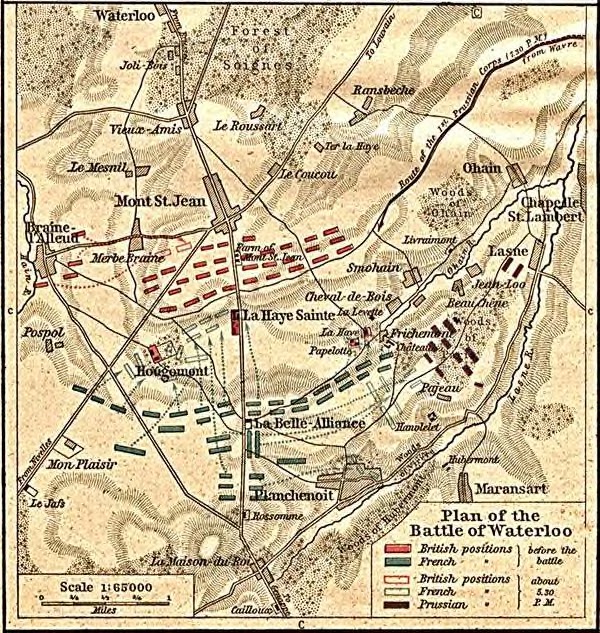


Yes, indeed, the Battle of Waterloo. In remembrance a picture and a map.

An important day in the history of England, the Anglosphere and political ideas: on June 15, 1215 the Great Seal was attached to the document called Articles of the Barons at Runnymede. We know it better as Magna Carta, the document that is seen by many as the basis of the special English political development, away from the Continental one, a development that was taken up by the countries that can now be called the Anglosphere.

One wonders, though, what history on the Continent would have been like if the Mongols had not invaded. For in 1222, the barons of Hungary extracted a very similar document from King Andrew II, the Golden Bull. Then in 1241 the Mongols invaded and destroyed what was a well set up kingdom.

The following year Batu Khan withdrew after a reasonable amount of destruction and mass slaughter because the Khan of Khans, Ögedei Khan, had died and his successor had to be elected. Hungary was rebuilt with many more fortresses, as these had largely withstood the onslaught. But political development became somewhat different and the Golden Bull did not occupy the same place that Magna Carta did.

The Conservative History Journal has had many postings about Dorothy L. Sayers, one of the best-known detective story writers and creator of Lord Peter Wimsey, popular theologian, literary scholar, playwright and undoubtedly a conservative in all her thoughts.

She is mentioned in the piece on scouting, described as being more anti-Semitic than John Buchan (one of TH's favourite postings), referred to in a general posting on the conservative nature of detective stories, quoted on various matters here and here and discussed as author of The Man Born to be King and of an essay on English character. Undoubtedly, there will be postings in the future.

That being so, Tory Historian feels only mildly guilty at being a day late in wishing Miss Sayers happy 119th birthday.

Today is the anniversary of the ending of the Falklands War.

On the day in 1982 the Prime Minister announced to a packed House of Commons that a ceasefire has been agreed between the British and the Argentinian forces. Those were the days, when Prime Ministers and members of the Cabinet made important announcements in  Parliament not on TV.
Mrs Thatcher told the Commons land forces commander Major-General Jeremy Moore had decided to press forward to the capital last night after a series of successful attacks on enemy troops.
"Large numbers of Argentine soldiers threw down their weapons - there are reported to be flying white flags over Port Stanley," she said.
The report goes on:
The prime minister was welcomed outside Downing Street by a jubilant crowd cheering and singing when she returned from Westminster.
Mr Hanrahan - who is with the UK troops close to the frontline - said the Falklands felt strangely quiet after weeks listening to the noise of war.
"The sound of the heavy guns, the bombs, the machine-gunning is gone. The island is still and once again Stanley is under British control," he said.
Today, the Metro newspaper and others report that while the Falkland Islands are celebrating the ending of the war and their own liberation, the Argentinian President, Cristina Fernandez de Kirchner is heading to New York to address the somewhat ridiculous and anachronistic UN Special Committee on Decolonisation (one wonders whether they ever discuss the case of Tibet) on the subject of the Falklands (known to the Argentinians as Las Malvinas) and British "colonization" in 1833. It will be interesting what the UN Special Committee, whose existence will now be better known than it has ever been, will decide.

Meanwhile Tom Chivers, not one of my favourite columnists but talking a reasonable amount of sense for once, asks what exactly is President Fernandez de Kirchner hoping to achieve.

The next event of the Conservative History Group will take place on July 5, when D. R. Thorpe, prize-winning biographer of Macmillan, Eden, Douglas-Home and Selwyn Lloyd, will talk about Prime Minister Harold Macmillan's infamous "night of the long knives", whose fiftieth anniversary falls on July 13, this year. The notice sums up:

In July 1962, following a slew of disappointing by-election results, Harold Macmillan dramatically sacked seven members of his Cabinet. It was seen as a ruthless cull, and marked the beginning of the end of the Macmillan government. The Liberal leader Jeremy Thorpe scathingly remarked: 'Greater love hath no man than this, that he lay down his friends for his life.'
It will be interesting to hear Dr Thorpe's analysis of the event and whether it did, in fact, signal the beginning of the end or, alternatively, extended the life of the government.

The meeting will be held at 7 pm, July 5, in the Thatcher Room in Portcullis House. It might be a good idea to register here though, I imagine, it will be possible to get in without it. Please remember security in Parliament and allow time for that.


Tory Historian spent Sunday on the river, trying to see as much as possible of the pageant, Monday wandering round Soho and Chinatown, watching the various parties and performances (especially the cooking ones outside Leong's Legends in Lisle Street, and Tuesday in Trafalgar Square and the Mall with an estimated one and a half million other people. It was impossible to take pictures so newspaper photos have to be used.

Also a link to an excellent article on the Diamond Jubilee by S. M. Maclean, a good friend of this blog, on The Organic Tory and the Adam Smith Institute blog.

Some time ago I heard about a letter General Eisenhower wrote on the eve of D-Day (D-day --1) to be used in case the invasion went horribly wrong. In it he completely shouldered the blame for the failure. As it happens, though the fighting of the first few days was hard and bloody, the invasion was seen to be a success very soon and the letter did not surface for another month. Interestingly, he dated the letter July 5 though it was clearly written on June 5. Even General Eisenhower's nerves were playing up.

Here is the text of the letter with some analysis.


Just found this blog written by the historian John L. Hancock, called Liberty Inherited. Lots of interesting stuff, particularly on the links between English and American thought. Here is a posting on the Second Amendment that causes frissons of horror in so many people on this side of the Pond who obviously do not know that the right to bear arms first appeared in the Declaration of Rights in 1689, a document that needs a little more attention than it usually gets.

What can one say about G. K. Chesterton that has not been said by many people? A conservative thinker par excellence, sometimes so conservative that he was driven to inventing an England that never really existed but would have been quite enchanting had it done so; a writer of detective stories that frequently turned into magical  fantasies while creating completely new ideas and plots; a novelist of huge imagination; a literary critic; a crusading journalist; and, sometimes, a man of rather dubious political views.

Born on May 29, 1874, he lived through turbulent times (sometimes making them even more turbulent) and died on June 14, 1936, realizing before his death that the casual and often unpleasant anti-Semitism that he indulged in was leading to something far more horrific in Europe.

He has inspired at least two societies, one English and one American, both concentrating on the Catholicism of his writing, something he would have approved of. Looking at all the different sites that deal with the different aspects of Chesterton's life and writings I have found myself being drawn back to his mysteries, a word he used in its many different meanings but, particularly, in connection with detective stories. Elizabeth Foxwell on The Bunburyist links to several of his essays on the subject.

To all those who are in or near London at around lunchtime on Friday, here is a reminder of an event in Parliament in connection with Spencer Perceval's assassination 200 years ago.

An anonymous comment on the posting added:

There is a commemorative service at St. Luke's Church, Charlton Village on Sat 12th May.
He was connected to Charlton and is laid to rest in the vault.
It is good to know that Mr Perceval is being remembered.

The Duke of Wellington, one of this country's greatest military commanders and no mean politician of the Conservative persuasion was born on May 1, 1769 in Dublin. Naturally, this site has honoured the great man in various ways before, of particular interest being this meditation about the Duke's role in politics.

Powered by Blogger.

Followers

Labels

Counters


Blog Archive