
The Codebreaker Girls – Only 99c!
2 months ago
 Unfortunately the National Gallery exhibition, Rebels and Martyrs – The Image of the Artist in the Nineteenth Century closed yesterday and Tory Historian, preoccupied with other matters, did not manage to see it until the last day.
The verdict: so-so. Some very nice pictures that we do not get to see very often, such as paintings by the Nabis group (though nothing by the Pre-Raphaelites who, though active later, had somewhat similar ideas) and a certain amount of information.
It is the information I have issues with. It was inadequate and unoriginal. Something like this: up to the second half of the eighteenth century artists were perceived to be little more than craftsmen and spent most of their time trying to rise in society. At that point, partly under the influence of the French Revolution and partly of new romantic ideas the concept of the artist and, particularly, the poet as a solitary genius outside society and misunderstood by it, was born. The artist no longer had ambitions within society but beyond it. This developed through the nineteenth century, taking different forms, such as the bohemian and the dandy, eventually acquiring the strange, almost mad attributes of the surrealist, the Secessionist and other ists of the twentieth century. Throughout all this, the artist was also seen as the martyr, tortured by the uncomprehending bourgeois society that also held the purse strings and the narrow-minded critic. Naturally, this artistic angst was linked to rebellion and left-wing politics.
That is a reasonable summary but leaves out rather a lot. For instance, what happened to irony? Is it not ironic that artists should profess to have ambitions beyond society and yet suffer so acutely when society misunderstood? The irony deepened with those artists who became quite successful. Some analysis along those lines would have been very welcome.
Then there is the question of politics. Undoubtedly, some artists, like Gustave Courbet became involved in left-wing politics, particularly the various French revolutions that culminated in the Paris Commune of 1870. But romanticism, as such, the precursor of all this rebellion and martyrdom was not necessarily on the left. Quite the opposite.
The romantics of the early nineteenth century in Europe were rebels against the ideas of the Enlightenment, the French Revolution and the Bonapartist regime. Though Napoleon himself became the idol of a number of them, the ideology he represented was alien.
Romanticism is individualistic; it emphasises individual people and nations – the precise opposite of the Enlightenment and of the French Revolutionary ideology that saw all development as one and all individuals as necessarily submissive to the Will of the People.
It is not coincidental that Romanticism placed so much emphasis on history with many of the artists, far from being forward looking and left-wing, turning their backs on the modern world. Even those who did not, looked at national history, at the differences between nations, at the need to keep those differences going. A very backward, conservative idea.
The left-wing aspect of Romanticism developed partially later on, as a response to the Treaty of Vienna and the European order established in the years after it. The nationalists of the 1830s and 1840s may have seemed radical but were, in fact, often harking back to an older order when their countries were independent and they had rights that had been destroyed by greater powers.
In other words, the concept of the Romantic Artist is a deal more complicated than the straightforward summary that the exhibition tried to convey. As it happens, Tory Historian also managed to see one of Sir Carol Reed’s superlative films made during the Second World War: “The Young Mr Pitt”. Robert Donat, acting with his usual under-stated sincerity, made William Pitt the Younger into a romantic hero, who sacrifices first his chance of happiness, then, effectively, his life for his country and the ideal of liberty.
The film itself purveyed another concept of Romanticism – liberty. The country that was fighting for it under Pitt and under Churchill, when the film was made, was Britain. What an irony for all those Continental Romantics.
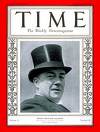 For various reasons Tory Historian is not a great fan of Stanley Baldwin (possibly that attitude has grown out of a long-held conviction that Lord Curzon ought to have become Prime Minister in 1923).
All the same, one must give credit where it is due and this is an excellent summary of what ought to be the mainspring of conservative political thinking:
"A government is not in power, it is in office, put there by the will of the people."Let us remember this every time some pipsqueak of a politician blathers on about the difficulties he or she faces in "running the country".
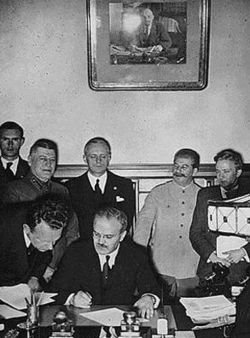 One of Tory Historian’s many weaknesses is an almost insuperable lack of interest in the actual military history of World War II. That is balanced by an abiding fascination with the politics around the various agreements before, during and after, particularly if these involved shenanigans to do with the great dictators.
Thus of the three anniversaries to be marked today – start of the Blitz (1940), start of the Battle of Stalingrad (1942) and signing of the Nazi-Soviet Pact (1939) – it is the last of them that is of particular interest.
The Pact, signed by Vyacheslav Molotov, who had replaced the Jewish Maxim Litvinov as Soviet Foreign Minister in May of that year and by Joachim von Ribbentrop, his German counterpart. Though it is sometimes referred to as the Stalin-Hitler Pact, the two tyrants never met.
The Nazi-Soviet Pact can be considered to be the real beginning of the Second World War. Whatever may have happened before that, once that was signed there was no way back. Though nominally a non-aggression treaty, it had secret clauses that referred to countries between Germany and the USSR falling into one or other sphere of influence.
In practice, that meant being invaded and there was a great deal of territorial rearrangement in the subsequent months.
The treaty stayed in force till June 22, 1941, that is Barbarossa Day, when Nazi Germany invaded what was then the Soviet Union (in fact, of course, eastern Poland, then western Ukraine that had been independent till 1938) and the deadly war between the two monstrous regimes began.
 Tory Historian sometimes finds it difficult to take the “martyrs” of the British labour or revolutionary movement seriously. There seems to be so few of them and so many potentially difficult situations are resolved peacefully in this country. Long may that continue.
Take the Tolpuddle Martyrs, for instance. Six of them and all came back after being deported. All that oppression during the French wars, real though it was, pales into insignificance when compared to what was going on in France at the same time. Think of how many people were killed in the suppression of La Vendée and in Lyons.
The one event that does merit sorrowful attention is the Peterloo Massacre of August 16, 1819, a clear example of panic and disorganization that resulted in 11 dead, one of them a woman, another a child carried by another woman and 400 injured. Still not on the La Vendée scale or the various massacres in Russia, let alone the Soviet Union, but something to talk about.
The most interesting part of it, however, is the outcome. The original meeting was called to advocate parliamentary reform, to widen the franchise. The horror of the Peterloo Massacre made those discussions more urgent, though it was not till 1832 that the Great Reform Act was passed, instituting a succession of constitutional reforms that would, in 1928 finally result in full and equal voting rights for all adults in the country.
Possibly a more important development was the move to establish civilian police forces in Britain, the most important of which was the Metropolitan Police Force, signed into existence on September 29, 1829. The Home Secretary, Sir Robert Peel, is said to have been greatly influenced by the events on St Peter’s Field, in August of 1819.
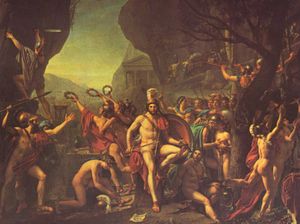 Tory Historian was brought up by an historian father, who had an overwhelmingly high opinion of western civilization and its progenitors, the Greeks of ancient times. Inevitably, the battles against the Persians, Thermopylae, Marathon, Salamis and Plataea were all names, familiar as household words (as the Bard said about another great battle).
Today is the anniversary of the Battle of Thermopylae. Well, to be quite precise, the anniversary of its beginning. The Greek army, led by the Spartan King Leonidas, held up the vast Persian army for seven days before finally succumbing to the overwhelming numbers.
The battle has remained an epitome of strength through patriotism, training and obedience as well as final sacrifice. The memorial on the battlefield, with the words of Simonides on it, says it all:
Oh foreigner, give a message to the LacedaemoniansThe battle may not have been successful from the Greek point of view but its length and the severe Persian losses allowed the Athenians to prepare for the subsequent, ultimately victorious fighting.
that here lie we, their words obeying.
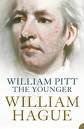 Michael Barone is one of the leading commentators in the United States and he seems to be something of an Anglophile. At least, he writes frequently and, usually, with approval on aspects of British life.
Here is his response, rather than review, to William Hague’s much lauded biography of William Pitt (readers will need to scroll down). Barone is greatly taken by Hague’s description of Pitt’s constant emphasis on the need for a long-term solution.
One of the most interesting aspects of the book, in Tory Historian’s opinion, is the special insight into the parliamentary activity of Pitt’s day that is given by a man with political and parliamentary experience.
It is outside the scope of this blog to comment on the politics of the Conservative Party as it is in 2006 rather than 1806, but one wonders what conclusions the author of this excellent biography has drawn to influence his own attitudes and statements as Shadow Foreign Secretary.
Charles Moore’s article in Friday’s Daily Telegraph dealt with the present Middle Eastern crisis and the somewhat incredible comparisons certain misguided British politicians (alas, the one he singles out is a great supporter of the CHG, Sir Peter Tapsell) have been making between Israel’s actions against Hezbollah and the German Nazis’ actions against the Jews in 1943.
Inevitably, Mr Moore looks at the background to the fact that, no matter which way one looks at it, European countries have next to no say in what is likely to happen in southern Lebanon or Gaza.
Part of the reason is recent politics and a refusal to understand that in order to be strong in international affairs one must be strong militarily but that is outside this blog’s scope.
However, all roads lead back to the Suez crisis:
“This week marks the 50th anniversary of the beginning of the last Middle East crisis in which Britain acted without concerting with America. On July 26, 1956, Gamal Abdel Nasser, the president of Egypt, nationalised the Suez Canal. Britain accounted for a third of the ships passing through the canal at that time, and we feared that Nasser had put his foot on our windpipe. Eden, perhaps reeling from his good fortune in having employed the young P. Tapsell, concocted a secret plot with France and Israel to regain control of the canal by violence and bring about the fall of Nasser.
Ignoring the delicacies of a presidential election in America and a president, Dwight D. Eisenhower, who had publicly made it clear that his country opposed force, we went ahead and invaded Egypt on November 5. Furious at having been deceived, America immediately refused to support the pound in the markets, and we crumpled almost overnight.
The then chancellor, Harold Macmillan, who supported the attack from the first but ratted on it in November, wrote in his diary on August 18: "…if Nasser 'gets away with it', we are done for… It may well be the end of British influence and strength for ever." Well, Nasser did get away with it, and British power in the Middle East did collapse.
We have now passed half a century in which the ultimate responsibility for these decisions has passed from us (and from France) to America. Unless we seriously propose to try to regain that responsibility, either alone or in concert, we do well to try to work closely with America rather than acting like a querulous octogenarian. Mr Blair's efforts in Washington yesterday to search for a ceasefire that prefers durability over immediacy are perfectly sensible.
Yet Mr Blair is bayed at by all parties and most of the media. It is as if, having relinquished power, we Europeans now wish our own powerlessness upon the rest of the world. We make vaporous and offensive Nazi comparisons. We preach that unilateral action is always wrong. That position can be maintained only by people who do not have to make life-and-death decisions. It is cheap and immoral.”
Who says we can learn nothing from history?
 It is a little unfortunate that Tory Historian was so busy on other matters as to miss one of the crucial dates for this country and the Conservative Party in the twentieth century.
Thursday saw the fiftieth anniversary of President Gamal Nasser’s nationalization of the Suez Canal. This act, in itself not unexpected, triggered off what turned eventually into a political crisis in Britain and made it clear to all the participants that the war-time alliance between Britain, France and the United States was no longer active.
It also led to the resignation of the Prime Minister, Anthony Eden.
We hope to see serious discussion on this blog in the next couple of months about the events that led up to the attempted invasion of the Canal by Britain, France and Israel and what the significance of those events might be. But, in the meantime, we could not pass the anniversary of the event that began it all, unmarked.
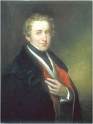 Yesterday Tory Historian attended a wonderfully interesting meeting of the Conservative History Group on the subject of Chamberlain’s reputation. A write-up of that will follow as soon as it is practicable.
Central to our understanding of the crisis that took up the second half of 1938 is the double appreciation that despite the fact that Churchill wrote the history of the period, Chamberlain was probably right politically and from the point of view of defence matters; and that he had public opinion on his side.
This led me to an interesting comment made by Sir Robert Peel:
“No minister ever stood, or could stand, against public opinion.”It is not so much public opinion that remains the problem more its expression by the media and other political interpreters. In Peel’s day there were still those immediate expressions of public opinion, the mob and the meeting. Over the last few decades both have largely disappeared. On the other hand, we now have the growing power of the blogosphere (still in its infancy in Britain) that might turn into another weapon of public opinion that circumvents its “interpreters”.
“Public opinion is a compound of folly, weakness, prejudice, wrong feeling, right feeling, obstinacy, and newspaper paragraphs.”As the French so aptly say: plus ça change, plus c’est la même chose.
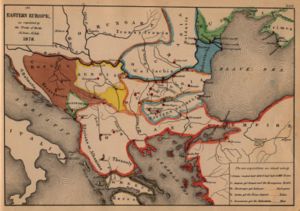 Disraeli again, I am afraid (there will be postings about Peel and others, I promise), as today is the anniversary of the signing of the Treaty of Berlin, the ending of the month-long Congress of Berlin in 1878.
“The treaty recognised the complete independence of the principalities of Romania, Serbia and Montenegro and the autonomy of Bulgaria, though the latter remained under formal Ottoman overlordship and was divided between the two principalities of Bulgaria proper and Eastern Rumelia, undoing Russian plans for an independent "Greater Bulgaria". The Ottoman province of Bosnia-Herzegovina as well as the former Sanjak of Novi Pazar were placed under Austro-Hungarian occupation, though formally remaining a part of the Ottoman Empire.”One could argue that the treaty launched many of the problems that culminated in the First World War and the subsequent unstable peace treaties but that would be a little unfair to the Earl of Beaconsfield whose negotiating skills elicited Bismarck’s admiring comment: “Der alte Jude, das ist der Mann.”
 Whenever I want to get depressed about American rather than British politics (well, after all, isn’t that what being Tory Historian is all about?) I think about the fact that Hillary Rodham Clinton is the successor to Daniel Patrick Moynihan as New York Senator.
Moynihan was a Democrat and it is useful to recall that until recently the division between conservative and “liberal” thinking was not along party lines. Moynihan, for instance was a man who believed in freedom internally and externally, individual responsibility and small government.
I particularly like this quotation that, I hope, will elicit comments from readers.
“The central conservative truth is that it is culture, not politics, that determines the success of a society. The central liberal truth is that politics can change a culture and save it from itself.”Where does the British Conservative Party fit in that equation?
 Undoubtedly many of this blog’s readers will disagree with it celebrating American Independence Day. It is undoubtedly true that at the time many Tories opposed the presumptuous Colonists’ Rebellion and it was a Whig, though one who has been seen as one of the founders of Conservative political thought, Edmund Burke, who spoke most eloquently in their favour.
It is, however, the 230th anniversary of the ringing proclamation of what can be seen as modern conservative values:
“We hold these truths to be self-evident, that all men are created equal, that they are endowed by their Creator with certain unalienable Rights, that among these are Life, Liberty and the pursuit of Happiness.--That to secure these rights, Governments are instituted among Men, deriving their just powers from the consent of the governed, --Whatever one’s views are on the Colonists’ Rebellion; whatever one’s views are on the way the United States developed in the eighteenth century and subsequently; few of us can fail to be touched by those words.
That whenever any Form of Government becomes destructive of these ends, it is the Right of the People to alter or to abolish it, and to institute new Government, laying its foundation on such principles and organizing its powers in such form, as to them shall seem most likely to effect their Safety and Happiness.
Prudence, indeed, will dictate that Governments long established should not be changed for light and transient causes; and accordingly all experience hath shewn, that mankind are more disposed to suffer, while evils are sufferable, than to right themselves by abolishing the forms to which they are accustomed. But when a long train of abuses and usurpations, pursuing invariably the same Object evinces a design to reduce them under absolute Despotism, it is their right, it is their duty, to throw off such Government, and to provide new Guards for their future security.”
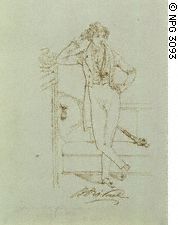 A long article on Benjamin Disraeli in the New Yorker by Adam Gopnik, loosely linked to the two most recent biographies: Christopher Hibbert’s “Disraeli: The Victorian Dandy Who Became Prime Minister” and William Kuhn’s “The Politics of Pleasure: A Portrait of Benjamin Disraeli”.
The article concentrates on Disraeli as adventurer who has lived his own dream and links him in various ways to modern politics. Specifically, there is a discussion as to whether he is the progenitor of Anglo-American conservatism of the present.
Mr Gopnik comes to the conclusion that he is not but his analysis of what the latter consists of is so inadequate as to make that conclusion questionable. Does he really understand what happened in Britain in the eighties and the nineties?
“Mrs. Thatcher’s ideological brilliance was to insist on Manchester-school politics to the exclusion of all else; the people who brought her down were the heirs of Disraeli, anxious about her rejection of the public welfare and more than a little snobbish about her openly middle-class antecedents.”Up to a point Lord Copper, as they said in Evelyn Waugh’s “Scoop”.
 Re-reading Harold Nicolson’s diaries for 1938 as part of separate research, I came across the entry for June 27:
“Anthony Crossley [Conservative MP for Oldham] takes me to task for being so anti-Chamberlain. He says I am working for his fall. He says that the Conservatives realise this and simply hate me. I say, ‘But surely, Anthony, they are always so polite when I meet them?’ ‘Yes,’ he answers, ‘that is part of their technique.’”Nicolson is generally acknowledged to be one of three members of the House (Churchill and Leo Amery being the other two) who opposed consistently the Munich Agreement and refused to cheer when the Prime Minister reported back on it.
“How difficult it is to decide! Vita takes the line that the Sudeten Germans are justified in claiming self-determination and the Czechs would be happier without them in any case. But if we give way on this, then the Hungarians and the Poles will also claim self-determination, and the result will be that Czechoslovakia will cease to exist as an independent State.By and large Vita Sackville-West was not interested in politics and could not be bothered to work her way through the various arguments often reacting emotionally to events. In this case, however, she managed to articulate the argument that was used by many people and quietly approved of by many more.
Vita says that if it is as artificial as all that, then it should never have been created. That may be true, although God knows how we could have refused to recognise her existence in 1918. It all seemed such a reality in those days.”
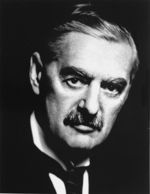 The next speaker meeting of the Conservative History Group will be held on Tuesday 18 July at 6.30pm in the Boothroyd Room of the House of Commons. The subject will be "The Reputation of Neville Chamberlain". Speakers are Robert Self and Professor John Charmley. If you'd like to attend please email info@conservativehistory.org.uk to register. If you're not already a member you will be expected to join on the evening!
 This posting may be seen as perhaps being somewhat irrelevant to Conservative history but it covers a subject that is so important that Tory Historian took a unilateral decision on posting it.
Today is the 65th anniversary of what turned out to be the crucial event of the Second World War – the German invasion of the Soviet Union, carried out despite the vows of eternal friendship of the 1939 Molotov – Ribbentrop Pact. It was the start of that monumental battle between the two most monstrous regimes of European history.
The one person who recognized fully the importance of the invasion was the Prime Minister, Winston Churchill, who displayed more relief at the turn of events in the immediate aftermath than he was to do even after America’s entry into the war.
Curiously enough, Stalin, who had never trusted anybody in his political career (and probably not before that, either) seems to have trusted Hitler. There are numerous accounts of his refusal to believe the news of the Nazi attack as it was being brought to him. He had, previously, refused to believe warnings sent to him by the British government and his own agents in the West that Hitler was planning an attack and probably in June.
There are various accounts of what happened immediately in the Soviet government and the top echelons of the party but, it seems, that panic set in and there was an immediate decampment from Moscow. Stalin’s greatest fear, shown in his refusal to set up a home guard as the capital itself became endangered during the autumn, was that people might turn against him.
This was not completely wrong. 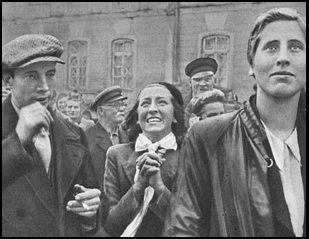 The people of Russia and other states of the Soviet Union are no less patriotic than anyone else but they had suffered considerably more from their own government than others. The propaganda picture of the people of Riga welcoming German invaders does not tell a complete lie. The German troops were welcomed at first in the Baltic states, in Byelorussia (now Belarus), in the Ukraine and even Russia itself.
We have to remember that it is not accurate to say that Germany invaded Russia in June 1941. They did not get to Russia itself for a number of weeks, despite the fact that the troops rolled forward unchecked, the air force had been destroyed and the trains that ought to have been bringing troops to the west were fully occupied carrying prisoners from the newly conquered countries to the east.
When the German troops crossed the border they were crossing from western to eastern Poland, both of which had been devastated by the two separate invaders. They then moved into the Baltic states who had lost around a third of their population into the Soviet gulags, moved on the Byelorussia and the Ukraine, both of which had suffered unspeakably from collectivization and the purges of the late thirties.
The Germans were seen as liberators and their drive to round up and murder the Jewish population was not always unpopular. Though many people, as in other countries, tried to help their Jewish neighbours and friends, many others saw the destruction of the Jewry as a just punishment for the fact that the Communist power, as they thought, had been imposed largely by Jews. Alas, there are too many people in that part of the world who still think that way.
While many in the higher echelons of the German army felt that they should capitalize on these feelings, disband the collective farms and install autonomous local governments, the Nazi ideology prevailed. The Slavs were also described as untermensch and treated accordingly. The horrors of the Nazi occupation of large chunks of the Soviet Union have been described by many.
Stalin’s own reaction was interesting. He first broadcast to the people on July 4. My mother, who was a teenager in Moscow at the time, has told me that his appeal to “brothers and sisters” caused panic. Things were far worse, the Russians reasoned, than anyone had told them if the old tyrant saw them as his brothers and sisters.
This is not the place to describe the subsequent developments of the war on the eastern front but a few aspects might be recalled, as we are often told that the EU is a direct and necessary reaction to the evil nationalism of, well, somebody called the Nazis.
We need to remember Stalin’s refusal to sign the Geneva convention and refusing to see Soviet PoWs as nothing more than traitors. All offers to help them by the Red Cross and the British government were refused. The severe maltreatment by the Germans of the Soviet prisoners cannot be excused but neither can Stalin’s own refusal to help.
We need to remember the lines of Smersh (Smert’ Shpionam – Death to Spies) machine gunners who stood behind the Soviet troops, mowing down those who tried to retreat from the German onslaught.
And we must recall that it was Stalin’s appeal to pure patriotism that made the Russians and many others fight on against all odds and through unimaginable losses until the victory of 1945.
We must also recall the nationalism of many other countries who fought the Nazis and its suppression by the Soviet “liberators”. The story of the doomed Warsaw uprising is just one of several one could recite.
Another 40 years elapsed before the second tyranny was overthrown.
The next issue of the Conservative History Journal will be out in just a couple of weeks. Almost all the material has now come in and the editor is busy doing the final bits of editing as well as looking up illustrations. So, for all those folks who are starved of intellectual entertainment: help is on its way.
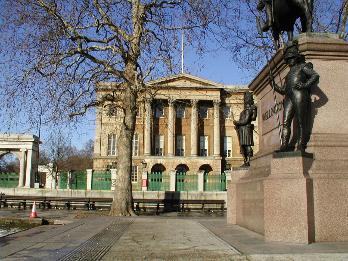 Yesterday, as all our readers know without doubt, was Waterloo Day and time for Tory Historian’s annual pilgrimage to Apsley House, where a great deal of jollification seemed to be going on.
Firstly, there were guards in appropriate uniforms; the Battle of Waterloo had been laid out on a large table in the Waterloo Gallery and enthusiastic children were helping no less enthusiastic adult experts to put away the model soldiers; there were also guided tours with good accounts of the battle and the history of the house, all listened to with rapt attention by other children and, naturally enough, their parents.
All of which makes me go off on that well-worn tangent: the teaching of history. For once, I’d like to concentrate not on the disgraceful lack of teaching in schools but on the assumption made by too many writers and organizers of events that the only way children’s interest can be kept is by jokes, hectic entertainment and as little information as possible. Some museums, I am sorry to say, have taken that view recently as well – entertainment rather than education.
But all evidence shows that interestingly presented historical information can capture and usually keep children’s attention. Why should they not find the Battle of Waterloo or the Napoleonic Wars in general interesting? The novels based on those wars sell in their millions. The reality is considerably more exciting.
Last year, when the anniversary was slightly more round that this year I became involved in an argument with a fan of the Emperor from the Continent. His argument was that, writing from a British point of view, I naturally assumed that the man’s defeat was a good thing for Europe and for freedom. But Britain was fighting not just for her existence as a country but also from a political and legal system that, despite the various problems, was more advanced than any of the Continental ones.
Even so, as Andrew Roberts points out in his “Napoleon and Wellington”, there were politicians and writers who, despite Napoleon’s growing despotism continued to support him against their own government, which happened to be of another party. Shades of more modern political and military debates there.
On the Continent, my correspondent maintained, the situation was different. With all his faults Napoleon was bringing some of the still untarnished ideas of the French Revolution with him – enlightenment, freedom of religion, destruction of feudalism. His defeat reversed all those processes, at least temporarily and returned power to feudal overlords.
What of the national wars of liberation, I asked, fought with increasing ferocity in several parts of Europe? That, too, in his opinion, was led by the local aristocracy who saw their power slipping away.
As they used to say in exam papers: discuss.
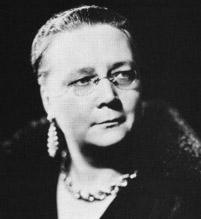 The fact that today is the birthday of one of the best-known detective story writers, Dorothy L. Sayers (1893 – 1957), gives me the chance to make a little detour in conservative history, not entirely unexpectedly, in the direction of that literary genre.
I have already expressed the view that the classic detective story is a peculiarly conservative form of literature, whatever the political views of the author (Julian Symonds, for instance, was one of the plethora of left-wing men of letters) and whatever the particular point of view expressed in the novel.
A detective story depends on the existence of a society that understands certain basic rules. In fact, everybody must understand and more or less agree on those rules, including the criminal. And the most important of those is that human life is not to be taken by another human being. That is a crime against nature as well as against society. The natural order of things can be restored only by the apprehension and punishment (in some form or other) of the criminal.
Dorothy L. Sayers is not, as it happens one of my favourite detective story writers. She was too verbose, too snobbish and there was more than a trace of anti-semitism in almost all her novels. There were many other aspects to her literary work – her religious as well as literary essays, a religious play for the BBC and, of course, her translation of Dante.
Still, she is mostly known as the writer of the Lord Peter Wimsey books (and a few stories with Montague Egg). Interestingly enough, the book that implicitly explores a conservative view of the world is one that does not have a murder in it, and that is “Gaudy Night”.
A tale of various ill deeds in an Oxford College, modelled on Somerville, it deals with subjects such as whether women should pursue careers or devote their lives to families; and whether personal relationships are of greater importance than the truth in academic pursuit.
There are many problems with the book, not least the fact that it is too long. But it does provide a vision of conservatism that is almost political: balance between the various factors. Balance between rationality and imagination, between the need to pursue career and the need to give to one’s family and, above all, balance between devotion to impersonal truth and devotion to individual human beings.
 It wasn’t all that long ago but seems to have been forgotten in the rush to declare the Conservative Party of the past the nasty party and its members, people who were barely seen to be human by the rest of the population. Really? How did that nasty, much-hated party of non-human aliens manage to win four elections, producing at least one landslide in 1983?
On June 9, the party led by Margaret Thatcher, took 397 seats to Labour’s 209 with the SDP Liberal Alliance managing 23. Michael Foot, presumably not wearing his famous donkey jacket, called the result a tragedy for the country. Well he would say that, wouldn’t he?
