
The Codebreaker Girls – Only 99c!
2 months ago
 Last week-end Tory Historian was wandering round Islington in London, carefully avoiding the very small trendy part of the old borough (there was, after all, a Fair Maid of Islington in the early eighteenth century and a Bailiff's Daughter of Islington mentioned in Percy's Reliques of 1765) and came across the statue of Sir Hugh Myddelton.
Although the man is clearly a hero in that part of the world, there was very little information about him on the pedestal. So, Tory Historian decided to investigate.
First stop was that old-fashioned piece of furniture, the bookshelf to consult a copy of the one volume Dictionary of National Biography, which said this about Sir Hugh Myddelton, first baronet (1560? - 1631):
Traded as a goldsmith, banker, and clothmaker; alderman of Denbigh 1597; M.P., Denbigh, 1603, 1614, 1620, 1623, 1625 and 1628; the London corporation having obtained a permission from Parliament to bring in a stream from Chadwell and Amwell, offered to execute the work. compelled by opposition and demands of the landlords to apply to James I for money, on which James paid half the cost on condition of receiving half the profits (the canal, which was about thirty-eight miles long, ten feet wide, and four feet deep, completed 1613); obtained large profits from some lead and silver mines in Cardiganshire, 1617; began reclaiming Brading harbour, 1620; created baronet, 1622.One must assume that James I reclaimed a substantial part of that money in return for the baronetcy.
 Nevertheless, one can begin to see why Sir Hugh Myddelton should be a hero, being the man who helped to bring clean water to London.
The due supply of pure spring water to the metropolis, had often been canvassed by the corporation. At times it was inconveniently scanty; at all times it was scarcely adequate to the demand, which increased with London's increase. Many projects had been brought before the citizens to convey a stream toward London, but the expense and difficulty had deterred them from using the powers with which they had been invested by the legislature; when Myddelton declared himself ready to carry out the great work, and in May 1609 'the dauntless Welshman' began his work at Chadwell, near Ware.Naturally enough there were many opponents to the scheme.
The engineering difficulties of the work and its great expense were by no means the chief cares of Myddelton; he had scarcely began his most patriotic and useful labours, ere he was assailed by an outcry on all sides from land-owners, who declared that his river would cut up the country, bring water through arable land, that would consequently be overflowed in rainy weather, and converted into quagmires; that nothing short of ruin awaited land, cattle, and men, who mightbe in its course; and that the king's highway between London and Ware would be made impassable! All this mischief was to befall the country-folks of Hertfordshire and Middlesex for Mr. Myddelton's 'own private benefit,' as was boldly asserted, with a due disregard of its great public utility; and ultimately parliamentary opposition was strongly invoked.The King's support and financial help seem to have been vital for the project, so one must not begrudge whatever profit James I himself made out of the whole project, not to mention the undoubtedly large sum that he extracted from Myddelton later on (as I suggested above) for that baronetcy.
 The building of the canal seems to have taken about 15 months (which raises certain questions, possibly not entirely appropriate to a history blog, about present day projects that are built or not with a great deal more mechanical assistance) and the New River was formally opened on September 29, that is, Michaelmas Day, 1613 with a great deal of pomp and circumstance, not to mention pageantry, as is to be expected from all events Jacobean.
There were present Sir John Swinnerton the lord mayor, Sir Henry Montague the recorder, and many of the aldermen and citizens; and a speech was written by Thomas Middleton the dramatist, who had before been employed by the citizens to design pageants and write speeches for their Lord Mayors' Shows, and other public celebrations. On this occasion, as we are told in the pamphlet descriptive of the day's proceedings, 'warlike music of drums and trumpets liberally beat the air' at the approach of the civic magnates; then 'a troop of labourers, to the number of threescore or up-wards, all in green caps alike, bearing in their hands the symbols of their several employments in so great a business, with drums before them, marching twice or thrice about the cistern, orderly present themselves before the mount, and after their obeisance, the speech is pronounced.'After speech making in verse, the floodgates were opened and the new canal began its function. London had its first taste of clean fresh water that flowed directly to the city.
 Famously, Hayek maintained that he was not a conservative or a Conservative with a capital "c". He is, nevertheless, the man who has influenced a good deal of modern conservative thinking. Right now he is out of fashion with the Conservative Party but his time will come again.
Hayek saw himself as a Whig or an old-fashioned Liberal, political categories that have been subsumed in other parties, notably the Conservative one of yesteryear.
At the end of the "Constitution of Liberty", the book Margaret Thatcher was supposed to have shown to the Conservative Central Office policy wonks on her election as leader of the party, explaining that this was what she believed in, there is a chapter: "Why I am not a Conservative?".
In it Hayek sums up the benefits of a free political system in very practical terms:
The main merit of the individualism which Adam Smith and his contemporaries advocated is that it is a system under which bad men can do least harm. It is a social system which does not depend for its functioning on our finding good men for running it, or all men becoming better than they are, but which makes use of men in all their given variety and complexities, sometimes good, sometimes bad, sometimes intelligent, more often stupid.One really cannot say it any better or more elegantly.
 Tory Historian was browsing through the Defense Visual Information Center's photographic archives - all freely available for use by the public - and came across this remarkable and moving picture.
This was taken on May 13, 1945. The war in Europe had finished but the war in the Far East was still raging.
The picture is that of the bombed out Coventry Cathedral where wounded US troops from nearby hospitals were attending a Mother's Day service.
 Another dam' long screed, to misquote the Duke of Cumberland's comment to Edward Gibbon. Scribble, scribble.
To continue the saga of the propaganda war waged after the Reichstag fire.
The first aspect of the counter-offensive was “The Brown Book”, followed later on by “The Second Brown Book”. Münzenberg mobilized many of the West’s intellectuals whom he had already enmeshed in his network or the Münzenberg Trust as it was known, to support this endeavour. Names of others, such as Albert Einstein, who protested, were simply added.
“The Brown Book” was probably written largely by Willi’s henchman and probably NKVD agent, the Czech Communist Otto Katz, who may well have been involved later on in Masaryk’s “defenestration”. Subsequently, the grateful Communist government of Czechoslovakia put him on trial together with Rudolf Slánský in the great show trial of 1952. (Incidentally, the trials of the tortured and pressurized accused were filmed and shown. Their self-abasement was made public at the time and later.)
Katz, the ruthless manipulator and brilliant propaganda writer, was accused of Zionism and espionage, confessed to all his “crimes” and begged to be executed as he had no right to live. His masters obliged and he was hanged.
As Stephen Koch, author of “Double Lives” and Sean McMeekin, author of “The Red Millionaire”, Münzenberg’s biography, argued “The Brown Book” so highly praised at the time and so valued by various historians, was largely a pack of lies. In fact, the lies were not really substantiated and only self-imposed hypnosis could have made all those writers and reviewers swoon with praise at the time.
There were three parts to the book. The first one told inaccurately of the Nazi rise to power, blaming largely the Social-Democrats and, naturally enough, being rather reticent about the war the KPD waged on the SD and the Weimar democracy in general.
The second part dealt with Nazi oppression in general and was, as Sean McMeekin puts it, “intuitively correct”, though short on facts. “The Brown Book” emphasised oppression as it affected left-wing parties and individuals not those dreadful people, capitalists, under which rubric came anyone who did not support the KPD.
Nor was there anything about the growing persecution of Jews. Instead of giving examples, the book and its supposed author, merely quoted Lenin’s attack on rich and powerful Zionists, adding quite dishonestly, that rich German Jews had not felt any discomfort under the Nazis. In fact, there was a great deal of indignation that the Nazis accused various non-Jewish left-wing and, above all, Communist activists of being that.
How ironic that the real author of this document should have ended his life as a “Zionist spy”. Communist history is full of ironies of this kind.
The third part dealt with the Reichstag fire and produced the accusations that it was organized by the Nazis, specifically by Göring. To prove this there were fraudulent charts and “photographs” produced that showed a network of subterranean passages through which the Nazis could have entered while Van der Lubbe was torching the place, to give him a hand.
To top the accusations, there were clear innuendos that Van der Lubbe was the SA Chief Ernst Röhm’s catamite, possibly a sexual toy boy to the SA in general.
Even at the time this was thin and has since been disproved quite categorically by, among others, Fritz Tobias in his 1964 book, “The Reichstag Fire”. No other writer has produced any evidence to back the half-baked assertions of “The Brown Book” and “The Second Brown Book”. They have, nevertheless, penetrated into popular psyche to quite an astonishing degree.
Münzenberg’s other ploy was the London counter-trial, the template for many other subsequent “trials”. It was timed to open the day the Leipzig trial of Van der Lubbe, Dimitrov and the others was to start, September 21, 1933.
The counter-trial was chaired by D. N. Pritt KC, barrister and member of the Labour Party, who was also one of the leading fellow travellers. In subsequent years he would use his standing as a barrister and a “silk” to explain why the Soviet show trials were legally entirely correct and how the guilt of the accused had been proved beyond any reasonable doubt.
The other "judges" were Maìtre Pierre Vermeylen of Belgium, George Branting of Sweden, Maìtre Vincent de Moro-Giafferi and Maìtre Gaston Bergery of France, Betsy Bakker-Nort of the Netherlands, Vald Hvidt of Denmark, and Arthur Garfield Hays of the United States.The lawyers, except for Pritt, complained about the atmosphere in the “court room”, the pressure under which they were put by Münzenberg, the lack of evidence and the laughable testimony produced by friends of Willi wearing SA uniforms and masks.
 Meanwhile, the real trial, in Leipzig was also a success for the Comintern. Dimitrov [pictured on the right], a superb speaker, dispensed with his defence lawyer and used the four month long trial to proclaim repeatedly his and his comrades’ innocence and the Nazis’ guilt as well as the guilt of all those who did not support the Communist line.
 Van der Lubbe [pictured on the left], by now probably heavily drugged, drooling and giggling, continued to insist (in so far as he could insist anything) that he did it all by himself to call attention to the problems of the German workers.
 Here is an interesting question for all our readers? Who burnt down the Reichstag in 1933? Can you recall the name of Marinus Van der Lubbe, the somewhat crazed Dutchman, who actually set it on fire? And even if you can, do you not think that there was somebody behind it all? After all, it could not be just a lone lunatic?
It would be interesting to know how many of those who read the above paragraph nodded and said: “Of course, Hitler ordered and manipulated Van der Lubbe (assuming you can recall the name) and then used the fire to get rid of the opposition and to blame the Communists.”
I am willing to bet that nobody said: “Oh yes, it was the Communists and they managed to get away with it because Dimitrov’s trial was unsuccessful. Hitler merely took advantage of the event.”
That, ladies and gentlemen, is the difference between good and bad propaganda. The truth is that Van der Lubbe [pictured here] did act on his own. This has been investigated and proved by a number of historians. No evidence has been found of anybody else’s involvement. (And, please, do not remind me of such things as Kirov’s murder, in December 1934. The evidence for Stalin’s involvement is everywhere.)
Further, Hitler did take advantage of the fire to do what he had always planned to do and destroy the remnants of German democratic parliament. All of that is true.
Now we come to the battle of the propagandists. Everyone, but everyone, quotes Dr Göbbels’s comment about the big lie and compares every would-be spin doctor with him. But who actually believed Göbbels? A large proportion of the German people for a time and some supporters in other countries who wanted to believe him.
As opposed to that, millions of people across the world repeat certain “truths” for which there is “full agreement” without once realizing that it is propaganda first started by that genius of spin doctoring and promoter of the Comintern, Willi Münzenberg [pictured above], without even knowing his name or comparing any tuppenny-ha’penny press officer to him. Now that is propaganda. Sheer genius. Back to the Reichstag fire. It occurred on the night of February 27, 1933 and the perpetrator was not hard to find. Van der Lubbe, a supposed Communist and an unemployed bricklayer, clearly mentally retarded, was found inside the building.
The following day the recently elected Chancellor, Adolf Hitler, went to see the President, Hindenburg, who signed an order that closed down all non-Nazi parties and banned the Communist one.
A few days later the Gestapo arrested four Communists, intending to try them with Van der Lubbe. Ernst Togler was a senior member of the KPD (Kommunistische Partei Deutschlands, German Communist Party), one of those who had not managed to escape. An arrest warrant was issued for him immediately and he surrendered himself to the police, something the KPD would later hold against him.
The other three were Bulgarians: Georgi Dimitrov, Vasil Tanev and Blagoi Popov, members of the Comintern.
What the Gestapo had not realized that Dimitrov was the head of the West European section of the Comintern and, thus, a close adviser of Stalin’s, one of the few people the latter would make an effort for. Normally Communist parties and their members would be sacrificed without a blink of an eyelid.
In addition, the man who had been charged to promote the cause of the Soviet Union and the Communist International through apparently innocuous publications, Willi Münzenberg was reasonably anxious to become involved.
Münzenberg was a German Communist, one of the few from a working class background. He was a deputy in the Reichstag and the owner of two newspapers and a publishing firm. He was also the most skilled propagandist the Soviet Union and its cause ever had. He did not write propaganda, he organized it, setting up hundreds of committees, using front organizations to run other front organizations, inspiring intellectuals to become fellow travellers and to manipulate other, innocent and ignorant intellectuals. In other words, he was the man who created the atmosphere in which it is considered to be normal to be on the left of the spectrum and intensely moral to support some of the worst tyrants in the world, as long as they seem to be a left-wing cause.
As Stephen Koch, author of “Double Lives” wrote in the New Criterion:
He wanted to instill the feeling, like a truth of nature, that seriously to criticize or challenge Soviet policy was the unfailing mark of a bad, bigoted, and probably stupid person, while support was equally infallible proof of a forward-looking mind committed to all that was best for humanity and marked by an uplifting refinement of sensibility.Before 1933 he had been enormously successful in his organizational activity. His biggest achievement was the Sacco-Vanzetti case. He took the case of two obscure Italian anarchists who had been accused of robbery and murder (of which Sacco was almost certainly guilty and Vanzetti possibly innocent) and turned it into a left-wing cause célèbre, achieving two things.
 Tory Historian is a great admirer of Benjamin Disraeli, the presiding genius of political spin doctors, as the historian John Charmley once put it.
Tory Historian is also fond of the odd quotation or two. Therefore, it is with great pleasure that this blog publishes the following quote from Dizzy:
The wisdom of the wise and the experience of the ages are perpetuated by quotations.One could never put it better oneself.
Nothing like consulting great Tory thinkers. Tory Historian is back on line.
 Tory Historian has been, unsurprisingly but only temporarily, flummoxed by modern technology, to wit, new blogger. Therefore, postings will be indirect, through Helen, while Tory Historian consults greater minds.
With the help of the Great Doctor, normal service, we hope, will be resumed as soon as possible. In the meanwhile, look upon Helen's postings as those emanating from Tory Historian.
 Certainly one can argue as one reader did very forcefully and Tory Historian somewhat less so, that Lincoln was not in any real sense a conservative. There can be no such argument about the fortieth President of the United States, Ronald Reagan.
Tory Historian is fully aware that a couple of Reagan quotes went up on this blog very recently but this story is not a very well known one and is worth repeating.
It comes from a book already mentioned in a previous posting: John O’Sullivan’s “The President, the Pope and the Prime Minister” and describes an episode that took place in 1984, when Reagan was over in France for the 40th anniversary of the Normandy landings.
For some reason, hard to discern now, the American President who had been the first to be called a cowboy and a bully by the West Europeans who were sheltering under the NATO umbrella was temporarily quite popular with the French government and with President Mitterand.
Here is the story from O’Sullivan’s book. To understand it fully one must remember that Reagan had volunteered for the US Army six years before the outbreak of World War II but because of poor eyesight and deafness in one year was assigned to making films for the armed forces at the outbreak of hostilities (I suspect, that means 1941).
Later that day [of Reagan’s address to the veterans], Evan Galbraith, the U.S. ambassador to Paris, brought the president some heartwarming news. The French government had decided to award him a decoration. Galbraith had not been told exactly what decoration; he thought it might be the Croix de Guerre.As the famous saying goes: they don’t make ‘em like that any more.
“The Croix de Guerre,” said Reagan, looking distinctly upset. “I couldn’t possibly accept that. That’s for bravery. All I did in the war was to fly a desk.” He asked Galbraith to find out if it were true and to solve the problem. Some time later the ambassador returned with the good news that the decoration was the Legion d’Honneur. But Reagan was still not quite satisfied. What was the citation? What were they giving him the honour for?
“For statesmanship,” replied Galbraith.
“Oh, statesmanship!” said Reagan and relaxed. “I can play that.”
 One thing leads to another as I have had occasion to mention. Another article led me to quote Abraham Lincoln’s famous saying about not being able to fool all of the people all of the time – a saying that all politicians should repeat to themselves every day – and to find a few other rather good ones.
It is, of course, debatable whether Lincoln was a conservative. The conclusion one comes to is much like the conclusion one comes to on most politicians: depends on what you mean by conservative.
Freedom from slavery, all slavery, is an important part of conservative thinking now, though it was not necessarily so in the middle of the nineteenth century. Tory Historian has just acquired a copy of Jeremy Black’s latest work (how does the man do it?) on the slave trade and is looking forward to reading it and sharing opinions with readers of this blog.
At the launch Professor Black made the straightforward and obvious comment that slavery has been the norm throughout most of history. One might argue that it has never been completely abolished in some parts of the world either in the state or private form.
What is unusual, though Professor Black did not say it, is the assumption developed in parts of the western world in the middle of the eighteenth century that slavery in any shape and form was wrong.
Going back to Lincoln, though, his views on trade – he was a complete protectionist and believer in high tariff, which was one of the causes of the War Between the States – would have delighted some Tories and the odd Conservative now. Others run from the idea in great terror. When they stop running they point out that most Anglospheric countries have done extremely well under free trade arrangements.
Given his shenanigans with the Supreme Court, it is hard to take Lincoln’s solemn pronouncements about the sanctity of the Constitution too seriously but here is one quotation that Tory Historian is sure will appeal to lots of readers:
This country, with its institutions, belongs to the people who inhabit it. Whenever they shall grow weary of the existing government, they can exercise their constitutional right of amending it, or exercise their revolutionary right to overthrow it.Here is another one that is singularly apposite to events in the world at the moment:
The shepherd drives the wolf from the sheep's for which the sheep thanks the shepherd as his liberator, while the wolf denounces him for the same act as the destroyer of liberty. Plainly, the sheep and the wolf are not agreed upon a definition of liberty.Indeed, the sheep and the wolf rarely agree on anything.
 Tory Historian apologizes for the gap in postings. These will resume with their usual (and even better) regularity. Of course, should any reader want to post something, Tory Historian will be happy to know of it.
In the meantime, here is an illustration from one of the greatest of the twentieth century novels, Mikhail Bulgakov's "Master and Margarita", a modern reworking of the Faust legend, a novel account of the Crucifixion and the events surrounding it, a satire on the Soviet Union and many other things. Tory Historian cannot recommend it highly enough.
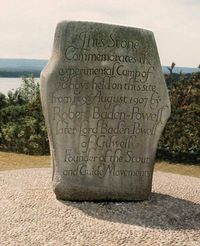 January 24, 1908 marked the publication of the first instalment of Robert Baden-Powell’s “Scouting for Boys”. There were six fortnightly instalments, which were collected and published in book form later in the same year. Both the magazine and the book version became immensely popular and not just among parents but among boys as well.
The story is well known. Robert Baden-Powell had defended Mafeking and part of his strategy was to mobilize boy volunteers into groups of scouts, thus leaving the fighting to the men. As the Wikipedia entry on the subject puts it:
The youths supported the troops by carrying messages, which freed the men for military duties and kept the boys occupied during the long siege.The idea of keeping children occupied with something useful that they can perceive to be useful is not a particularly difficult one but has disappeared from most of our educational discussions.
 Counterfactuals are a lot of fun and, except for people who say rather grandly that they are not interested in alternatives, thus showing themselves to be determinists, of some import. Faced with certain historical developments it is tempting to take them apart and remove one particular aspect to see whether the same conclusion could have been reached. Most times the author of the counterfactual has to admit that history would probably have been quite similar.
There are, of course, some events and some people so crucial to the particular historical development that took place that their absence would, quite literally, have made all the difference in the world. One such event is the arrival of Lenin at the Finland Station in Petrograd in April 1917.
The one I am proposing as a question is considerably less important and less likely to have made any difference.
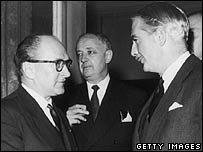
There has been a great deal of what might be called kerfuffle around the formerly secret documents, now unearthed, that show Guy Mollet, then Prime Minister of France, proposed, firstly, a union between France and Britain and, when that was greeted with pursed lips and raised eyebrows, for France to become part of the Commonwealth.
As it happens, Sir Anthony Eden rejected both suggestions, no doubt with some bemusement and elegantly raised eyebrows. Had he not done so, neither idea could possibly have got through either Westminster or the Assemblée Nationale. So, that’s really that. The story is of interest only as a possible counterfactual analysis: what if France had become a member of the Commonwealth in 1956?
On the other hand, it might be worth one’s while to speculate a little as to why Mollet came up with such a harebrained and rather desperate scheme. After all, nobody had treated Churchill’s suggestion of an Anglo-French union in 1940 particularly seriously.
Mollet is generally described as an Anglophile though as someone on the left of French politics his Anglophilia remains somewhat questionable. He does seem to have been impressed and grateful for the help Britain had given the French resistance during World War II.
There is the suggestion that he wanted to use the British card in his negotiations with West Germany over the Common Market. Unfortunately, the British card was no longer in the pack, having dropped out in 1955.
A more serious problem in the autumn of 1956 was France’s involvement in North Africa and the Middle East. The Algerian War was beginning to take its toll in political and economic terms and the French suspected rightly that Gamal Nasser, the self-appointed ruler of Egypt was supplying the FLN with arms and ammunition in the name of the anti-colonial struggle.
As a left-winger, Mollet had previously opposed French colonialism in North Africa and welcomed all chances of negotiation with the FLN. As Prime Minister, he announced that the rebels had to be defeated first and negotiated with afterwards. Possibly, as one who had opposed the war previously, he felt anxious to prove his credentials as a strong leader.
France was still a staunch ally of Israel with a left-wing government being particularly strongly supportive. (How times change.)
When Nasser announced the nationalization of the Suez Canal in July, France was considerably more gung-ho than Britain in her desire to punish the upstart leader. It was France that pushed the initially reluctant Israelis towards a military plan.
September 1956 was a time when Britain once again seemed to be dragging her feet. British soldiers had left the Suez zone. Initial support for a military solution to the crisis was waning. Israel was worried that she would find herself in the unwelcome position of the fall guy. And the war in Algeria was going on.
Mollet came up with his rather desperate proposal in the hopes that Britain would be tied more firmly into the French struggle to hang on to Algeria and other parts of North Africa, nipping the growing anti-colonial fight led by Egypt, if not precisely in the bud then not too long after early flowering.
The ideas were rejected and the Suez adventure ended badly, not least because of lack of American support. As it happens, the Israelis were successful beyond their wildest dreams in the Sinai but Nasser and other Arab leaders chose to ignore that, concentrating on the humiliation of the two colonial powers, France and Britain.
It was after the Suez debacle that Konrad Adenauer told Mollet that he should make the European Community his revenge for Suez and the negotiations proceeded apace. Britain chose to learn another lesson which, given the much closer cultural links with the United States, made perfect sense: a revival and fostering of the “special relationship”.
The Algerian War went on to its disastrous ending and Nasser’s refusal to accept that Egypt had been militarily defeated in Sinai led almost inexorably to the catastrophe (from the Arab point of view) of the Six-Day War in 1967.
Would any of it have been different if Mollet’s proposals had been taken seriously?
This is the one, Tory Historian suspects, everyone has been waiting for. Are there any new quotes from Margaret Thatcher? Well, I have chose a couple of less well known ones but, I expect, most of our readers on this side of the pond will have heard them.
To me, consensus seems to be the process of abandoning all beliefs, principles, values and policies. So it is something in which no one believes and to which no one objects.And one that is very well known but is rarely given in full:
Why do you climb philosophical hills? Because they are worth climbing. There are no hills to go down unless you start from the top.
There is no such thing as society: there are individual men and women, and there are families.Though not, perhaps, for those who think the state is the one to solve all the problems.
Before I get on to the lady everyone is waiting for (and there has been a fair amount of posting about her) let me produce two quotations from that greatest of all communicators, probably the greatest twentieth century American president, Ronald Reagan. One well known, one not so well known.
Government's view of the economy could be summed up in a few short phrases: If it moves, tax it. If it keeps moving, regulate it. And if it stops moving, subsidize it.
How do you tell a communist? Well, it's someone who reads Marx and Lenin. And how do you tell an anti-Communist? It's someone who understands Marx and Lenin.
Tory Historian has been reading instead of going to exhibitions (well, apart from following the abysmally bad East meets West trail at the Tate Britain) and the book of choice is John O'Sullivan's "The President, the Pope and the Prime Minister", already out in the United States and due out in the UK in the spring. This will be a must-read for all conservatives with either a big 'C' or a small one as it tells the story of three conservatives (Reagan, Thatcher and John Paul II, since you ask) who, n ot so long ago, changed the world we all inhabit.
There will be more postings on the book but this time I would like to recall one of the players: John Paul II, the man who helped to reignite the fight against Communism in Eastern Europe and gave hope to many millions of people there. One does not have to be a Roman Catholic to understand and admire the man's achievement in the political world.
One thing leads to another and reading the book has led to looking up some of John Paul's better known sayings. Here is one I particularly like, as it is the all-purpose reply to anyone who whines about people's alienation in the free world with a free economy:
The historical experience of socialist countries has sadly demonstrated that collectivism does not do away with alienation but rather increases it, adding to it a lack of basic necessities and economic inefficiency.Freedom can, indeed, be quite frightening. But slavery will not provide anyone with security.
 Back in the days Tory Historian studied A level history there was a saying (one with which most readers are probably familiar).
Only two developments in history are inevitable: the country (whichever country) is always going to the dogs and the middle classes are always rising. In fact, there was an urban myth of a history examiner who set the following question: "Give an example of a period when the middle classes were not rising in England and explain why not." Not sure whether there were any takers.
According to Andrew Roberts, a Conservative historian if ever there was one, the present rise of the middle class in the shape of Kate Middleton, possible bride to Prince William, is an entirely GOOD THING. Good for the monarchy and, therefore, good for the country. Sadly, the article is in today's Evening Standard, the newspaper with the most useless website in existence.
Mr Roberts considers it rather a problem that the British royal family has consistently married either European royals (sometimes it worked but sometimes not) or offsprings of the English aristocracy (sometimes it worked but most often not). They should look beyond that rather limited gene pool to the middle classes.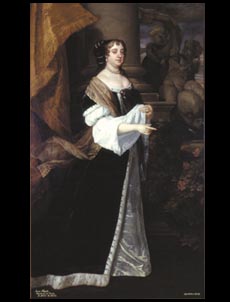
The last time it happened was in 1660, when Anne Hyde, daughter of the politician Edward Hyde, married James, Duke of York, the future King James II. She turned out to be an excellent wife for him, and she ran his politican and economic affairs adroitly. Samuel Pepys might have complained in his dary that "The Duke of York in all things but his amours was led by the nose by his wife," but she led him very well. Had it not been for her tragically early death in 1671, aged only 34, James might not have become one of the most disastrous and shortest-reigning monarchs.There is a wonderful idea for a counterfactual article: what if Anne Hyde, wife of the Duke of York, had not died in 1671. After all, we know that his second marriage, wherein he reverted to type, was anything but successful for him as King. Then again, would we have had the Glorious Revolution?
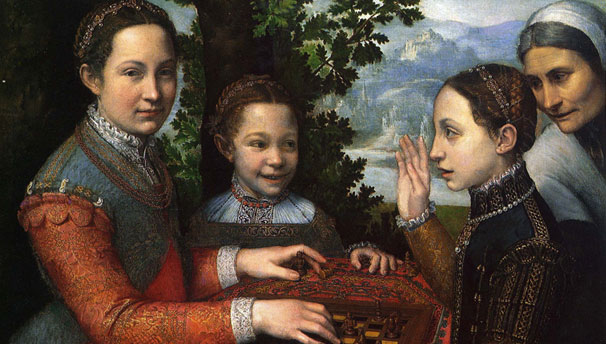 Another Bank Holiday and another exhibition. On New Year’s Day Tory Historian visited the excellent and, alas, soon to close “At Home in Renaissance Italy” at the Victoria and Albert Museum. In parenthesis it might be noted that the V & A is a superb museum or would be if the powers that be would finish developing it and get down to running it.
Anyway, the exhibition was not much liked by Brian Sewell, who felt that anything that was not precisely high art and …. gasp …. had a good deal of information about women (domestic life, you see) was really beneath contempt. Or wretched, as he would say.
Tory Historian does not share those prejudices, not least because, as the exhibition notes made it clear, the division between art and craft was not as clear-cut in fifteenth and sixteenth century Italy as it has been since the Romantic period. Mr Sewell, of course, knows that, but makes a point of being contemptuous of many things.
Indeed, the inevitable focus on women and their role was a particularly interesting aspect of the exhibition. The great households of the Italian nobility and the smaller households of the financiers and bankers together with the smaller or, at least, poorer households of the merchants and townsfolk and peasants were run by the women. To be honest, these households resembled small and medium sized businesses and running them well required various skills.
Growing out of that need was the appearance of some of the first books of etiquette, household instruction and cookery. This, of course, presupposes that a sizeable proportion of the women could read those books.
The V & A, on the whole, does not believe in dumbing down. The notes in the permanent and temporary exhibitions can be populist but are definitely on the educational side of the divide. Here they provided a good deal of information and were heavily spiced with useful quotations from contemporary works of literature and instruction.
There were one or two mis-steps. Incorrectly, it was pointed out that women’s lives revolved entirely around their biological cycles. The rest of the exhibition gave a lie to that comment. Of course, biological cycles were and are important. Equally, birth, marriage and death were and are crucial events in all lives and many rituals surrounded them in the Renaissance and do so now. But, as I said above, running those households required skills, training and ability. On top of which, they had to entertain guests, be knowledgeable at least to some extent about the various art and craft works around them (to be able to show them off in the right way), read books, say their prayers and teach their children and, according to the artist Sofonisba Anguissola, play chess.
Clearly, the cooking both of household meals and grand banquets were heavily supervised by the mistress of the house, who took part in some of the preparations, particularly of such things as pastry or some special cordial.
Tory Historian possesses a Penguin edition of a book of sixteenth century recipes, edited by Hilary Spurling, “Elinor Fettiplace’s Receipt Book”. The Fettiplace family were undoubtedly aristocratic but it is clear from the collection and the “receipts” in general that the lady of the house ran the house, particularly as her husband was frequently away at court. Part of that entailed keeping a collection of recipes for cooking, medication, cordials and preserves.
The recipes may have been written out by a secretary but Lady Fettiplace had clearly added new ones and made notes on others. She also swapped recipes with others, like Sir Kenelm Digby and various relatives.
It would be interesting to work out exactly when that attitude changed and it became a badge of honour to the family for the ladies of the house to be idle. There is an interesting conversation in “Pride and Prejudice” that might indicate a change at that very time, though Jane Austen herself, together with her sister, had plenty of domestic duties.
Mrs Bennett has come to visit Jane and Elizabeth who are staying perforce at Netherfield, Mr Bingley’s house. On Elizabeth’s enquiry about her friend Charlotte Lucas, Mrs Bennett explains that she and other Lucases had called in but Charlotte could not stay long as she was wanted at home in connection with the mince pies. Sir William Lucas clearly ran an old-fashioned household in which the women had plenty to do and the boys, possibly, less so. Mrs Bennett explains rather proudly to Mr Bingley and the others that as far as she is concerned there were servants to deal with such matters as the mince pies.
That raises an interesting question: exactly what did the Bennett girls do with themselves day in and day out?
A very happy and prosperous new year to all readers of the Conservative History blog (and of the Journal, whose next issue will appear in January). Tory Historian intends to carry on writing the somewhat random postings of the kind that appeared last year and hopes that many more readers will join in the discussions.
Together with my co-blogger, Iain Dale, I hope that many more of you will join in the Conservative History Group activities and, if you have any ideas about them, please let us know either here or through the Conservative History Group website.
In the meantime, let me remind everyone of an interesting historical date. On January 2, 1776 the Continental Congress published the Tory Act, a set of instructions on how to deal with those misguided, misinformed and mistaken individuals who persisted in supporting loyally their King and Country, that is George III and Great Britain.
The instructions were mild and smacked more than a little of a desire to re-educate those who have been “been deceived and drawn into erroneous opinions, respecting the American cause, and the probable issue of the present contest”.
Resolved, That it be recommended to the several Committees, and other friends to American liberty in the said colonies, to treat all such persons with kindness and attention, to consider them as the inhabitants of a country determined to be free, and to view their errors as proceeding rather from want of information, than want of virtue or public spirit, to explain to them the origin, nature and extent of the present controversy, to acquaint them with the fate of the numerous petitions presented to his Majesty, as well by Assemblies as by Congresses for reconciliation and redress of grievances, and that the last from this Congress, humbly requesting the single favor of being heard, like all the others has proved unsuccessful; to unfold to them the various arts of administration to ensnare and enslave us, and the manner in which we have been cruelly driven to defend by arms those very rights, liberties and estates which we and our forefathers had so long enjoyed unmolested in the reigns of his present Majesty's predecessors. And it is hereby recommended to all Conventions and Assemblies in these colonies liberally toSadly, as the war proceeded, many of these good intentions were abandoned and Loyalists found that they had to flee for their lives (those who managed it). Never mind – Canada benefited.
distribute among the people the Proceedings of this and the former Congress, the late speeches of the great patriots in both houses of parliament relative to American grievances, and such other pamphlets and papers as tend to elucidate the merits of the American cause. The Congress being fully persuaded that the more our right to the enjoyment of our ancient liberties and privileges is examined, the more just and necessary our present opposition to ministerial
tyranny will appear.
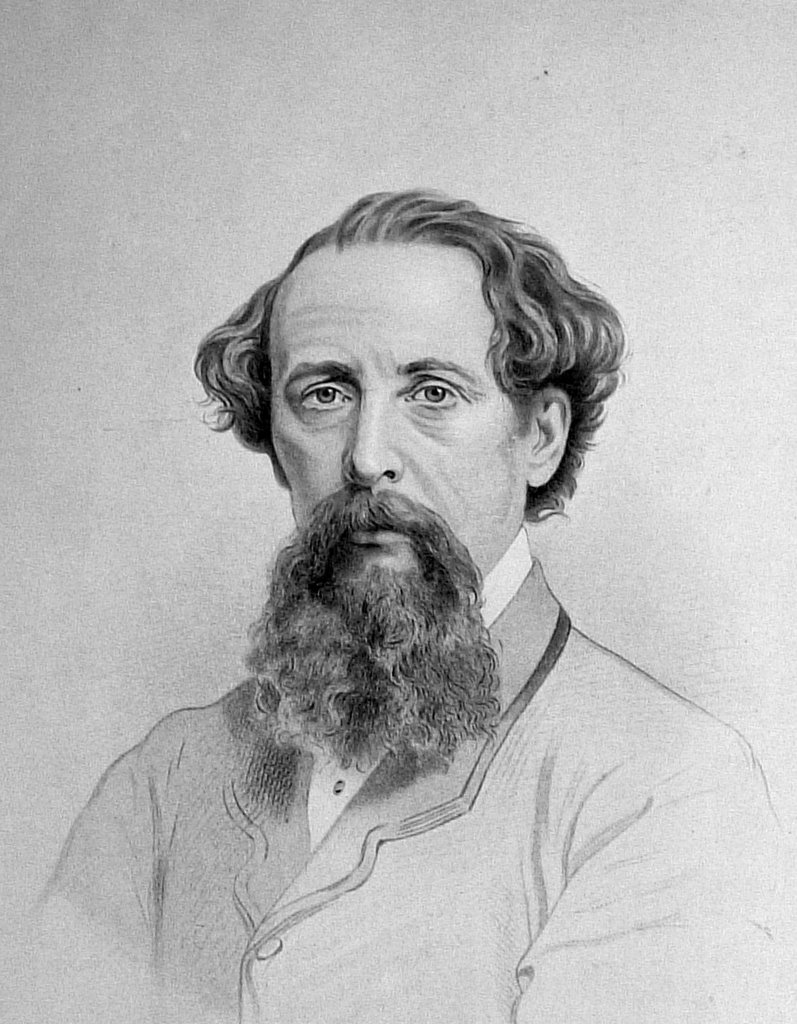 On Boxing Day Tory Historian fulfilled a long-standing plan and visited Dickens House in Doughty Street. Charles Dickens lived there for only three years but it would appear that all the other houses in London that he lived in have been knocked down. So, one takes what one can get.
The house is well-arranged and there is a great deal of information about the man, his work, his life and his friends. A rather surprising failing was in the food department. The drawing room was decorated as for an early Victorian Christmas but the display of festive goodies on the table was rather miserable, as were the promised refreshments before a reading of a part of “The Christmas Carol”. This is not a question of greed. Dickens was pre-eminent in his descriptions of food and drink and general jollity. Those refreshments should have included at least a few of the goodies he describes. To have a couple of boxes of Marks and Spencer biscuits and a few cartons of juice with two bottles of rather uninteresting wine did not do the great man justice. Why not mulled wine with a great deal of raisins and orange peel in it together with a really fine Christmas pie? (Is there a possible career for Tory Historian here?)
There was an exhibition called “Ignorance and Want”, referring to the two miserable children who cling to the Ghost of Christmas Present and dealing with Dickens’s fight both in his writing and in action against those evils. The exhibition immediately raised the question of whether Dickens was a radical as he is described by many.
Undoubtedly, he was on the side of the underdog, of the oppressed, of the humiliated, no matter who they were. In “Tale of Two Cities” he makes it clear that the horrors of the revolution are brought about by the behaviour of the French aristocracy or the rather degenerate members of it that he writes about. But, once the tables are turned, the tumbrils are rolling, the tricoteuses are in place there can be no doubt as to whose side the author is on.
Be they underfed and severely flogged children, exploited clerks, girls forced into prostitution or any other group of victims, Dickens was on their side. He wrote about them with real passion and he tried to help through various organizations such as those set up by Angela Burdett-Coutts. But was he a radical?
It was George Orwell in his first-class essay of 1939 entitled simply “Charles Dickens” who first posed this question and noted that Dickens and his novels are loved by all those he attacked: lawyers, civil servants, teachers of all kind, rich and poor alike. The reason for that, Orwell posited, is that Dickens had not interest in either changing or subverting society.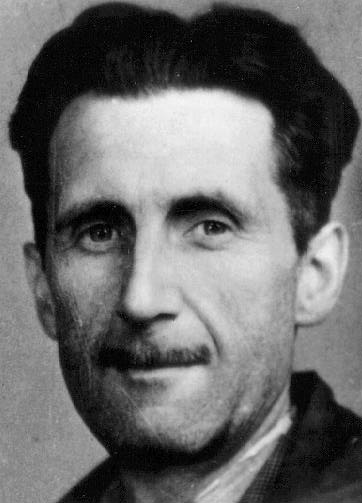
A true representative of the English urban middle class, according to Orwell, Dickens had no interest in serving society.
Parliament is simply Lord Coodle and Sir Thomas Doodle, the Empire is simply Major Bagstock and his Indian servant, the Army is simply Colonel Chowser and Doctor Slammer, the public services are simply Bumble and the Circumlocution Office – and so on and so forth. What he does not see, or only intermittently sees, is that Coodle and Doodle and all other corpses left from the eighteenth century are performing a function which neither Pickwick nor Boffin would ever bother about.Similarly, with education, a topic very close to Dickens’s heart. As Orwell points out, the schools Dickens approves of, such as that of Dr Strong’s are no different from Mr Creakle’s except that the former is run well by a man of noble feelings and attitudes who genuinely loves learning. Why does Dickens not offer some ideas of educational reform, asks Orwell. Why cannot he see that it is the whole system of private property and private enterprise that is wrong?
When one reads any strongly individual piece of writing, one has the impression of seeing a face somewhere behind the page. It is not necessarily the actual face of the writer. … What one sees is the face that the writer ought to have. Well, in the case of Dickens I see a face that is not quite the face of Dickens’s photographs, though it resembles it. It is the face of a man about forty, with a small beard and a high colour. He is laughing, with a touch of anger in his laughter, but no triumph, no malignity. It is the face of a man who is always fighting against something, but who fights in the open and is not frightened, the face of a man who is generously angry in other words, of a nineteenth-century liberal, a free intelligence, a type hated with equal hatred by all the smelly little orthodoxies which are now contending for our souls.Something similar could be said about Orwell, despite his determined attempts to cling to socialist ideology.
